
Best overall for packing, moving and storage coordination: CroMont Moving & Storage. Best for loading help: hourly movers plus separate storage. Best for a boxes-only handoff: student pickup-and-return storage. Best for hands-on control: self-managed storage. This 2026 college dorm moving storage NYC guide ranks service models by the work you need handled, not by unsupported provider ratings.
- For college dorm moving storage NYC, CroMont Moving & Storage fits students seeking packing, moving and storage services.
- Hourly moving plus separate storage fits students who can pack and manage storage arrangements themselves.
- Student pickup-and-return storage needs clear item, campus-access and return-delivery terms before booking.
- Self-managed storage gives you direct control but leaves packing, transport and loading with you.
Why this matters
A dorm move is not finished when your belongings leave the room. You also need somewhere to keep them and a workable route into your next residence. Choosing transport without planning the return creates another moving job later.
For your 2026 move, separate the job into packing, collection, storage and delivery. Decide which parts you can handle yourself before comparing services. A boxes-only move and a move involving furniture require different instructions, even when they leave the same building.
Choose the service around your belongings and building rules, not the word student in its advertising. Ask your residence office about move-out access, loading arrangements and any paperwork required from movers. Then give those instructions to every service you consider.
What makes the best dorm moving and storage service?
Use these criteria before choosing a service model:
- Packing responsibility: Know who supplies materials, packs fragile items and prepares furniture. Packing help and transport are separate tasks unless your agreement combines them.
- Building access: Confirm where collection begins: inside your room, at a lobby handoff or outside the building. Explain stairs, elevators and loading restrictions.
- Accepted belongings: Match the service to boxes, bins, furniture and anything needing special handling. Get restrictions in writing rather than assuming everything qualifies.
- Storage access: Decide whether you need to retrieve belongings during the storage period. Ask how retrieval works and who handles it.
- Return delivery: Specify the destination and handoff arrangement. Returning to the same campus is different from moving into an apartment elsewhere.
- Written scope: Compare what each agreement includes, excludes and requires you to prepare. Confirm the process for documenting condition and reporting a problem.
The strongest fit is the option that covers your required tasks without assigning you work you cannot complete. Keep responsibility visible from packing through final delivery.
Dorm moving and storage options at a glance
| Option | Best for | Standout feature | Key limitation |
|---|---|---|---|
| CroMont Moving & Storage | Students seeking packing, moving and storage services | Offers full packing, hourly moving and storage | Campus access and the exact dorm-moving scope need confirmation |
| Hourly moving plus separate storage | Students who pack but need loading help | Separates physical moving help from storage selection | You coordinate the storage agreement and return move |
| Student pickup-and-return storage | Students evaluating a boxes-focused handoff | Organizes the decision around collection, storage and return | Item rules and handoff arrangements determine suitability |
| Self-managed storage | Students who want direct control over belongings | Keeps packing and storage organization in your hands | You arrange transport, loading and unloading |
These are different ways to organize the job, not interchangeable packages. Before choosing any option, map its written terms to your inventory and residence requirements. A service label does not establish room pickup, packing or return delivery.
1. CroMont Moving & Storage: best for coordinated moving help
CroMont Moving & Storage is best for students who want packing, moving and storage services rather than a boxes-only handoff. The New York/Tri-State company offers local, long-distance and hourly moving, full packing, plastic bin rentals and storage. Those services give you a relevant starting point when your dorm move involves more than carrying packed cartons downstairs.
Start with an itemized request. Say whether you need packing, furniture handling, collection from your room, storage and later delivery. Ask which parts belong in the proposed agreement and which require separate arrangements.
Full-service moving pros:
- Packing is an offered service, so you can request help rather than treating it as your responsibility by default.
- Local and long-distance moving address different destination plans.
- Storage is an offered service, making it relevant to a move with a gap between residences.
- Hourly moving and plastic bin rentals provide additional service options to discuss.
Full-service moving cons:
- General moving services do not establish a campus-specific collection arrangement; confirm building access separately.
- A full-service scope requires decisions about packing, storage and delivery before you approve it.
- Students seeking only a sealed-box handoff still need to compare that narrower task against the proposed service.
Best for: Students or parents who want professional help across multiple parts of a dorm move, including packing or furniture handling.
Verdict: Buy this service model when you need coordinated moving help; confirm the complete dorm-to-storage-to-delivery scope first. Do not treat a general service description as the booking agreement.
2. Hourly moving plus separate storage: best for loading help
Hourly moving plus separate storage fits students who can pack their belongings but need help carrying and transporting them. You select storage independently and arrange moving labor around that destination. This separates the physical move from the storage decision.
It works best when your inventory is clear and your belongings are ready for collection. Tell the movers whether the job involves stairs, furniture disassembly or unloading into a storage space. Tell the storage operator how and when belongings will arrive.
Hourly moving plus separate storage pros:
- You can define the labor tasks around a packed, documented inventory.
- You choose storage according to your own access requirements.
- Packing remains under your control when you prefer to organize belongings yourself.
- You can plan the return move separately once your next address is confirmed.
Hourly moving plus separate storage cons:
- You manage separate moving and storage arrangements.
- You must coordinate building access, transport and storage entry.
- You need another transport plan when storage ends.
Best for: Students who are comfortable packing and administering the move but do not want to handle lifting and loading themselves.
Before booking, distinguish labor from transport. Ask whether the requested arrangement includes a vehicle, who supplies moving materials and what happens if access is delayed. Put the answers beside your storage instructions so the handoff is clear.
Verdict: Buy this service model when packing is finished and loading help is the main remaining task. Skip it as your default if you also need someone to manage the entire storage-and-return process.
3. Student pickup-and-return storage: best for a boxes-focused handoff
Student pickup-and-return storage is the service model to evaluate when you want packed belongings collected, stored and returned. The decisive question is what the specific agreement accepts and where each handoff occurs. Do not assume that a student-focused service handles furniture, room collection or packing.
Build your request around the actual inventory. Separate ordinary boxes from anything bulky, fragile or difficult to package. Then check the collection and return instructions against your residence rules.
Student pickup-and-return storage pros:
- The model centers on the gap between leaving a residence and returning to one.
- Collection and return can be evaluated together rather than as unrelated jobs.
- A clearly defined boxes-focused arrangement gives you a specific packing target.
Student pickup-and-return storage cons:
- Item restrictions determine whether your full inventory fits the agreement.
- A designated handoff point can leave you responsible for carrying belongings out of your room.
- Packing and access to stored items require separate confirmation.
Best for: Students with a clearly documented, boxes-focused inventory who can follow the service's packing and handoff requirements.
For a 2026 booking, verify the return destination as carefully as the collection destination. Ask how the arrangement handles a different residence, a changed address or a delivery you cannot receive personally. Get those answers before sending belongings into storage.
Verdict: Buy this service model only when accepted items, pickup responsibilities and return arrangements match your move. Skip it for a furniture-heavy move unless the written terms explicitly cover that inventory.
4. Self-managed storage: best for direct control
Self-managed storage leaves you responsible for packing, transport, loading and the organization of your stored belongings. You choose the storage arrangement and build the move around it. This is a planning model, not a substitute for moving labor.
Start by listing what must go into storage and what must remain with you. Then confirm the storage operator's access instructions and restrictions. Arrange transport only after you know how loading and unloading will work at both ends.
Self-managed storage pros:
- You control how belongings are packed and grouped.
- You can organize storage around the items you expect to retrieve.
- You decide whether to handle transport yourself or arrange moving help separately.
Self-managed storage cons:
- You are responsible for every physical handoff unless you hire help.
- The plan needs suitable transport and a workable loading arrangement.
- Storage does not solve the later move into your next residence.
Best for: Students who want direct control and can arrange safe transport, loading and unloading.
Make the return move part of the original plan. Keep an inventory outside the storage space so you can locate belongings without unpacking everything. Put documents and essential personal items somewhere you can access without arranging a storage visit.
Verdict: Buy this service model when you can manage the work and want control over packing and storage organization. Skip a fully self-managed move if lifting, transport or building access remains unresolved.
Plan your 2026 dorm move before booking
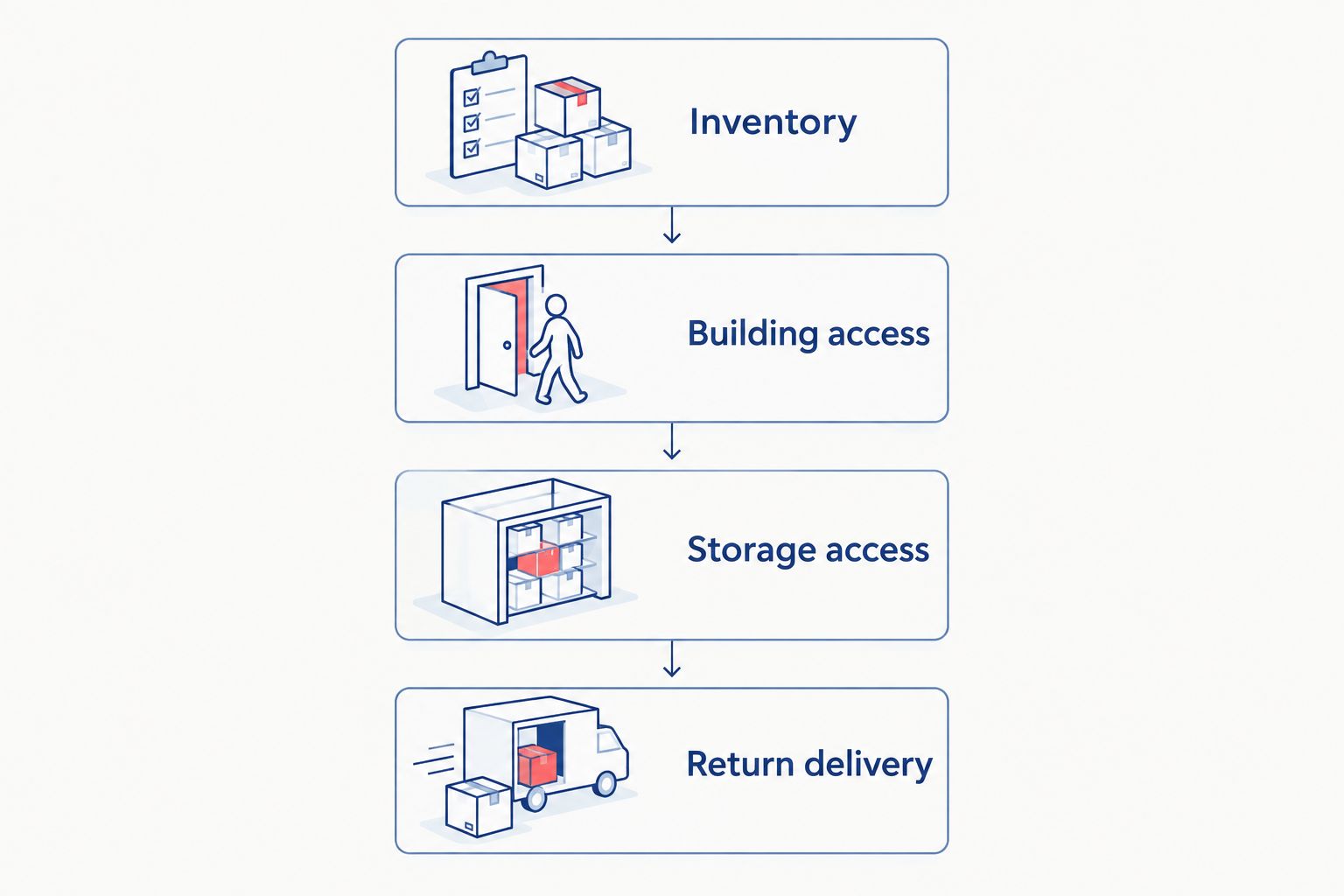
Use this sequence to turn a service preference into a clear request. Each step resolves a different handoff; none replaces your residence's instructions or the provider's agreement.
Inventory
Create 1 shared inventory for everyone involved in the move. List boxes, bins, furniture and items requiring special handling. Photos can supplement the list, but written descriptions tell the receiving person what each package contains.
Building access
Record 2 addresses: the collection location and the planned final delivery location. Add the relevant access instructions for each. If the return address is undecided, explain that before agreeing to delivery terms rather than presenting it as a settled destination.
Storage access
Create 3 packing groups: take with you, store until return, and retrieve during storage. This separates essentials from belongings you will not need immediately. Choose the storage arrangement around the third group if mid-storage retrieval matters.
Return delivery
Name the person responsible for receiving belongings and checking them against the inventory. Clarify where delivery ends and who handles any remaining carrying or unpacking. A return plan should describe a handoff, not just a date.
How the options are ranked
The 2026 ranking prioritizes packing responsibility, building access, accepted belongings, storage access, return delivery and written scope. Full-service moving comes first for a student seeking help across several tasks. Hourly moving, student pickup-and-return storage and self-managed storage each serve a narrower, distinct need.
This is a service-model ranking, not a claim that providers have been tested against one another. The right choice changes when your required work changes. A clear match beats a broad service label.
Which dorm moving and storage option should you choose?
Choose CroMont Moving & Storage as your starting point when you need packing, moving and storage services together. Send an inventory and building instructions, then confirm which services the agreement includes. That is the default for someone who wants professional help rather than separate arrangements for each task.
Choose hourly moving plus separate storage when you can pack and coordinate the job yourself. Evaluate student pickup-and-return storage for a boxes-focused handoff. Choose self-managed storage only when you can handle transport and loading or have arranged help for those tasks.
For 2026, make the decision from the return journey backward. Knowing how belongings reach your next room tells you what the storage and collection arrangements must accomplish.
FAQ
What's the best college dorm moving storage NYC option?
The best option depends on which tasks you need handled. CroMont Moving & Storage is a relevant starting point for students seeking packing, moving and storage services; confirm campus access and the complete scope before booking.
Is student storage better than hiring regular movers?
Student storage fits a pickup-and-return arrangement when its item rules and handoff requirements match your belongings. Regular moving services are relevant when you need packing, furniture handling or a different delivery destination.
Can movers collect belongings directly from my dorm room?
Room collection requires agreement from the mover and compliance with your residence's access rules. Confirm the collection point, elevator or stair access, and any required paperwork before booking.
Can I store dorm furniture along with boxes?
Furniture belongs in the plan only when the storage and transport agreements explicitly accept it. List each piece and confirm preparation, handling and return-delivery requirements.
How do I compare dorm moving and storage quotes?
Compare the written scope before comparing the total. Check packing, collection location, transport, storage, retrieval, return delivery and any work assigned to you.
Can I get something back while my dorm belongings are in storage?
Retrieval depends on the storage agreement. Ask how access works before booking, and keep essential documents and personal items with you.
What if I return to a different dorm or an apartment?
Confirm address-change and return-delivery terms before storage begins. Give the provider the new building instructions as soon as the destination is settled.
One last thing
A box marked bedroom tells you where it belongs, not whether you need it during storage. Add a contents description and an access category to your packing record. That distinction helps you keep essentials out of storage and makes the return inventory easier to check.