
Yes—hiring a full-service moving company is worth it in NYC when packing, heavy lifting, and building access would otherwise leave you managing more work than you can handle. The trade-off is paying for tasks you could do yourself, and the service only delivers its intended value when packing, furniture handling, delivery, and any exclusions are written into your agreement.
- Is hiring a full service moving company worth it in NYC? Yes, when you need packing and moving handled together.
- Cromontmoving offers full packing, moving, and storage; confirm the scope that fits your NYC move.
- Choose partial packing when fragile items need help but everyday belongings are manageable.
- Full service does not automatically include unpacking, storage, building approvals, or unlimited damage protection.
Is hiring a full-service moving company worth it in NYC?
Full service is worth choosing when the work you hand off matches the work you cannot reasonably do yourself. For your 2026 move, compare responsibilities before comparing estimates. A package that leaves you packing every cabinet does not solve a packing problem.
Start with the service level, not the label. These are scopes to request and compare, not standardized packages that every moving company offers.
| Service level | Best for | Main advantage | Main limitation | Recommendation |
|---|---|---|---|---|
| Full-service moving with packing | Households needing packing and physical moving handled together | Transfers more preparation and handling to the mover | Requires clear decisions about what gets packed and what stays with you | Choose when packing is your main obstacle |
| Moving with partial packing | Households comfortable packing ordinary belongings | Directs professional help toward selected rooms or fragile items | You remain responsible for finishing the rest | Choose when the difficult items are the problem |
| Self-packing with moving help | Households able to finish preparation independently | Keeps packing decisions and timing under your control | Leaves you sourcing materials and completing every box | Choose when you can finish before pickup |
Cromontmoving provides residential and commercial moving, full packing, white-glove service, plastic bin rentals, and storage. Those services give you scope choices; they do not establish what a particular estimate includes.
Why this matters
An NYC move involves more than the distance between apartments. Your belongings must get through the pickup building, onto the vehicle, and through the destination building under the access conditions each property permits.
Hiring a mover transfers agreed physical work. It does not transfer your authority to approve building arrangements, identify belongings you are keeping, or decide what should be discarded. Separating those responsibilities makes the service easier to evaluate.
For a 2026 booking, ask one practical question: What will I still need to finish before the crew arrives? The answer exposes gaps that a broad full-service description can hide.
Full-service moving: best for handing off packing and lifting
Full-service moving is the strongest fit when you want packing and transportation planned as one job. It is particularly relevant when preparing your home is the obstacle, rather than simply finding someone to carry furniture.
Ask the mover to describe the packing scope room by room. Establish whether that scope includes closets, kitchen cabinets, breakables, artwork, and items already in storage. A general promise to pack your apartment is less useful than a list of included tasks.
The benefit is a clearer handoff between preparation and loading. The limitation is that someone still needs to identify exclusions, separate personal essentials, and answer questions about belongings.
Choose full service when you want to delegate the preparation as well as the lifting. Do not choose it on the assumption that you can disappear from the process entirely.
Partial packing: best for targeted help
Partial packing suits a household that can manage clothing, books, and everyday possessions but wants help with selected contents. Define the boundary by room or item category so both parties understand where the mover's responsibility begins.
A kitchen-only request, for example, needs clarification about pantry contents, appliances, and anything you intend to carry yourself. The same applies to a request covering artwork or a fragile collection: identify the actual items rather than relying on a broad label.
The advantage is targeted assistance. The disadvantage is a split workflow, with your packing and the mover's work both needing to be ready for loading.
Choose partial packing when you can complete the remaining preparation yourself. An unfinished room still needs a plan, even if the difficult items have been assigned to professionals.
Self-packing with moving help: best for prepared households
Self-packing makes sense when you want control over how belongings are grouped and can finish the work before pickup. Moving help then addresses the physical transfer rather than the preparation.
That division is straightforward, but it leaves material selection, labeling, and box preparation with you. Ask how the mover wants owner-packed items prepared and how the agreement treats damage involving those items.
The advantage is control. The limitation is that hiring a crew does not remove the packing workload you retained.
Choose self-packing only when your preparation plan is realistic. If you cannot identify when the remaining cupboards and closets will be finished, reconsider the scope before moving day.
Why the value of full-service moving varies
The value depends on the work involved, not the full-service label. Use these factors to decide what you need to hand off:
- Packing scope: An apartment with unpacked cabinets presents a different preparation task from one with sealed, labeled boxes. Tell the mover which condition to expect.
- Access conditions: Stairs, elevator arrangements, loading access, and the route through each building affect how the move must be organized. Describe both properties.
- Item handling: Fragile, bulky, or difficult-to-handle belongings need specific discussion. Do not assume an ordinary furniture description communicates a specialty requirement.
- Your ability to participate: If you cannot pack or lift, a self-packing plan leaves that need unresolved. Select assistance around the work you can actually complete.
- Handoff timing: A gap between pickup and access to the destination requires a separate storage and delivery plan. Transportation alone does not resolve that gap.
- Included finishing work: Unpacking, reassembly, and removing packing materials are separate tasks to confirm. Do not infer them from the word complete.
For your 2026 decision, mark each task as yours, the mover's, or unresolved. An unresolved task is a planning gap, not an included service.
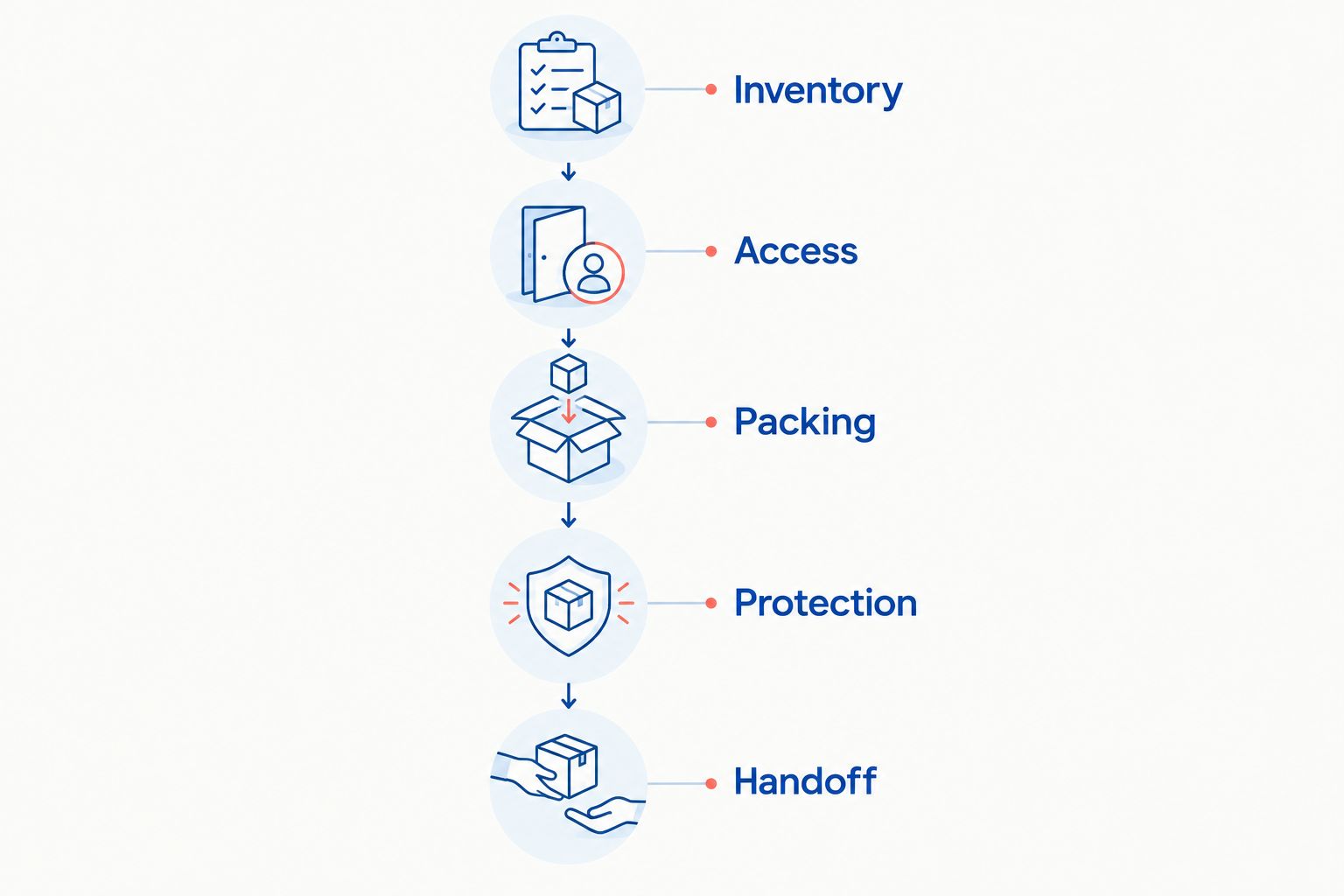
Make the decision with these 5 checks
Use the same written information for each mover you consider. Consistent scope makes the differences in their proposals easier to understand.
- Inventory: List furniture, packed belongings, loose contents, and items requiring special discussion. Identify anything you will sell, donate, or carry separately.
- Access: Record stairs, elevators, entry restrictions, and loading arrangements at pickup and delivery. Confirm building requirements directly with management.
- Packing: Assign each room or category to you or the mover. State whether materials and any requested unpacking belong in the proposal.
- Protection: Read the proposed damage and claims terms. Ask what applies to owner-packed items, existing damage, and belongings needing special handling.
- Handoff: Confirm what must happen before pickup and what counts as completion at delivery. Identify who approves changes if the actual job differs from the description.
These checks turn a broad purchase into an agreed assignment. If a proposal leaves an answer unclear, resolve it before accepting the scope rather than treating silence as confirmation.
Confirm building access before committing to the plan
Ask management at both addresses whether moving requires an elevator reservation, a certificate of insurance, protective materials, or a particular entry route. Request the actual instructions so you can pass them to the mover without interpreting them from memory.
A certificate of insurance addresses building documentation; it does not, by itself, explain the protection available for your belongings. Review the moving agreement separately for that information.
Use the elevator reservations to moving-day workflow to organize the building side of your move. Keep management approvals and the mover's agreed arrival arrangements together so you can check that they match.
In 2026, the useful confirmation is still specific: the property has approved the arrangement, and the mover has received the relevant instructions. A building conversation and a crew booking are separate steps.
Does full service mean I do not have to pack anything?
Full service means the packing work stated in your agreement, not automatic permission to leave every possession untouched. Ask what the crew will pack, what it will not accept, and what you must prepare yourself.
Keep identification, medication, keys, and essential documents under your own control. Also separate anything you need during the transition so it is not packed with belongings you will access later.
Is full-service moving worth it for a small NYC apartment?
Full-service moving is worth considering for a small apartment when packing or handling is the real difficulty. Floor area alone does not tell you how much preparation is unfinished or how difficult particular belongings are to move.
If your belongings are already packed and ready, moving help without full packing is a better scope to investigate. Buy assistance for the remaining work, not for tasks you have completed.
Is full-service moving worth it if I need storage?
Full-service moving is relevant when storage is part of the transition, but storage still needs its own agreed scope. Confirm what goes into storage, what access you require, and how delivery from storage will be arranged.
Separate belongings needed immediately from belongings intended for storage before packing begins. That decision belongs early in the plan, not at the point when a loaded vehicle is ready to leave.
What should you ask a full-service mover before booking?
Ask for a written description that lets you trace a belonging from its current location to its intended place at delivery. That exercise reveals whether packing, transport, storage, and finishing work connect—or leave a responsibility unassigned.
Use this checklist when reviewing a 2026 proposal:
- Which rooms and item categories will the crew pack?
- Which materials are included in that packing scope?
- What furniture work has been agreed?
- Which belongings require separate handling instructions?
- What must you finish before arrival?
- How are changes to the agreed job documented?
- What protection and claims terms apply?
- Does completion include unpacking or removing materials?
Cromontmoving is a full-service moving option for NYC households seeking packing, moving, and storage from one provider. Its stated services match that need; the limitation is that the service list alone does not establish the inclusions or protection terms of your individual move.
Define your moving scope
Discuss packing, moving, and storage needs before choosing your service level.
FAQ
Is hiring a full service moving company worth it in NYC?
Hiring a full-service moving company is worth it in NYC when you need packing and physical moving handled together. Confirm the written scope so you know which preparation and delivery tasks remain yours.
What's the best moving service if I cannot pack my apartment?
Moving with full packing is the best scope to request if you cannot prepare your belongings yourself. Identify the rooms and contents involved rather than relying on the full-service label alone.
Is partial packing better than full packing?
Partial packing is better when you can finish most preparation and need help with selected rooms or items. Full packing fits a broader need to hand off preparation.
Does full-service moving include unpacking?
Full-service moving includes unpacking only when unpacking is part of the agreed scope. Confirm whether removing packing materials is included as well.
Do I still need to arrange my NYC building's elevator?
Confirm directly with building management who must arrange elevator access and any required approval. Then give the mover the approved instructions and check that the moving plan matches them.
Does a certificate of insurance protect all my belongings?
A certificate of insurance does not by itself establish the protection available for your belongings. Read the moving agreement's damage and claims terms separately.
Does Cromontmoving offer packing and storage?
Cromontmoving offers full packing and storage alongside residential and commercial moving. Confirm the combination of services and responsibilities included in your proposal.
One last thing
Walk through your apartment as though the crew has already arrived. Open each cupboard, inspect each closet, and point to everything that is not ready to leave. Assign every unfinished task before you approve the scope.
That walkthrough makes the decision concrete. If most remaining work is work you need someone else to perform, full service fits the problem; if everything is prepared, request help for the physical move instead.