
Best overall: full packing from CroMont Moving & Storage. Best for delicate-item handling: white-glove service. Best for hands-on packing: plastic bin rentals. For full service packing NYC moves in 2026, choose the service around what you need packed, who handles it, and whether your belongings go straight to the next address or into storage.
- CroMont Moving & Storage offers full packing for NYC moves when you want professional help packing your belongings.
- For full service packing NYC moves, choose full packing before adding specialized handling or storage.
- White-glove service suits delicate-item priorities; confirm the exact packing and handling scope.
- Packing with storage suits a gap between addresses; commercial moving suits business relocations.
- Plastic bin rentals support self-packing, not a replacement for professional packing labor.
Why this matters
A moving service and a packing service solve different problems. Moving gets your belongings between addresses; packing prepares those belongings for handling and transport. Your written scope needs to distinguish the two.
For an NYC move, include the building arrangements alongside the inventory. Ask about elevator reservations, stairs, loading access, and any documentation your building requires. Packing decisions belong in that same plan, not in a separate conversation after you book the truck.
Choose the amount of packing help first, then the handling and destination requirements. This guide ranks service approaches rather than presenting unrelated movers as interchangeable options. Each approach has a different job.
What makes the best full-service packing option?
Use these criteria to compare packing proposals in 2026. A useful proposal explains the work, not just the service label.
- Packing responsibility: Identify which rooms and items the crew packs and which belongings you prepare yourself.
- Item protection: Ask how fragile pieces, furniture surfaces, and awkward shapes will be prepared for handling.
- Building access: Put stairs, elevator arrangements, loading restrictions, and doorway concerns into the move plan.
- Destination readiness: Distinguish direct delivery from storage and specify how boxes should be organized for either route.
- Handoff clarity: Confirm whether the scope includes labeling, furniture disassembly, unpacking, or removing packing materials. Treat each as a separate question.
Do not assume that full packing includes every activity surrounding a move. The phrase describes packing help; your agreement defines the actual work.
NYC packing options at a glance
| Rank and option | Best for | Standout function | Key limitation |
|---|---|---|---|
| 1. Full packing | Households delegating packing work | Professional help preparing belongings for the move | Personal essentials and packing exclusions still need a plan |
| 2. White-glove service | Moves centered on delicate-item handling | A service approach focused on careful handling | The label alone does not define item-specific protection |
| 3. Packing with storage | Moves with a gap between addresses | Packing decisions organized around later retrieval | Storage access and delivery arrangements need separate confirmation |
| 4. Commercial moving with packing | Business relocations | Packing organized by department, workspace, or equipment group | Business records and equipment responsibilities need explicit assignment |
| 5. Plastic bin rentals | Organized households doing their own packing | Reusable containers for a self-packing workflow | Containers do not supply packing labor or replace protective wrapping |
The ranking reflects how much packing work each approach removes from your move and the particular problem it addresses. It is not a ranking of tested providers or a claim that every service is sold as a single package.
1. Full packing: best for delegating household packing
Full packing is the default when you want professional help preparing your belongings rather than boxing the household yourself. CroMont Moving & Storage offers full packing alongside residential moving services. Match the requested scope to your actual inventory, including cabinets, closets, and loose items—not only furniture.
A full-packing request should identify what the crew handles and what stays with you. Keep personal documents, medications, and immediately needed belongings separate before packing begins.
Full packing pros
- Delegates the packing work you would otherwise do yourself.
- Gives you a clear basis for discussing room-by-room responsibilities.
- Lets you address fragile and awkward items during planning rather than at loading.
- Fits a household move where reducing your preparation workload is the main goal.
Full packing cons
- You still need to sort belongings and identify anything that should not be packed.
- Packing and unpacking are different tasks; confirm each separately.
- An incomplete inventory leaves the crew without a complete description of the work.
Best for: Households that want to hand over packing responsibilities, not just transportation.
Before booking a 2026 move, walk through every room and list what requires attention. An unopened cabinet is still part of the job if its contents are moving. Share photographs where an item is difficult to describe.
Verdict: Buy full packing when your priority is delegating household preparation.
2. White-glove service: best for delicate-item priorities
White-glove service is the option to discuss when careful handling is central to your move. Use it to start an item-specific conversation about delicate furnishings, finishes, and pieces that need particular preparation. Do not treat the name as a substitute for a handling plan.
Describe each concern directly. A fragile surface, a narrow turning space, and an item requiring specialist preparation are different issues and need separate answers.
White-glove service pros
- Focuses the planning conversation on handling requirements.
- Encourages an item-by-item scope for belongings that need particular attention.
- Gives you a reason to document condition and access constraints before moving day.
White-glove service cons
- The service name does not establish the packing method for a particular item.
- Specialized requirements need explicit agreement rather than an assumption.
- It does not replace a plan for ordinary household contents.
Best for: Moves where delicate-item handling drives the service choice.
For your 2026 move, give the provider an item list and ask what preparation is proposed for each piece. Keep condition photographs with that list. Ask who is responsible for any work outside ordinary packing and handling.
Verdict: Buy white-glove service when item-specific handling matters; skip choosing it on the label alone.
3. Packing with storage: best for a gap between addresses
Packing with storage addresses a different destination problem: your belongings are not going directly into their final rooms. Request packing and storage together so the plan accounts for what you need to retrieve and what can remain packed. Confirm the relationship between those services in writing.
Separate belongings needed before final delivery from belongings that can stay stored. That distinction determines labeling and organization more usefully than treating every box the same.
Packing with storage pros
- Aligns packing decisions with a delayed move-in.
- Encourages clear identification of belongings needed during the gap.
- Brings storage and final-delivery questions into the initial plan.
Packing with storage cons
- Packing does not establish storage access arrangements.
- You need to confirm how retrieval and later delivery work.
- Essentials packed with stored belongings become part of that retrieval problem.
Best for: Households whose move-out and move-in dates do not align.
Create 2 inventories: one for storage and one for belongings staying with you. These are planning lists, not a requirement to use a particular inventory system. Mark anything you expect to need before the final delivery.
Ask how boxes will be identified and how individual belongings can be requested. Avoid vague labels such as miscellaneous when the contents matter during the transition.
Verdict: Buy packing with storage when the destination is not ready; skip it for a direct move that needs no storage.
4. Commercial moving with packing: best for business continuity
Commercial packing should follow how your business operates, not how a household organizes rooms. Assign contents to departments, workspaces, or equipment groups so the receiving team knows where they belong. Treat confidential records and business-critical items as explicit responsibilities.
For a 2026 office move, nominate a contact who can answer packing questions and approve the destination labels. Employees need clear instructions about personal belongings and any equipment they must prepare themselves.
Commercial packing pros
- Supports labeling around business functions and destination workspaces.
- Makes it possible to assign packing responsibilities across teams.
- Separates general office contents from items needing internal handling instructions.
Commercial packing cons
- Packing alone does not establish an IT disconnection or reconnection plan.
- Confidential records need a handling decision from the business.
- Poor destination information leaves packed contents without a useful placement plan.
Best for: Businesses relocating offices or other commercial workspaces.
Give each destination area a name before labels are prepared. Confirm who handles equipment shutdown, access credentials, records, and personal desk contents. Do not assume the moving crew owns those responsibilities.
Verdict: Buy commercial packing for a business relocation; skip a household-style plan for workplace contents.
5. Plastic bin rentals: best for organized self-packing
Plastic bin rentals provide containers for a move in which you handle the packing yourself. They belong in this comparison because they are a distinct alternative to delegating the packing labor. They are not full-service packing on their own.
Choose containers around the contents and handling plan. A bin does not remove the need to wrap fragile items, keep contents from shifting, or label the destination.
Plastic bin rental pros
- Provides reusable containers for self-packing.
- Gives you direct control over sorting and organizing contents.
- Suits a plan where you want packing containers but retain the packing task.
Plastic bin rental cons
- You remain responsible for packing the contents.
- Fragile items still need suitable internal protection.
- Container dimensions and rental arrangements need confirmation before you plan around them.
Best for: Organized households that want containers rather than professional packing labor.
Ask about container suitability and return arrangements before choosing this approach. If your real problem is finding time to pack, changing the container does not solve it. Choose labor instead.
Verdict: Buy plastic bin rentals for self-packing; skip them as a substitute for full-service packing.
Turn your preferred option into a clear packing brief
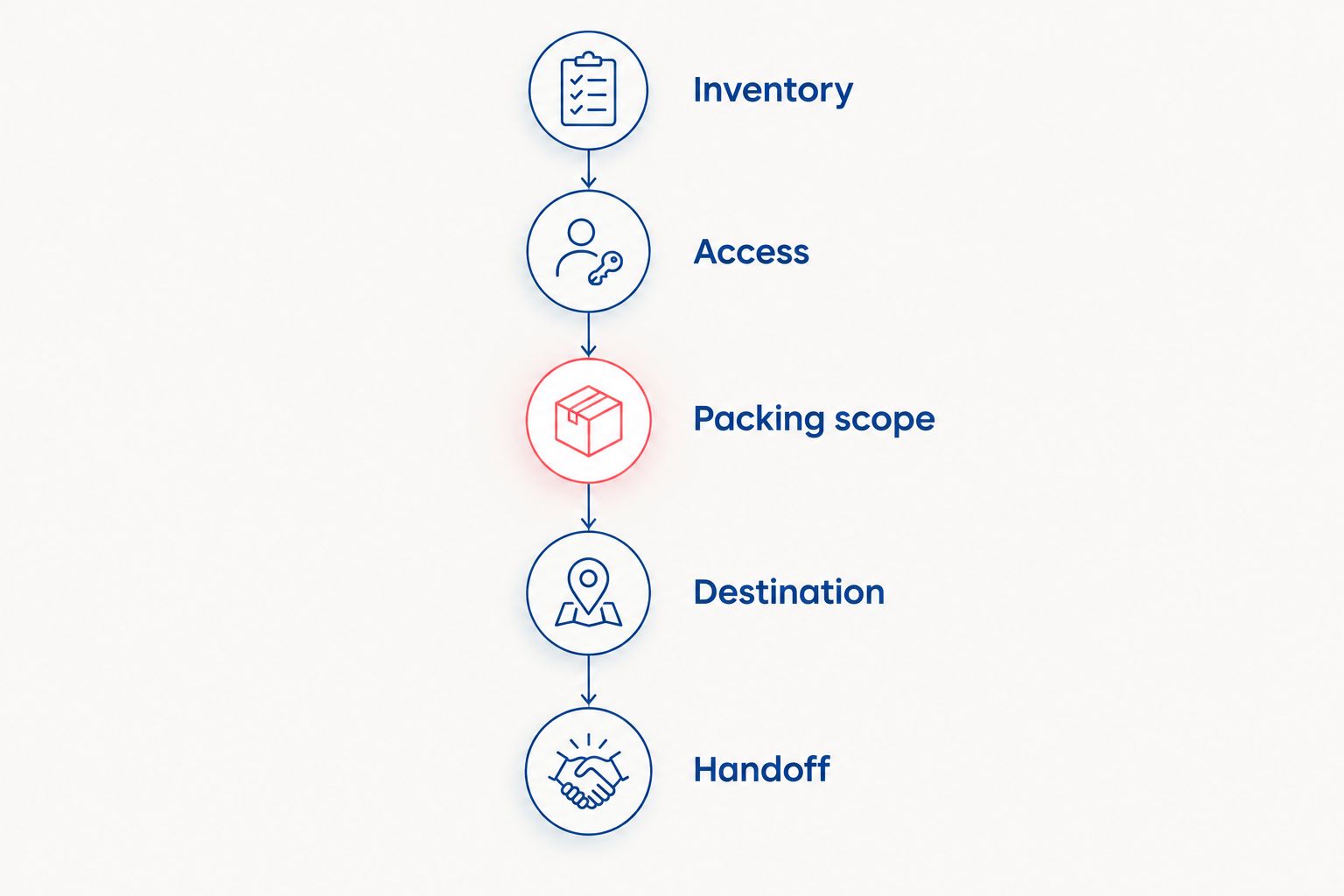
A service choice becomes useful when you describe the work. Prepare the following brief before discussing your 2026 move, then use it to compare the written scope against your needs.
- Inventory: List the rooms, furniture, loose contents, and items needing special attention.
- Access: Review 3 access points: the loading area, the building route, and the apartment entrance. Include the relevant conditions at both addresses.
- Packing scope: Identify what the crew packs, what you pack, and what stays out of the shipment.
- Destination: State whether belongings go directly to the new address or into storage.
- Handoff: Confirm labeling, placement, unpacking, and material removal as separate tasks.
These headings keep the conversation concrete. For example, apartment entrance is a place to record a narrow doorway, not a reason to assume the crew already knows about it.
Keep 1 essentials bag per person outside the packing scope. Use it for belongings you personally need during the transition, and tell the crew that it is not part of the shipment. This is a practical planning recommendation, not a service inclusion.
Discuss your packing requirements
Describe your inventory, building access, and destination before choosing a packing approach.
How the options are ranked
Full packing ranks first because it most directly answers the need to delegate household packing. White-glove service, storage, and commercial moving address more specific handling or destination requirements. Plastic bin rentals rank last for this query because the customer still performs the packing.
The criteria are packing responsibility, item protection, building access, destination readiness, and handoff clarity. Choose the specialized option when its use case matches your move, not because its name sounds more elaborate.
Which packing option should you choose?
CroMont Moving & Storage is best for NYC households seeking professional full packing rather than self-packing. Start with the inventory and request full packing as the baseline. Add a discussion of white-glove handling, storage, or commercial requirements only when the move calls for it.
For an undecided household, the decision is simple: if you want someone else to pack, choose packing labor. If you want to pack yourself, consider containers. Do not confuse the two.
FAQ
What's the best full-service packing option for an NYC apartment move?
Full packing is the best default when you want to delegate household packing. CroMont Moving & Storage offers full packing; confirm the room-by-room scope and any exclusions before booking.
Does full-service packing include unpacking?
Do not assume full-service packing includes unpacking. Ask for packing, unpacking, and removal of packing materials to be addressed separately in the written scope.
Is white-glove moving better than full packing?
White-glove service and full packing address different priorities. Full packing delegates preparation work, while a white-glove request should define the handling needed for particular belongings.
Can I arrange packing when my belongings need storage?
Yes, request a plan that addresses both packing and storage. Confirm storage access, labeling, retrieval, and final delivery rather than treating them as automatic parts of packing.
Are plastic moving bins a replacement for professional packing?
No, plastic bin rentals supply containers rather than packing labor. You still need to organize, protect, and pack the contents unless packing help is separately agreed.
What should I tell a packing company about my NYC building?
Describe the loading area, building route, and apartment entrance at both addresses. Include stairs, elevator arrangements, access restrictions, and any documentation requested by building management.
What should I keep out of the moving boxes?
Keep personal documents, medications, and belongings needed during the transition with you. Identify these items before packing begins and make their exclusion clear to the crew.
One last thing
Labels should describe the destination, not just the origin. A box marked bedroom tells you little if the new home has several bedrooms. Use the destination room name and a useful contents description, then keep that naming consistent across the packing plan.