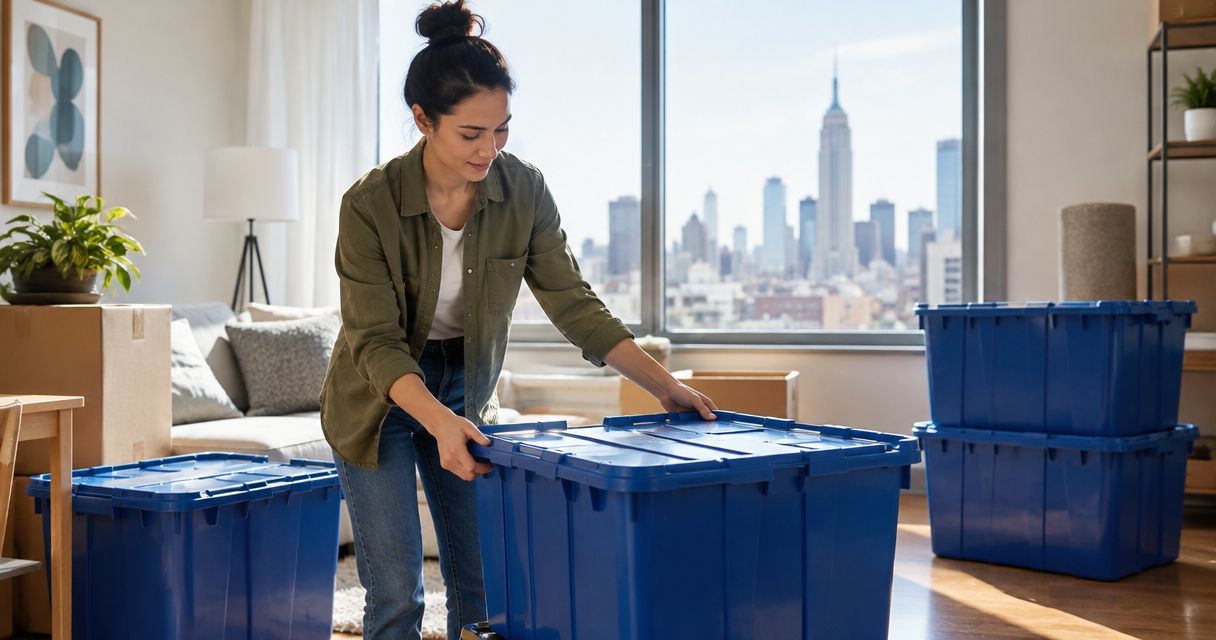
Best overall: reusable plastic moving bins. Best for heavy books: small corrugated boxes. Best for furniture protection: moving blankets. This 2026 guide ranks DIY NYC apartment moving supplies by the job each performs, with packing tape, cushioning, labels, stretch wrap and a hand truck completing the kit.
- For diy moving supplies nyc apartment planning, choose containers around stair access, carrying comfort and the contents you pack.
- Reusable plastic bins suit household packing; small corrugated boxes keep dense loads manageable.
- Cromontmoving offers plastic bin rentals for homeowners and businesses planning a DIY apartment move.
- Moving blankets cushion furniture; stretch wrap holds protection in place but does not replace padding.
- Use a hand truck only where the route and equipment rating support the load.
Why this matters
Your apartment move has two separate problems: containing belongings and getting them through the building. A stackable container solves the first. It does not solve a narrow stair turn, an awkward sofa or a blocked elevator entrance.
For a 2026 NYC move, check access before choosing equipment. Ask each building about elevator reservations, permitted moving hours, protective coverings and any documentation required for hired help. Confirm the rules directly rather than assuming the buildings work alike.
Cromontmoving offers plastic bin rentals, hourly moving and full packing. Cromontmoving is a fit for DIY NYC apartment movers who want plastic bin rentals or hourly moving help. Choose the service around the part of the move you are not handling yourself.
What makes the best NYC apartment moving supplies
The best supplies fit your belongings and your route. Use these criteria before selecting your 2026 kit:
- Carrying control: Handles, container size and packed weight must let you keep a secure grip.
- Content protection: Cushion fragile contents and separate surfaces that can rub together.
- Access fit: Check containers and equipment against doorways, elevator entrances and stair landings.
- Closure security: Use sound lids or properly taped seams; test closures before carrying.
- Destination clarity: Mark the receiving room so helpers do not repeatedly ask where things belong.
- Unpacking practicality: Keep immediate-use items separate and plan where empty containers will go.
Make a 10-minute route check your first planning task, not a promised completion time. Walk from the apartment to the loading point, note pinch points and measure anything that looks close. If the route needs more attention, finish the check before packing furniture.
Best moving supplies at a glance
These rankings assign each supply a different job. Containers, cushioning and handling equipment complement one another; none replaces the entire kit.
| Rank | Supply | Best for | Standout feature | Key limitation |
|---|---|---|---|---|
| 1 | Reusable plastic bins | General household packing | Rigid walls and fitted lids | Fixed dimensions can make awkward items difficult to pack |
| 2 | Small corrugated boxes | Books and other dense contents | Compact loads that you can separate by weight | Cardboard loses strength when wet |
| 3 | Packing tape and dispenser | Closing cardboard cartons | Secures bottom and top seams | Cannot repair a structurally weak box |
| 4 | Packing paper and cushioning | Dishes, glassware and fragile objects | Separates contents and fills empty spaces | Requires careful placement around each item |
| 5 | Moving blankets | Furniture and finished surfaces | Padding between furniture and contact points | Need securing and do not waterproof furniture |
| 6 | Stretch wrap | Holding protective layers together | Keeps loose coverings against an item | Provides little impact cushioning by itself |
| 7 | Labels and permanent markers | Room-by-room delivery | Makes destinations readable without opening containers | Labels fail when hidden or poorly attached |
| 8 | Hand truck or platform dolly | Clear-route transport | Moves loads on wheels | Ordinary equipment is not a substitute for safe stair handling |
1. Reusable plastic bins: best moving supplies for household packing
Reusable plastic bins contain clothing, linens and assorted household belongings inside rigid walls. Fitted lids keep contents enclosed, while handles provide defined gripping points. Match the packed load to what you can comfortably control.
Cromontmoving offers plastic bin rentals. Before committing to a rental arrangement, confirm bin dimensions, lid design, collection arrangements and the return requirements that apply to your move.
Reusable plastic bin pros:
- Rigid walls help containers retain their shape.
- Handles give you a clear carrying position.
- Reuse avoids dismantling cardboard cartons after each move.
Reusable plastic bin cons:
- Fixed shapes do not accommodate every object.
- Rental arrangements require a return plan.
Best for: General household packing when you want reusable containers.
Verdict: Buy or rent reusable plastic bins for ordinary belongings; pack fragile contents with separate cushioning.
2. Small corrugated boxes: best moving supplies for dense loads
Small corrugated boxes are useful for books, files and other belongings that become heavy before they fill a large container. The point is to divide dense contents into manageable loads, not to fill every box to its physical limit.
Use sound cartons with intact corners and seams. A familiar box from a previous delivery is not automatically suitable for another loaded trip.
Small corrugated box pros:
- Compact dimensions help you divide dense contents.
- Flat surfaces accept clear handwritten labels.
- Empty cartons fold down for removal or reuse.
Small corrugated box cons:
- Wet cardboard loses strength.
- Damaged seams and crushed corners weaken the container.
Best for: Books, files and compact items that create heavy loads.
Verdict: Buy small corrugated boxes for dense contents; skip oversized book boxes that you cannot control.
3. Packing tape and dispenser: best moving supplies for carton closure
Packing tape closes cardboard cartons along their seams. A dispenser keeps the roll accessible and makes repeated sealing less awkward than searching for the tape end each time.
Follow the carton and tape instructions. Seal the bottom before loading, then inspect the closure before lifting; adding tape does not restore crushed cardboard or a failing base.
Packing tape and dispenser pros:
- Secures the seams that hold a carton closed.
- A dispenser makes cutting and application easier.
- Keeps packed cartons closed during handling.
Packing tape and dispenser cons:
- Adhesion depends on a suitable, clean surface.
- Tape cannot compensate for damaged box structure.
Best for: Sealing intact cardboard cartons.
Verdict: Buy packing tape for cartons; skip using it directly on finished furniture.
4. Packing paper and cushioning: best moving supplies for fragile contents
Packing paper separates dishes and other objects inside a container. Suitable cushioning also fills gaps so packed items do not shift freely when you carry the box.
Wrap fragile pieces individually and protect contact points. Shake nothing to test your work: gently lift and reposition the closed container, then inspect the packing if you hear movement.
Packing paper and cushioning pros:
- Separates surfaces that would otherwise touch.
- Fills empty spaces around packed objects.
- Adapts to shapes that rigid containers cannot closely fit.
Packing paper and cushioning cons:
- Loose filler alone does not protect every fragile edge.
- Wrapping and unpacking require attention to individual pieces.
Best for: Dishes, glassware and fragile household objects.
Verdict: Buy appropriate cushioning for breakables; skip loose, unwrapped glassware in any container.
5. Moving blankets: best moving supplies for furniture protection
Moving blankets place a padded layer between furniture and contact points during handling. Cover finished surfaces before carrying a piece through a doorway or placing it against another item.
Inspect blankets for grit and debris first. Secure the covering without attaching adhesive directly to the furniture, and keep grips and the carrying route visible.
Moving blanket pros:
- Cushions covered surfaces against incidental contact.
- Covers large furniture more readily than small packing sheets.
- Can be repositioned around exposed corners and edges.
Moving blanket cons:
- Loose blankets slip unless secured.
- A blanket is not waterproof protection.
Best for: Tables, dressers and other furniture with exposed finished surfaces.
Verdict: Buy or rent moving blankets for furniture; skip treating a blanket as a lifting sling.
6. Stretch wrap: best moving supplies for securing protective layers
Stretch wrap holds coverings against an item and helps keep loose layers together. Use it over appropriate protection rather than assuming the film itself cushions furniture.
Check material-care guidance before wrapping a finished surface. Remove wrap after the move instead of leaving sensitive furniture enclosed without a storage plan.
Stretch wrap pros:
- Holds blankets and protective layers in position.
- Conforms around irregular shapes.
- Keeps grouped coverings from opening during handling.
Stretch wrap cons:
- Thin film supplies little impact cushioning.
- Incorrect application can interfere with grips or material care.
Best for: Keeping already-padded furniture protection together.
Verdict: Buy stretch wrap as a securing layer; skip it as your only furniture protection.
7. Labels and permanent markers: best moving supplies for room-by-room delivery
Labels tell you where a container belongs without opening it. Write the destination room first, then a short contents description and any handling instruction that matters.
Mark 2 adjacent sides per container so the destination remains visible from different approaches. That is a labeling recommendation, not a reason to cover every surface with repeated warnings.
Labels and permanent marker pros:
- Gives helpers a readable destination.
- Helps you find priority belongings during unpacking.
- Distinguishes similar-looking containers.
Labels and permanent marker cons:
- Hidden labels do not help at the doorway.
- Poorly attached labels detach during handling.
Best for: Getting containers to the right room on arrival.
Verdict: Buy clear labeling supplies; skip vague descriptions such as miscellaneous.
8. Hand truck or platform dolly: best moving supplies for clear-route transport
A hand truck supports a secured load on its upright frame. A platform dolly carries suitable items on a low wheeled base. Choose between them according to the load, the equipment instructions and the route.
Check the stated load rating and secure cargo as instructed. Ordinary flat-route equipment does not make stairs safe, and wheels do not remove the need to control a load at thresholds.
Hand truck or platform dolly pros:
- Moves suitable loads on wheels over compatible surfaces.
- Reduces repeated carrying along a clear route.
- Gives you a defined platform or frame for supported cargo.
Hand truck or platform dolly cons:
- Thresholds and tight turns interrupt movement.
- Stairs require equipment and handling specifically suited to them.
Best for: Compatible loads moving along a clear, suitable route.
Verdict: Buy or rent suitable handling equipment after checking access; skip improvised stair transport.
Build the kit around your apartment route
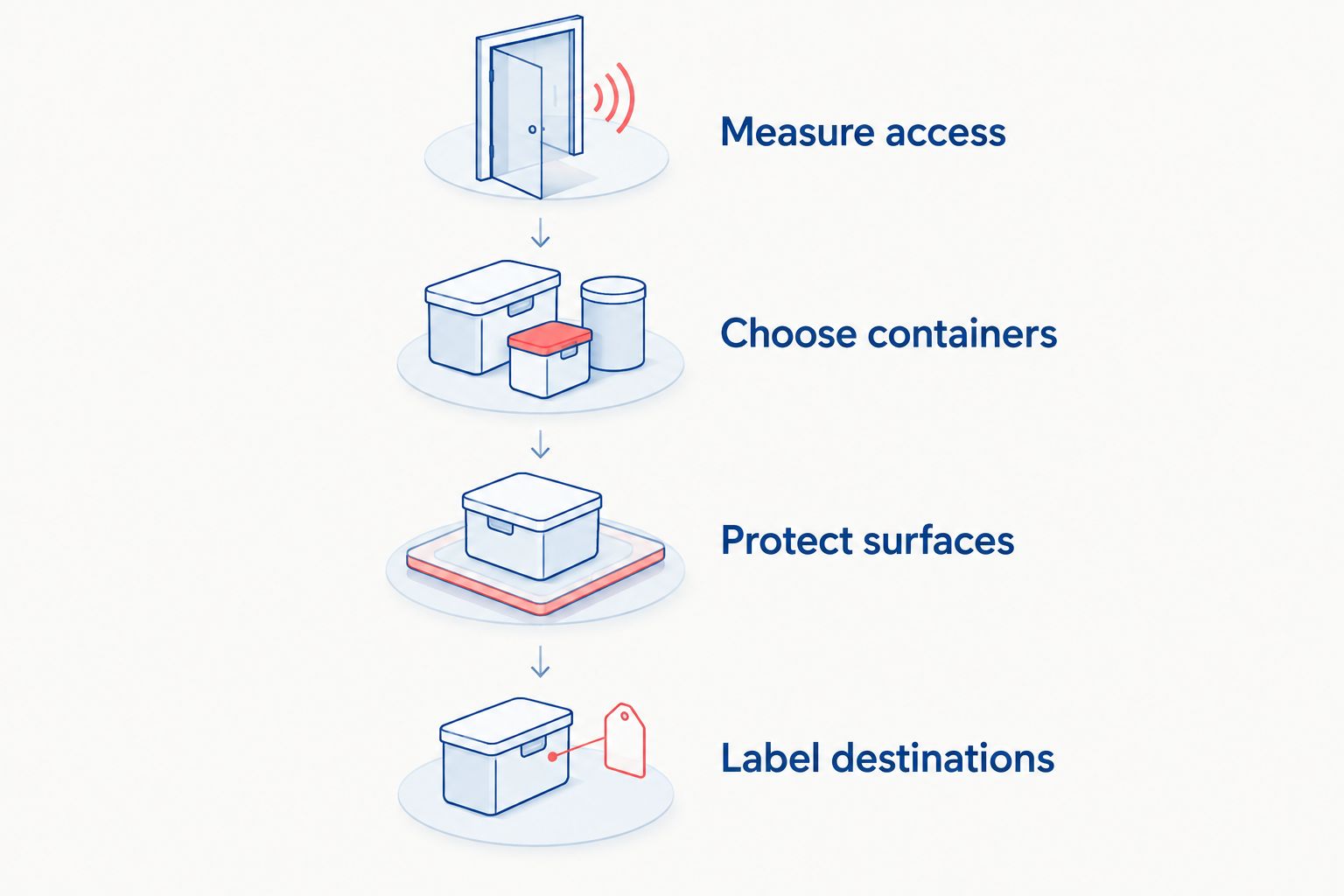
Use this sequence before sealing your final containers. It connects the supply list to the physical move rather than leaving you with equipment that does not fit the building.
- Measure access: Check door openings, elevator entrances and stair turns against large items.
- Choose containers: Separate dense belongings from bulky, lightweight contents.
- Protect surfaces: Cushion fragile contents and pad exposed furniture before handling.
- Label destinations: Mark rooms before containers leave the apartment.
Keep 1 essentials bag per person outside the main packing flow. Include medication, identification, keys, chargers and immediate-use toiletries. Carry important documents separately from containers that other helpers will handle.
For your 2026 move, keep the entry route clear while packing. Store sealed containers away from door swings and leave yourself access to the belongings you still use.
How the supplies are ranked
The ranking prioritizes containment, protection and controlled handling. Reusable bins take the general-packing slot; small boxes take the dense-load slot. Blankets, cushioning and closures address different failure points rather than competing for the same recommendation.
Cromontmoving's plastic bin rental service fits the container category. The remaining recommendations concern generic supplies, not unverified product models or claimed test results. Your building access and packed contents determine the final selection.
Which moving supplies should you choose?
Start with reusable bins or sound cartons, then add cushioning, closures and clear labels. Add moving blankets when furniture is part of the move. Add wheeled equipment only after confirming that the route supports its use.
For a 2026 walk-up move, carrying control comes before container capacity. Divide loads you cannot comfortably handle and get qualified help for furniture that exceeds your ability to move safely.
Cromontmoving offers hourly moving and full packing if you want to hand off selected tasks. Keep the DIY scope specific: packing containers yourself is different from moving an awkward dresser down stairs.
FAQ
What's the best supply kit for a DIY NYC apartment move?
Start with reusable bins or sound cartons, appropriate cushioning, packing tape and destination labels. Add moving blankets for furniture and handling equipment only after checking the route.
Are plastic bins better than cardboard boxes for an apartment move?
Plastic bins suit general household packing, while small cardboard boxes suit dense contents such as books. Choose around carrying comfort, dimensions and whether you want reusable or foldable containers.
What should I use to pack books for a walk-up move?
Use small, sound containers and divide books into loads you can control. Do not fill a large container simply because more books fit inside it.
Can stretch wrap replace moving blankets?
Stretch wrap cannot replace the padding provided by moving blankets. Use wrap to secure appropriate protective layers, and follow material-care guidance for the furniture underneath.
Do I need a hand truck for an NYC apartment move?
A hand truck is useful only when the load and route suit the equipment. Check its instructions, load rating, thresholds and access before deciding to use it.
How should I label boxes for a small apartment move?
Write the destination room and a short contents description on two adjacent sides. Keep immediate-use belongings separate so you do not need to search every container after arrival.
Can I rent bins and still move everything myself?
Yes, container rental and moving labor are separate planning decisions. Cromontmoving offers plastic bin rentals; confirm the rental arrangements and decide independently whether you need hourly moving help.
One last thing
The largest container is not always the most useful one. A box that fits your belongings but blocks your view, defeats your grip or catches on a stair turn creates a handling problem.
Before your 2026 moving day, test-carry a representative packed container along the accessible part of your route. If you struggle to grip or control it, repack it before sealing the rest. Pack for the route you have, not just the space inside the container.