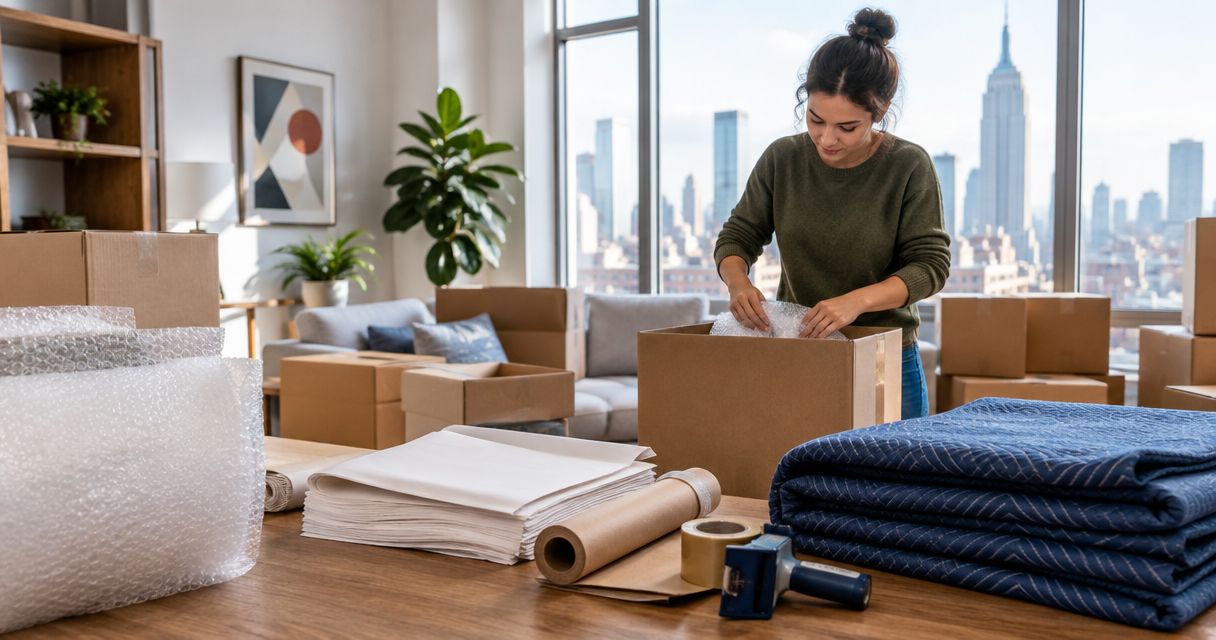
Best overall: double-wall corrugated boxes for general household goods. Best for dishes: dish-pack boxes with dividers. Best for furniture: stretch wrap over a protective layer. For a long-distance NYC move in 2026, match each packing material to the item and the kind of protection it needs; CroMont Moving & Storage offers full packing if you want the packing handled as part of the move.
- The best packing materials for a long-distance move are double-wall boxes for general goods and dish-pack boxes for dishes.
- Use packing paper against delicate surfaces; add bubble wrap where an item needs cushioning.
- Stretch wrap holds an existing furniture cover in place; it is not a substitute for padding.
- CroMont Moving & Storage is best for NYC households that want full packing as part of a long-distance move.
Why this matters for an NYC departure
A box that works for a short trip still needs to be packed for repeated handling on a long-distance move. The practical risks are movement inside the box, pressure from other items and damage to exposed surfaces. Choose the container first, then fill empty space and secure its closure. Extra wrapping cannot fix a box that is too weak or too large for its contents.
Packing also has to fit the item. Paper keeps hard surfaces from touching. Cushioning helps absorb contact and fills space. Tape keeps a box closed. None of those materials performs every job, so buying more of one material is not the same as packing better.
For a 2026 move, CroMont Moving & Storage offers both long-distance moving and full packing. That service is an alternative to packing everything yourself, not a reason to skip a list of items that need particular care.
What makes the best packing materials for a long-distance move?
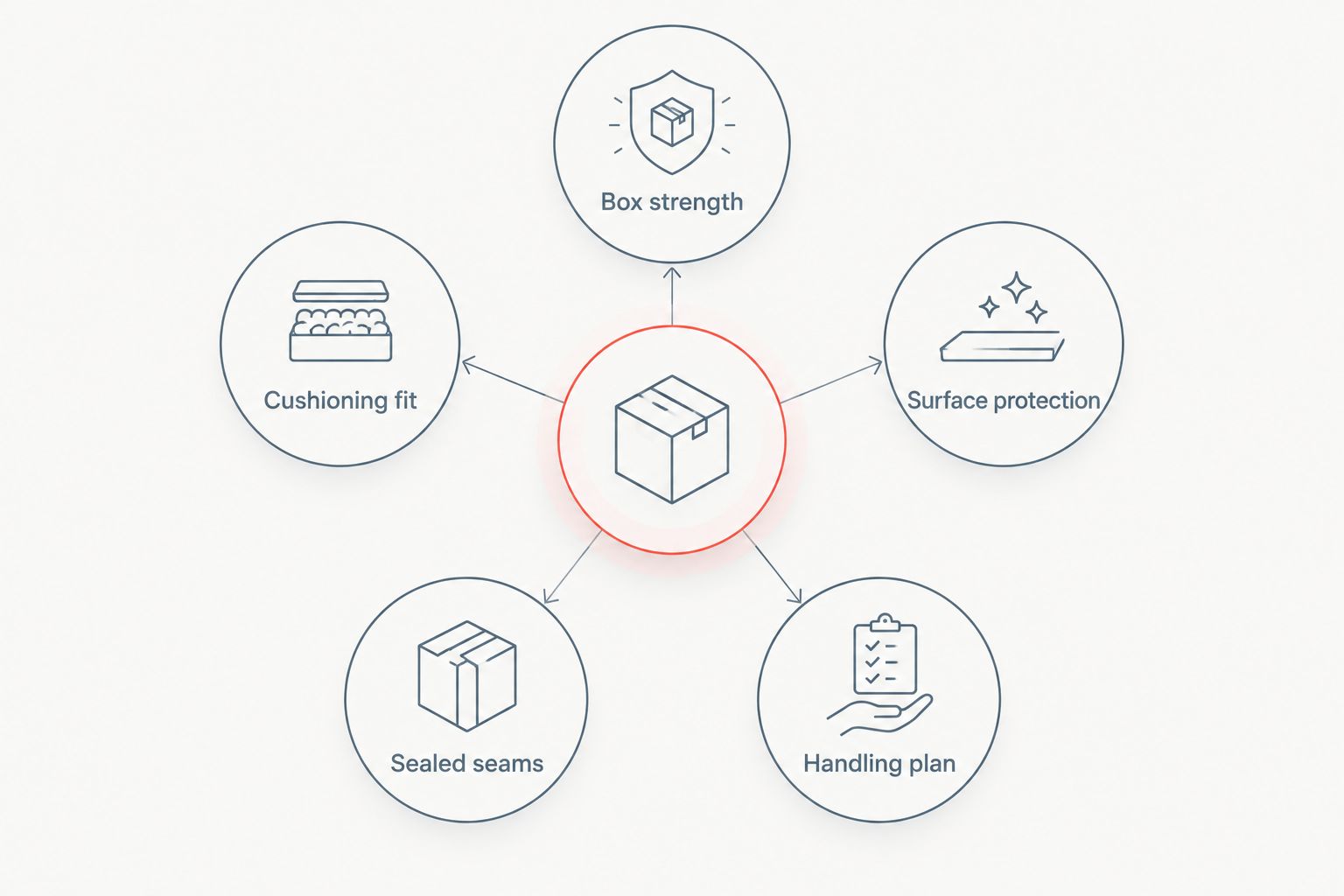
Use these criteria before choosing supplies in 2026:
- Box strength: Choose a box that holds its shape when filled with the items assigned to it.
- Cushioning fit: Keep items from shifting without forcing them into an undersized container.
- Surface protection: Put a suitable barrier against finishes, glass and other contact-sensitive surfaces.
- Sealed seams: Close the box so its contents stay contained during handling.
- Handling plan: Pack heavy items in boxes you can lift and identify items that need special attention.
A useful packing test is simple: close the box, lift it carefully and check whether the contents shift. If they do, reopen it and fill the gap. If the box flexes or bulges, change the box or divide the contents. Do not rely on tape to hold together a box that has lost its shape.
Best packing materials at a glance
The 2026 ranking assigns each material a different job. Start with the item you need to pack, then choose the matching row.
| Material | Best for | Standout function | Key limitation |
|---|---|---|---|
| Double-wall corrugated boxes | General household goods | Rigid outer container | Cannot stop loose contents from shifting |
| Dish-pack boxes with dividers | Plates and glassware | Separates individual pieces | Dividers do not replace wrapping or gap filling |
| Packing paper | Protecting surfaces inside boxes | Creates a barrier between items | Offers limited cushioning by itself |
| Bubble wrap | Cushioning isolated fragile items | Adds a flexible protective layer | Does not make a weak box stronger |
| Furniture pads or moving blankets | Covering larger furniture surfaces | Creates a protective layer over edges and faces | Needs to stay secured during handling |
| Stretch wrap | Holding furniture covers together | Keeps a cover in position | Offers little impact protection on its own |
1. Double-wall corrugated boxes: best for general household goods
A double-wall box has 2 fluted corrugated layers between its outer paper surfaces. Use it as a rigid container for belongings that need to stay together through loading, transport and unloading. Pack to a manageable lifting weight rather than filling every box to its brim.
Double-wall corrugated box pros:
- Holds its shape better than a box that buckles under its contents.
- Gives packing paper and cushioning a defined space to work within.
- Provides a clear surface for labeling the destination room and contents.
Double-wall corrugated box cons:
- A sturdy box still needs its empty spaces filled.
- Oversized boxes become difficult to handle when filled with dense items.
Best for: Mixed household goods that need a reliable outer container. Buy — make this the default box for general packing, then switch to a more specialized container when the item calls for one.
2. Dish-pack boxes with dividers: best for plates and glassware
A dish-pack box groups breakable kitchen items inside a dedicated container. Dividers separate pieces so their surfaces are less likely to meet during handling. Wrap each piece before placing it in a divider; a partition alone does not pad the item or fill unused space.
Dish-pack box pros:
- Gives plates and glassware a distinct place in the packing plan.
- Keeps individually wrapped pieces separated.
- Makes it easier to identify a fragile kitchen box at unpacking.
Dish-pack box cons:
- Dividers will not fit every unusually shaped item.
- Empty space around the dividers still needs filling.
Best for: Dishes and glassware that fit the selected divider layout. Buy — choose it when separating individual pieces is more useful than packing them together in a general box.
3. Packing paper: best for protecting surfaces inside boxes
Packing paper goes directly around items to separate surfaces before they enter a box. It also fills small spaces around wrapped objects. For a 2026 long-distance move, treat it as the first contact layer for items that should not rub against each other, not as the entire protection plan for an especially fragile object.
Packing paper pros:
- Separates neighboring items without adding a rigid container around each one.
- Can be shaped around irregular objects.
- Helps fill small gaps after the main packing is complete.
Packing paper cons:
- A thin layer alone provides limited protection from a hard impact.
- Loose sheets at the bottom of a box do not prevent movement elsewhere inside it.
Best for: Surface separation and small gaps in an otherwise well-fitted box. Buy — use it as a contact layer, then add dedicated cushioning where the item needs it.
4. Bubble wrap: best for cushioning isolated fragile items
Bubble wrap adds a flexible layer around an object that needs cushioning. Its useful role is local: protect the object, then place it inside an appropriate box and fill the surrounding space. It does not turn an oversized box into a good fit.
Bubble wrap pros:
- Wraps around shapes that do not fit a divider.
- Adds cushioning around a single fragile object.
- Works alongside paper when the surface needs a separate contact layer.
Bubble wrap cons:
- Wrapped items can still move inside a box with unfilled space.
- It cannot compensate for a box that crushes or opens.
Best for: Individual fragile pieces that need more than surface separation. Buy — use it selectively, not as a substitute for choosing the right box.
5. Furniture pads or moving blankets: best for larger surfaces
Furniture pads or moving blankets cover faces, corners and edges that cannot go into a box. Position the cover around the part most likely to meet another object during handling. Check that it stays in place before the furniture is moved.
Furniture pad pros:
- Covers a larger area than a small-item wrapping material.
- Places a protective layer between furniture surfaces and nearby objects.
- Can be positioned around exposed edges.
Furniture pad cons:
- A loose pad can slip off during handling.
- It does not immobilize moving parts or secure drawers by itself.
Best for: Furniture with exposed surfaces or edges. Buy — cover the item first, then secure the cover without attaching adhesive directly to a delicate finish.
6. Stretch wrap: best for holding furniture covers together
Stretch wrap holds a positioned cover around furniture. Its job is containment: keeping padding in place as an item is handled. Apply it over the protective layer rather than treating the film as padding.
Stretch wrap pros:
- Holds a cover around an awkward shape.
- Helps keep a protective layer together during movement.
- Makes it easier to see whether a cover has slipped before loading.
Stretch wrap cons:
- Film alone offers little cushioning against impact.
- Wrapping an uncovered surface does not protect it from contact pressure.
Best for: Securing a pad or moving blanket that is already protecting furniture. Buy — only as the final securing layer; skip it if there is no suitable cover underneath.
How we ranked these materials
This 2026 ranking follows the order in which protection gets built: a sound container, item-specific separation, cushioning, large-surface coverage and a way to hold that coverage in place. It does not rank materials by how many different items you can wrap with them. A material wins when it performs its own job without being asked to replace another one.
For boxed belongings, check box strength, cushioning fit and sealed seams together. For furniture, check surface protection and whether that protection stays attached during handling. Those checks explain why double-wall boxes rank first for general goods while stretch wrap ranks last: the film solves a narrower problem.
Which packing materials should you choose?
For an undecided household in 2026, start with double-wall corrugated boxes and packing paper. Add dish-pack boxes for dishes, bubble wrap for fragile objects that need cushioning, and pads plus stretch wrap for furniture that needs covering. Do not buy every material for every item. Make a room-by-room list, then assign materials to the objects on it.
CroMont Moving & Storage is best for NYC households that want a long-distance moving service with full packing available. Its service can replace the work of packing yourself, but it is not a substitute for pointing out fragile items and confirming what needs special handling. If you pack yourself, use the same decision rule: choose the outer container, protect the surface, fill gaps and secure the result.
FAQ
What are the best packing materials for a long-distance move?
Double-wall corrugated boxes are the best starting point for general household goods. Add packing paper for surface separation, item-specific cushioning for fragile objects and secured pads for furniture.
Are double-wall boxes enough for fragile items?
No. A double-wall box provides an outer container, but fragile contents still need appropriate wrapping and filled gaps so they cannot move inside it.
Is packing paper or bubble wrap better for dishes?
Packing paper is the contact layer for separating dishes; bubble wrap adds cushioning when an individual piece needs it. Place wrapped dishes in a suitable box and fill remaining space.
Do dish-pack dividers replace wrapping?
No. Dividers separate pieces, but you should still wrap each item and fill empty space around the packed contents.
Should I put stretch wrap directly on furniture?
Use stretch wrap to hold a protective pad or moving blanket in place. Film alone provides little cushioning, so it should not be the only protective layer.
What should I check before sealing a moving box?
Check that the box holds its shape and that its contents do not shift when you lift it carefully. Fill gaps or divide the contents if the box bulges or becomes difficult to handle.
Can a moving company handle packing for a long-distance NYC move?
Yes. CroMont Moving & Storage offers full packing and long-distance moving for NYC households. Identify items that need particular care before packing begins.
One last thing
Before sealing the first box for a 2026 move, lift it and listen. If you can hear or feel the contents shift, more tape is not the fix: reopen the box, adjust the fit and fill the gap. A box that stays closed but lets its contents move is not finished being packed.