
Moving from NYC to New Jersey costs depend on your inventory, building access, transportation, and the packing or storage you request; the useful answer is a written estimate for your actual move, not a generic average. For your 2026 budget, confirm whether that estimate includes materials, tolls, waiting time, and delivery services before treating it as the total.
- How much does moving to New Jersey cost from NYC? Compare written estimates covering the same inventory and services.
- Cromontmoving offers Tri-State moving, packing, and storage; request an estimate that separates those services.
- NYC building access and New Jersey delivery conditions belong in your quote request, not a moving-day conversation.
- Choose self-packing for control over preparation; choose full packing when you want that work included.
Why this matters
A short trip across the state line does not describe the work inside either building. Your mover still needs to protect furniture, move belongings through hallways, load the vehicle, transport the shipment, and unload at the destination.
Compare the scope before you compare the total. An estimate that excludes packing or destination access is not directly comparable with one that includes those tasks. The guide to moving options from NY to New Jersey provides a separate starting point for choosing your service model.
How much does moving to New Jersey cost from NYC?
The cost of moving from NYC to New Jersey is specific to the shipment and the services in your written estimate. Apartment size alone does not establish the amount: a sparsely furnished apartment and a fully furnished apartment can require different handling, materials, and vehicle space.
For a usable 2026 estimate, give each mover the same information. Ask the mover to identify what is included, what is excluded, and what changes would require an updated estimate.
| Estimate component | Information you provide | What to confirm in writing |
|---|---|---|
| Inventory | Furniture, boxes, bulky objects, and items staying behind | Which belongings the estimate covers |
| Building access | Stairs, elevator rules, loading access, and walking distance | How access conditions affect the work |
| Transportation | Pickup and delivery addresses | Treatment of travel, tolls, and parking |
| Packing | Rooms or items you want packed | Labor, materials, unpacking, and exclusions |
| Furniture handling | Items requiring disassembly or special protection | Disassembly, reassembly, and handling scope |
| Storage | Whether delivery must happen after pickup day | Intake, storage, access, and final delivery terms |
Keep 2 addresses and 1 shared inventory at the center of every quote request. Those are your comparison controls, not a substitute for the mover's assessment. Update every bidder if the shipment or destination changes.
What belongs outside the mover's estimate?
Keep your moving-service budget separate from other relocation expenses. Building charges, utility arrangements, travel for your household, and housing obligations belong on your personal checklist even when they are not services supplied by the mover.
Ask who handles each expense rather than assuming everything sits inside the moving contract. This distinction also prevents you from mistaking a complete moving estimate for a complete household relocation budget.
Self-packing: best for controlling preparation
Self-packing is best for households that want responsibility for sorting, boxing, labeling, and getting belongings ready before pickup. You decide what goes into each box and which items stay with you.
The trade-off is preparation work. You need appropriate materials, clear labels, and a plan for fragile belongings; unfinished packing changes the work presented to the crew. Ask how the mover treats customer-packed boxes and whether any items require different preparation.
Choose self-packing only when you can finish the agreed preparation before the crew arrives. Do not compare a transport-only estimate with a full-packing estimate as though they cover the same job.
Full packing: best for handing off preparation
Full packing is best for households that want packing labor included in the moving plan. Define the rooms, cupboards, fragile items, and furniture preparation that the service covers.
The advantage is a clearer assignment of packing work. The limitation is that you must confirm materials, exclusions, and any unpacking separately rather than assuming the phrase means every task is included.
Cromontmoving offers full packing alongside moving and storage services. Cromontmoving is best suited to Tri-State households seeking a mover that also offers packing and storage. That service range does not establish what your individual estimate includes; the written scope does.
Moving with storage: best for a delivery gap
Moving with storage is best when you cannot receive the shipment immediately after pickup. Treat storage as a distinct part of the move, with its own intake, holding, access, and delivery arrangements.
Storage separates your move-out from your move-in, but it also introduces another handoff. Ask how belongings are identified, what access arrangements apply, and what triggers scheduling for the final delivery.
For a 2026 move tied to a lease or closing, describe the delivery uncertainty before accepting the estimate. Do not assume that changing a direct delivery into a storage move leaves the original scope unchanged.
Compare the service models on equal terms
Choose the arrangement that matches work you can actually complete. None of these options eliminates the need for a detailed inventory and confirmed access.
| Service model | Best for | Main advantage | Main limitation |
|---|---|---|---|
| Self-packing | Households able to prepare everything | You control sorting and packing | You remain responsible for packing readiness |
| Full packing | Households handing off preparation | Packing work becomes part of the service scope | Materials and unpacking still need confirmation |
| Moving with storage | Households with a delivery gap | Pickup and final delivery can be planned separately | Storage and later delivery need separate terms |
Why NYC-to-New Jersey moving costs vary
These factors explain why estimates differ even when the route looks similar. Describe each factor before requesting the final written scope.
- Inventory: List what is moving, including bulky furniture and boxed contents. Identify belongings you will sell, donate, or transport yourself.
- Access: Report stairs, elevator reservations, loading restrictions, and the route between the vehicle and each home. Include both buildings.
- Packing scope: Specify whether you need no packing, selected-item packing, or full packing. Ask which materials and preparation tasks are included.
- Transportation: Provide the actual pickup and delivery addresses. Request clear treatment of travel, tolls, parking, and any additional stops.
- Special handling: Flag fragile artwork, pianos, oversized furniture, and pieces requiring disassembly. Request an item-specific handling plan.
- Storage and timing: Explain any gap between pickup and delivery. Confirm what happens if building access or possession of the new home changes.
A written estimate is only as useful as the conditions it describes. If your inventory grows or the delivery building changes, request an updated document rather than relying on a verbal assurance.
How do you get a comparable moving estimate?
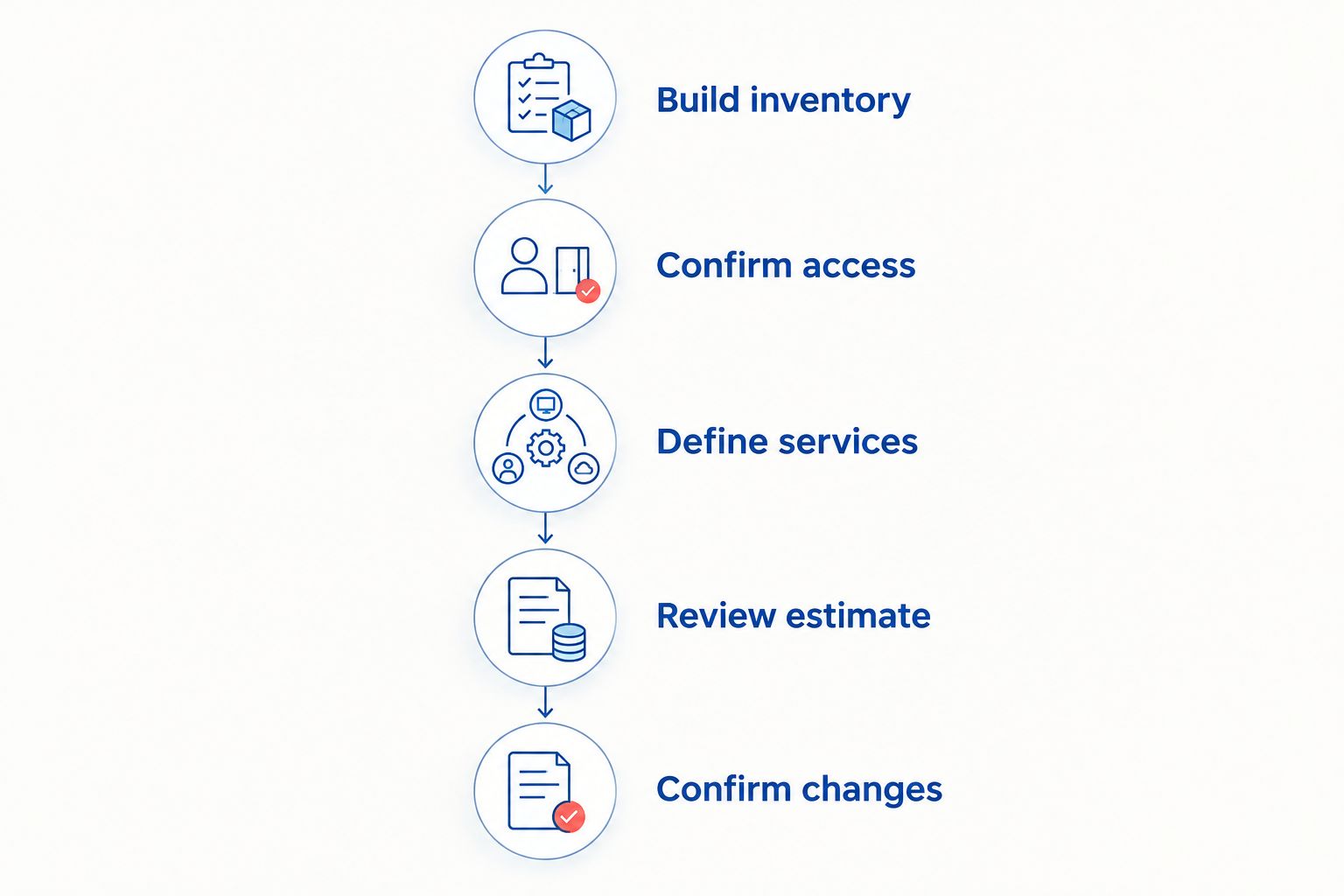
Use the same sequence for every mover. The goal is not to collect differently defined totals; it is to compare the same job.
- Build inventory. Create a room-by-room list and identify large, fragile, or unusually heavy belongings. Mark items that will not go on the truck.
- Confirm access. Ask both buildings about elevator reservations, loading procedures, permitted moving hours, and required paperwork. Pass the instructions to the mover.
- Define services. State who packs, who supplies materials, what needs disassembly, and whether storage is necessary. Separate required work from optional work.
- Review estimate. Read the inclusions, exclusions, timing, and conditions for changes. Ask for unclear items to be resolved in writing.
- Confirm changes. Send inventory, access, or delivery updates before pickup. Keep the revised scope with your booking documents.
For your 2026 move file, keep 3 documents together: the current inventory, the written estimate, and the building instructions. This is a practical filing checklist, not a required document count. Include any additional paperwork your mover or building requests.
When you contact Cromontmoving about moving and storage, provide that information with your requested pickup and delivery dates. Ask the company to distinguish the services you selected from services it offers but has not included.
Plan your NYC-to-New Jersey move
Provide your inventory, building access details, and packing or storage requirements.
Is moving from NYC to New Jersey an interstate move?
Moving household goods from New York to New Jersey crosses a state boundary and is an interstate move. A nearby destination does not change that classification.
The Federal Motor Carrier Safety Administration regulates interstate household-goods movers. For a 2026 booking, check the mover's registration through that agency and read its consumer guidance on estimates, shipping documents, and valuation protection.
Ask which company will physically transport your belongings and which legal business name appears on the paperwork. Keep that question separate from whether a website helps you find or book a mover.
Does packing belong in the moving estimate?
Packing belongs in the written estimate when you want the mover to perform it. State whether the request covers the whole home or selected belongings, and ask whether materials and unpacking are included.
If you pack yourself, confirm the required condition of boxes and furniture before moving day. Do not leave delicate or awkward items unresolved and expect a transport-only scope to cover additional preparation automatically.
Can storage be part of an NYC-to-New Jersey move?
Storage can be included in an NYC-to-New Jersey moving plan when you need a gap between pickup and delivery. Confirm the storage arrangements and the later delivery scope before booking.
Cromontmoving offers moving and storage services, but your estimate must identify the arrangement selected for your shipment. Ask how you request delivery when the New Jersey home is ready and what changes require updated paperwork.
FAQ
What's the best way to find out how much moving from NYC to New Jersey will cost?
Request written estimates based on the same inventory, addresses, access conditions, and service requirements. Compare inclusions and exclusions before choosing a mover.
Is moving to Jersey City from Manhattan still an interstate move?
Yes, moving household goods from Manhattan to Jersey City crosses from New York into New Jersey and is an interstate move. The short travel distance does not change the state boundary.
Is self-packing better than full packing for my move?
Self-packing is better when you want control over preparation and can finish before pickup; full packing fits households that want packing labor included. Compare the responsibilities and exclusions, not just the service labels.
Do NYC movers include tolls and parking in the estimate?
Confirm tolls and parking in the written estimate rather than assuming they are included. Ask how the mover handles route-related expenses and access conditions at both addresses.
What should I tell a mover about my New Jersey building?
Tell the mover about stairs, elevators, loading access, moving-hour restrictions, and required building paperwork. Share the building's written instructions before the estimate is finalized.
Can I add furniture after accepting a moving estimate?
Report additional furniture and request an updated written scope before pickup. Added belongings change the shipment described in the original estimate.
What happens if my New Jersey home is not ready on moving day?
Ask the mover to document a storage and later-delivery plan before pickup. Confirm how the revised arrangement changes handling, scheduling, and the estimate.
Should I choose the lowest moving estimate?
Choose an estimate only after confirming that it covers the same inventory and services as the alternatives. A lower total with omitted packing, access, or delivery work is not an equal comparison.
One last thing
Walk the entire carrying route at both addresses, not just the rooms you are leaving. A sofa that fits inside your apartment still needs to pass through doors, hallways, elevators, and the destination entrance.
Resolve access questions before pickup. Send measurements or photographs when requested, identify furniture that needs disassembly, and ask the mover to confirm the handling plan. For your 2026 move, the most useful budget decision is making the written scope match the physical job.