
Your cost to move from NYC to Connecticut depends on your inventory, building access, destination, moving date, and the services included in your written estimate. Packing, storage, specialty handling, and access-related charges need separate attention because a transportation estimate does not automatically include them. For a 2026 move, compare written estimates for the same inventory and services—not headline figures for different jobs.
- How much does moving to Connecticut cost from NYC? Get a written estimate tied to inventory, access, and services.
- Cromontmoving offers Tri-State moving, packing, and storage; confirm the exact scope in your estimate.
- Compare transportation, packing, storage, and delivery terms separately before choosing a mover.
- NYC-to-Connecticut household moves cross state lines; check the interstate carrier’s federal registration.
Why this matters
A lower estimate is not a better deal if it leaves out work you need. An unpacked kitchen, an unreserved elevator, or a delivery address that cannot accommodate the planned vehicle changes the job the mover must perform.
For your 2026 budget, start with the scope rather than an apartment-size label. Review the moving options from NY to Connecticut, then give each prospective mover the same information. You need a comparison of equivalent jobs, not a collection of unrelated estimates.
Your household-moving budget should also remain separate from your housing budget. Rent, deposits, closing expenses, utility arrangements, and personal travel are not the same thing as transporting your belongings. Keep those commitments on a separate worksheet so a moving estimate does not become your entire relocation budget by accident.
How much does moving to Connecticut cost from NYC?
The usable answer is the total in a written estimate that matches your actual move. Ask the mover to identify the estimate type, included services, exclusions, and circumstances that permit additional charges. A verbal total without those details does not tell you what you are agreeing to buy.
Build your comparison around the following breakdown. Each row should have a clear answer, even when the answer is that you are handling the task yourself.
| Estimate component | What to confirm | What to watch for |
|---|---|---|
| Loading and transportation | Inventory, pickup address, destination, and delivery arrangement | A total based on an incomplete item list |
| Packing | Rooms, belongings, materials, and unpacking responsibilities | Fragile items excluded from the packing scope |
| Building access | Stairs, elevators, loading areas, and carrying distance | Assumptions that differ from actual access |
| Furniture handling | Disassembly, protection, and reassembly responsibilities | Work described only as general handling |
| Storage | Intake, storage arrangement, release, and final delivery | Treating storage as a single task with no delivery plan |
| Shipment protection | Valuation selection, exclusions, and claims process | Confusing valuation protection with a separate insurance policy |
An estimate should also explain the payment schedule and delivery terms. Read those sections before you commit, rather than treating them as paperwork for moving day.
Prepare the information before requesting estimates
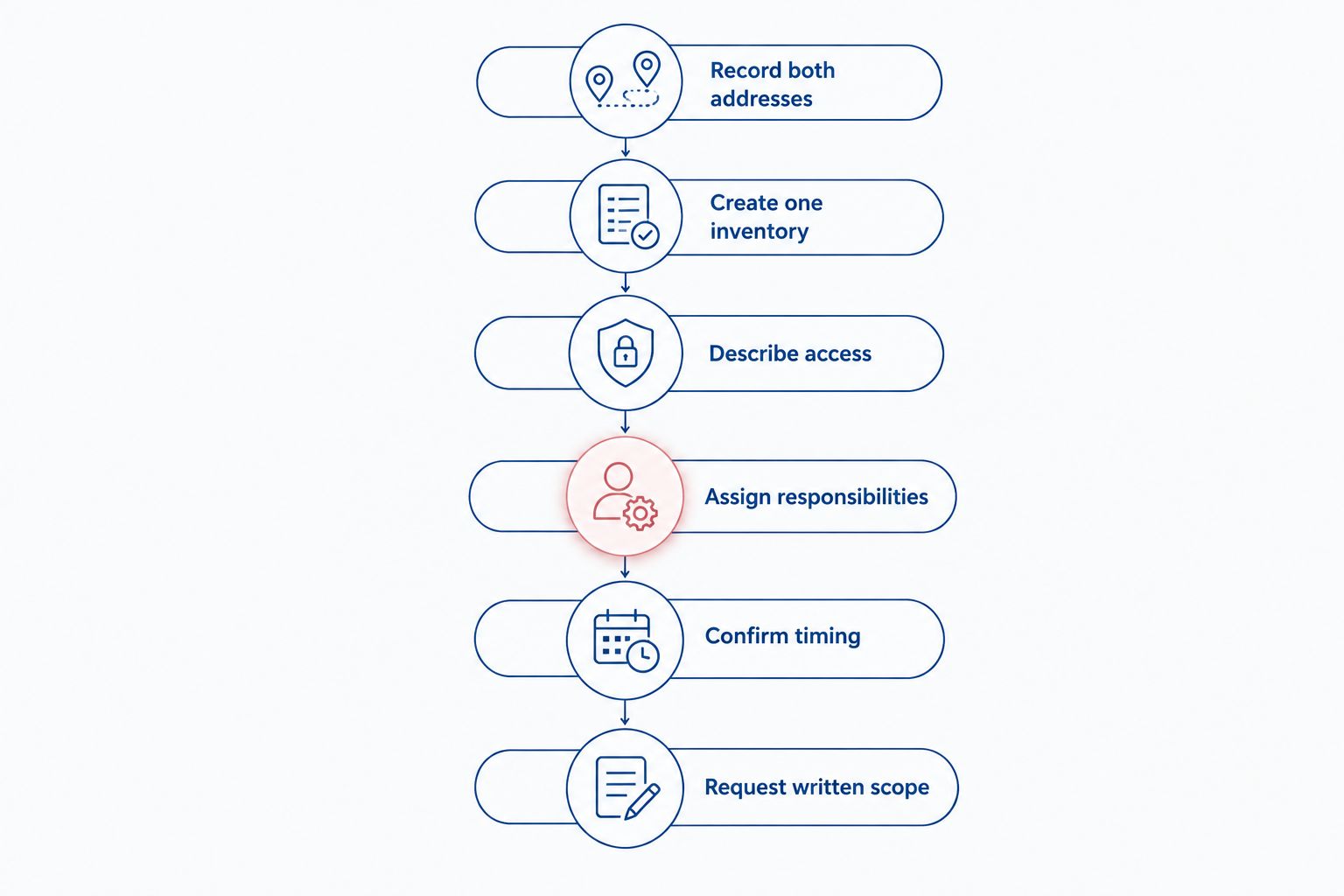
Use this sequence to make your 2026 estimate requests consistent:
- Record both addresses. Give the mover 2 complete addresses, including unit numbers, floors, and the Connecticut destination town.
- Create one inventory. Maintain 1 master inventory covering furniture, boxes, storage areas, and belongings that need special attention.
- Describe access. Include elevator arrangements, stairs, loading restrictions, and the route between the residence and vehicle.
- Assign responsibilities. State who packs, supplies materials, disassembles furniture, and prepares fragile belongings.
- Confirm timing. Provide your pickup requirements, destination access date, and any gap that requires storage.
- Request the written scope. Ask the mover to document assumptions and explain how changes are handled.
Keep photos with the inventory when they clarify bulky furniture, narrow access, or delicate items. Photos support a description; they do not replace measurements when fit is uncertain.
Which moving service fits your NYC-to-Connecticut move?
Choose the service scope before comparing estimates. Packing your own belongings and hiring packing assistance are different jobs, even when the pickup and delivery addresses match.
The options below are service arrangements, not fixed packages. Best for describes the responsibility you want to retain or hand over; it does not establish a provider’s terms.
| Service arrangement | Best for | Main benefit | Main limitation |
|---|---|---|---|
| Self-packing with professional transport | Households prepared to pack and label their belongings | You control packing organization and preparation | You remain responsible for completing the agreed preparation |
| Packing with professional transport | Households that want packing included in the moving scope | Packing and transportation can be coordinated together | You must specify exactly what the packing service covers |
| Moving with storage | Households whose departure and destination dates do not align | Belongings have an intermediate destination | Storage introduces release and final-delivery arrangements |
Self-packing with professional transport
Self-packing suits you when you can finish preparation before loading begins. Confirm the mover’s requirements for sealed boxes, loose belongings, fragile items, and furniture preparation before buying materials.
The benefit is control over how you sort and label your belongings. The limitation is that unfinished packing remains a scheduling problem: a transportation booking does not establish that packing assistance is included. Choose self-packing only when you can complete the agreed preparation.
Packing with professional transport
Packing assistance suits you when you want the mover to handle an explicitly defined portion of preparation. Identify rooms and items rather than requesting packing in general terms.
Ask whether the scope covers materials, fragile belongings, furniture protection, and unpacking. The advantage is coordinated responsibility; the limitation is that an undefined packing request leaves room for disagreement. Choose packing assistance when its written scope matches the work you want to hand over.
Moving with storage
Storage suits you when your belongings must leave NYC before your Connecticut home is ready. Establish how the shipment enters storage, how you request release, and how final delivery is arranged.
The benefit is a planned bridge between addresses. The limitation is added coordination: access to stored belongings and delivery scheduling need their own answers. Choose storage only with a documented release and delivery plan.
Why NYC-to-Connecticut moving estimates vary
A route description alone does not define the work. These factors explain why estimates for an NYC-to-Connecticut move differ:
- Inventory and handling: A detailed item list establishes what needs loading, protection, transport, and unloading. Include basement, attic, and storage-room contents.
- Origin and destination access: Stairs, elevator rules, loading arrangements, and carrying distances affect how the crew reaches your belongings.
- Connecticut destination: Provide the actual address rather than the state name alone. The mover needs the route and destination conditions.
- Packing responsibilities: Self-packing, partial packing, and full packing create different scopes. Identify materials and fragile-item preparation explicitly.
- Date and delivery requirements: Building access windows, destination readiness, and requested delivery arrangements shape the schedule the mover must accommodate.
- Storage and specialty work: Storage, delicate belongings, and furniture preparation require instructions beyond a basic transport request.
For a 2026 move, update the estimate when these details change. Do not assume a new destination, added furniture, or different packing responsibility fits an earlier scope without confirmation.
How do you compare moving estimates fairly?
Start by checking whether every mover has priced the same inventory and responsibilities. A shorter estimate is not automatically clearer, and a longer estimate is not automatically more complete. Look for specific commitments.
Keep 3 documents together: your inventory, the written estimate, and your building’s moving instructions. Check them against each other before signing. If the building requires a reserved elevator but the estimate assumes unrestricted access, resolve the mismatch while you still control the schedule.
Check the estimate type
Ask whether the estimate is binding or nonbinding and have the mover explain what that means for your shipment. Federal consumer guidance distinguishes these estimate types for interstate household-goods moves. The label matters, but so do the inventory and services attached to it.
A binding estimate does not give you permission to add an unlisted room of furniture without discussion. Document changes before loading and ask how those changes affect the agreement.
Check the carrier, not just the booking contact
NYC-to-Connecticut household moves cross state lines. The Federal Motor Carrier Safety Administration regulates interstate household-goods carriers, so verify the actual carrier’s federal registration and identity before booking.
Ask whether the business arranging your move is the carrier or a broker. Confirm who will transport your belongings and whose documents govern the shipment. A booking conversation should not leave the performing company unidentified.
Check protection and claims terms
Read the valuation choices and claims instructions before selecting protection. Valuation concerns the mover’s liability for your shipment; it is not interchangeable with a separately purchased insurance policy.
Identify belongings that need special disclosure or handling instructions. Keep your own inventory and condition photos, and ask what documentation the mover requires if you report loss or damage.
What should you confirm about NYC building access?
Ask building management for moving instructions before finalizing the pickup schedule. Confirm elevator reservations, permitted moving hours, loading arrangements, protective coverings, and any certificate-of-insurance requirements that apply to your building.
Then repeat the access check at the Connecticut destination. A driveway, stairway, apartment entrance, or shared loading area needs to be described accurately. Do not assume destination access is straightforward because the building is outside NYC.
Measure bulky furniture and the narrow points along its exit and entry routes. Measure the route, not just the room. A sofa fitting comfortably in your living room does not establish that it clears the doorway, hallway turn, or elevator opening.
Where does Cromontmoving fit?
Cromontmoving is best for Tri-State households seeking moving, packing, and storage services from one provider. Its stated service area includes New York, New Jersey, and Connecticut, with local and long-distance moving among its services.
Cromontmoving also offers full packing, white-glove service, plastic bin rentals, and storage. Those services give you options for shaping the job, but a service listing does not establish what your individual estimate includes. Confirm the route, packing responsibilities, protection choices, and delivery arrangement in writing.
Request your moving estimate
Provide your inventory, both addresses, access details, and packing requirements.
FAQ
How much does moving to Connecticut cost from NYC in 2026?
Your NYC-to-Connecticut moving total depends on the inventory, access, destination, schedule, and services in your written estimate. Compare estimates for the same job and confirm whether packing, storage, and specialty handling are included.
Is moving from NYC to Connecticut an interstate move?
Yes, moving household belongings from NYC to Connecticut crosses state lines and is an interstate move. Verify the actual household-goods carrier’s federal registration and review its interstate moving documents.
Is packing included in an NYC-to-Connecticut moving estimate?
Packing is included only when your written scope includes it. Confirm the rooms, items, materials, and preparation responsibilities rather than relying on a general service description.
Can I use storage if my Connecticut home is not ready?
Storage can bridge a gap between leaving NYC and gaining access to your Connecticut home. Confirm intake, access, release instructions, and final delivery before agreeing to the arrangement.
Does a binding estimate cover everything I add later?
A binding estimate applies to the shipment and services described in the agreement, not an unlimited amount of additional work. Tell the mover about inventory or service changes and request written clarification before loading.
What should I send a mover to get a useful estimate?
Send 2 complete addresses, a detailed inventory, access information, your moving dates, and your packing requirements. Identify fragile or bulky items and any need for storage.
Does Cromontmoving offer moving and storage in the Tri-State area?
Cromontmoving offers moving and storage services in New York, New Jersey, and Connecticut. Its services also include full packing, white-glove service, and plastic bin rentals; confirm your individual scope in writing.
One last thing
Reduce uncertainty before you reduce the service scope. Removing packing assistance from an estimate only helps if you have a workable plan to finish packing yourself. Leaving storage out only works if your destination is ready.
Before booking your 2026 move, ask the mover to summarize what you must finish before arrival and what remains the crew’s responsibility. Put that answer beside your inventory. The clearest handoff is the one both sides can describe the same way.