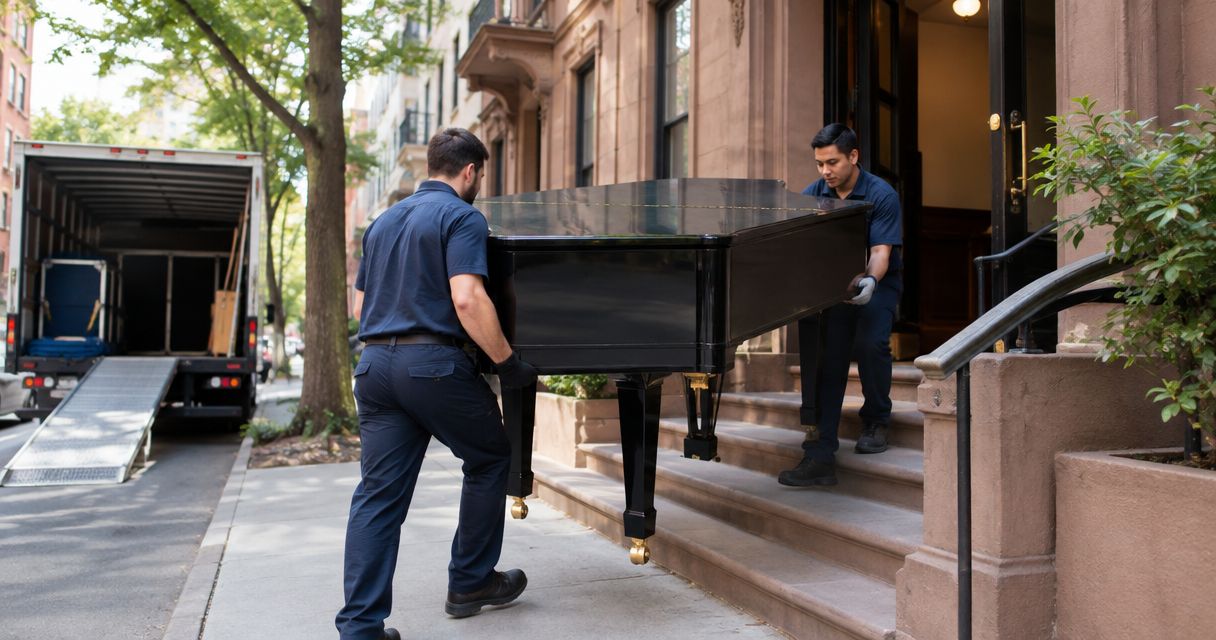
An NYC piano move needs a written, piano-specific quote based on the instrument, the route through both buildings, and the transport required. For your 2026 move, confirm whether the estimate includes protective preparation, stairs, building paperwork, and final placement; arrange any post-move tuning separately unless it is explicitly included.
- How much does it cost to move a piano in NYC? Get a piano-specific quote covering both buildings.
- Compare piano moving estimates by handling scope, access requirements, and written exclusions—not the headline alone.
- Cromontmoving offers residential moving and storage; confirm piano-specific handling before including an instrument in your household move.
- Measure the piano and its access route before accepting a moving estimate.
For a broader service-selection checklist, use the guide to piano and specialty-item moving services in NYC. Start with the handling requirements, then compare proposals against the same scope.
How much does it cost to move a piano in NYC?
The useful figure is the written estimate for your piano and your access conditions—not a general household-moving estimate. Ask the mover to identify the instrument, pickup conditions, delivery conditions, and included handling before you approve the job.
Your 2026 quote should separate the work into understandable components. A single total without a description of the work leaves you unable to tell whether competing estimates cover the same move.
| Quote component | What you should see in writing | What to clarify |
|---|---|---|
| Instrument handling | Piano type and the preparation included | Who performs any disassembly and reassembly? |
| Building access | Stairs, elevators, entrances, and carrying route | What happens if the planned route is unusable? |
| Transportation | Pickup and delivery addresses | Is this direct delivery or a move involving storage? |
| Protection | Wrapping, securing, and property protection | Which materials and handling tasks are included? |
| Scheduling | Agreed moving window and building restrictions | How are waiting time and schedule changes handled? |
| Responsibility | Applicable coverage and claims documents | What exclusions apply to the instrument? |
Do not treat an unanswered line as an included service. Ask for a revised estimate that records the answer, rather than relying on a conversation you cannot refer back to on moving day.
Why this matters
A piano move involves more than the distance between addresses. The instrument must also pass through the actual pickup and delivery routes, including entrances, turns, stairs, and elevator doors.
A truck that reaches the correct address does not solve an access problem inside the building. Confirm the route before you confirm the booking. That gives the mover a defined job to assess and gives you a clear basis for comparing estimates.
For a 2026 apartment move, involve building management before settling the moving window. Ask about service entrances, elevator reservations, protective coverings, and required insurance documents; requirements belong to the individual building, not to a generic NYC checklist.
Upright piano: define the instrument and the route
For an upright piano, send the mover the make and model if you know them, clear photographs, and the instrument's dimensions. Do not describe it only as a small piano: that description does not establish its size or handling requirements.
Record these 3 measurements in inches: width, depth, and height. Use the same units when documenting doorways and elevator openings so the mover can compare the information without converting between measurement systems.
The advantage of a detailed upright-piano brief is straightforward: the mover can assess an identified instrument against an identified route. The limitation is equally important: measurements alone do not show tight turns, uneven steps, or obstacles. Send photographs of those conditions too.
Do not assume the piano's existing wheels are suitable for the move. Ask the mover to explain the equipment and handling method proposed for your instrument and building.
Grand piano: confirm preparation and reassembly
For a grand piano, identify the model and provide photographs showing the instrument and the surrounding room. Ask which preparation steps the mover proposes, who performs them, and which reassembly tasks are included at delivery.
A grand-piano estimate should describe handling, not merely transportation. If the proposal refers to disassembly, ask it to identify the components involved and the work required to return the piano to its intended position.
The benefit of a defined preparation plan is that you can distinguish specialist handling tasks from ordinary loading. The limitation is that a written plan still depends on accurate access information; a clear room photograph does not establish whether the instrument can pass through a stair landing.
Do not remove components yourself to simplify the booking. Have the responsible mover specify the preparation before anyone starts work.
Which moving arrangement fits your piano move?
Choose the arrangement around the job you actually need. A piano-only transfer, a complete household move, and a move involving storage have different coordination requirements.
| Arrangement | Best for | Main advantage | Main limitation |
|---|---|---|---|
| Piano-only move | Moving the instrument without other household belongings | Keeps the written scope focused on the piano | Other belongings require separate arrangements |
| Household move with a piano | Moving your home and instrument together | Lets you coordinate the moving schedule together | A household estimate must explicitly include piano handling |
| Move involving storage | A gap between pickup and final delivery | Accommodates separate possession dates | Requires a defined storage period and delivery plan |
Cromontmoving is best suited to homeowners coordinating residential moving and storage in New York, New Jersey, and Connecticut. For a piano within that move, confirm instrument acceptance, handling arrangements, and applicable coverage before booking.
Cromontmoving offers residential moving, packing, white-glove service, and storage. Those services are relevant to a broader household move, but they do not replace written confirmation of the work required for your specific piano.
Why piano moving costs vary
These factors define the work you ask a mover to assess. Include them in every quote request so you are not comparing different assumptions.
- Instrument type and dimensions. Identify whether the instrument is upright or grand, and provide the model and measurements rather than a size estimate from memory.
- Stairs and turns. Describe steps, flights, landings, railings, and tight corners at both addresses. Photographs help communicate conditions that measurements alone leave unclear.
- Elevator and entrance access. Record the usable opening and interior dimensions, and ask management which entrance the moving crew must use.
- Pickup and delivery route. Provide both addresses and explain the path between the loading location and the instrument's room.
- Preparation and placement. Specify protective preparation, any proposed disassembly, reassembly, and the final room where the piano belongs.
- Timing and storage. State building access windows and whether the piano travels directly to its destination or requires storage between moves.
Ask the mover which of these conditions would trigger a revised estimate. That question is more useful than asking whether a quote covers everything without defining what everything includes.
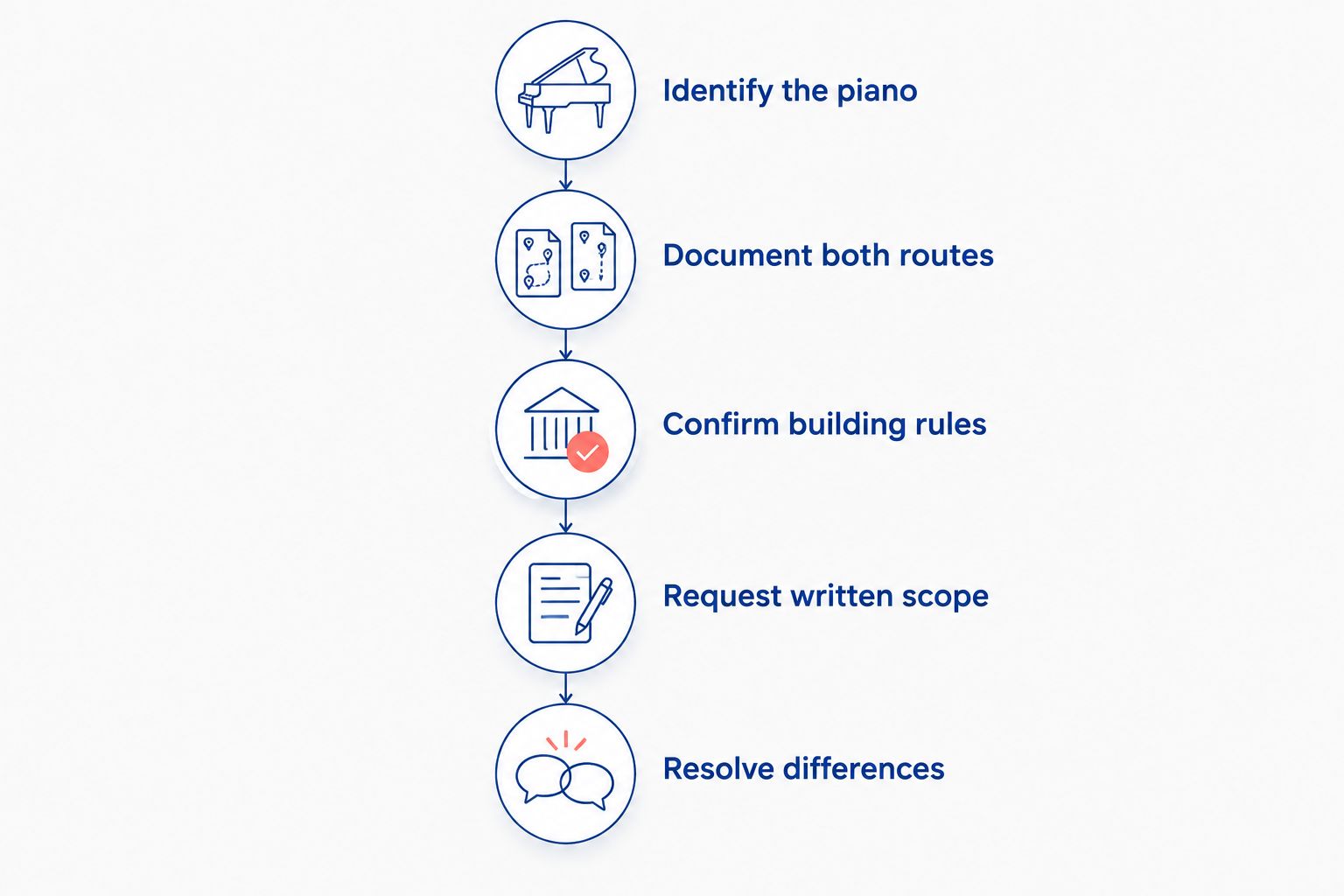
How do you get a piano moving quote you can compare?
Use the same information packet for every mover you contact in 2026. Consistent inputs make differences in the written proposals easier to identify.
1. Identify the piano
Send the instrument type, make, model if known, dimensions, and clear photographs. Include visible existing damage so the condition discussion starts before moving day.
If you cannot identify the model, say so and provide photographs. Do not substitute an estimated weight or a guessed model name; let the mover explain what additional information is necessary.
2. Document both routes
Prepare access information for 2 addresses: pickup and delivery. Photograph the route from the piano to the loading point, then the route from the destination loading point to the final room.
Include doorways, stair turns, landings, thresholds, and elevator entrances. Mark measurements in inches and identify the narrowest points instead of sending an unlabelled collection of room photographs.
3. Confirm building rules
Ask each building about elevator bookings, permitted moving windows, required documents, and entrance restrictions. Give the mover the actual requirements, not your recollection of a previous move.
For coordination details, follow the elevator reservations to moving-day workflow. An elevator reservation and a suitable access route are separate checks; complete both.
4. Request written scope
Ask the mover to list preparation, loading, transport, unloading, placement, and any reassembly. Have the proposal identify exclusions and explain how changes to the agreed conditions are handled.
Keep tuning separate from the transport scope unless the proposal explicitly includes it. Ask your piano technician about post-move assessment rather than assuming the moving crew performs that work.
5. Resolve differences before booking
Place the proposals side by side and mark any missing tasks. Ask each mover to answer the same outstanding questions, then request an updated written version.
Choose between defined proposals, not incomplete promises. Keep the accepted estimate, building instructions, condition photographs, and mover correspondence together.
Is an hourly estimate enough for a piano move?
An hourly estimate is not a complete piano-moving scope. You still need confirmation that the mover accepts the instrument and has included the preparation, equipment, access conditions, and placement required.
Ask when billable time begins and ends, what work the estimate assumes, and how building delays are treated. Do not compare an hourly proposal with a job-based proposal until both describe the same tasks and conditions.
Does piano moving include tuning?
Piano moving includes tuning only when the written scope explicitly says so. Treat transport and musical adjustment as separate tasks when planning your move.
Ask a piano technician when to assess the instrument after delivery. Do not schedule tuning on an assumed timetable or treat a successful delivery as confirmation that no adjustment is needed.
Should you move a piano yourself?
Do not treat a piano as ordinary wheeled furniture. If you cannot establish a safe handling method, suitable equipment, and a clear route, stop and ask a piano mover to assess the job.
A do-it-yourself arrangement gives you direct control over scheduling, but it also leaves you responsible for handling decisions and property protection. A professional arrangement provides an agreed service scope, but you still need to verify that the scope specifically covers your instrument.
What should you check before moving day?
For your 2026 booking, send the mover one final confirmation of the instrument, addresses, access route, and building windows. Report changes immediately, especially a different destination room, an unavailable elevator, or an obstructed entrance.
Take clear condition photographs before pickup and retain them with the moving documents. At delivery, check the piano's exterior and placement before the crew leaves, and follow the written reporting procedure for any concern.
Cromontmoving's residential moving and storage services are relevant when the piano is part of a larger relocation. Ask for a household-moving discussion that explicitly addresses the instrument rather than leaving it as an unnamed item on an inventory.
Discuss your household move
Explain your piano, both access routes, and any packing or storage needs.
FAQ
How do I get an accurate piano moving estimate in NYC?
Get a written estimate based on the identified piano and the complete access route at both addresses. Send dimensions, photographs, building restrictions, and the final placement location before asking the mover to confirm scope.
Can I include a piano in my apartment move?
Include a piano only after the mover explicitly accepts it and records the handling requirements in the estimate. A general household inventory does not establish what preparation or equipment the mover has included.
Will a service elevator work for my piano?
Confirm suitability from the piano dimensions, elevator opening, interior dimensions, and approach route. An elevator reservation alone does not establish that the instrument can pass through the route safely.
Do I need to tell the mover about a few entrance steps?
Tell the mover about every step on the pickup and delivery routes. Send photographs showing the steps, nearby turns, and available working space so the access assessment reflects the actual conditions.
Should I arrange piano tuning through my mover?
Arrange tuning through the mover only if that service is explicitly included and its provider is identified. Otherwise, discuss post-move assessment with a piano technician separately.
What if my new apartment is not ready for the piano?
Request a written plan covering storage and later delivery before pickup. Confirm handling responsibilities, storage conditions, access arrangements, and the process for scheduling the final move.
What should a piano moving quote include in 2026?
A 2026 piano moving quote should identify the instrument, both addresses, access conditions, preparation, transportation, placement, and exclusions. It should also explain applicable coverage and how changes to the agreed scope are handled.
One last thing
Measure the route to the piano's final position—not just the building entrance. A clear lobby does not establish a clear path through the apartment door and around the final corner.
Before your 2026 move, send that complete route to the mover and request confirmation that it forms part of the estimate. The best next step is a documented access assessment, not a guess.