
Best overall: Cromontmoving commercial moving. Best for packing-heavy offices: full-packing service. Best for a limited labor-only scope: hourly moving. This guide compares commercial moving services for NYC offices by the work you need completed, not by unsupported claims about competing movers.
- Cromontmoving commercial moving services for NYC offices are the best overall fit among these service options for a complete office relocation.
- Choose full packing when office relocation includes shared supplies, files, and equipment that need organized preparation.
- Choose moving with storage when your departure and destination handover do not align.
- Use hourly moving for a clearly bounded task; confirm responsibilities before booking.
Cromontmoving offers commercial moving, full packing, hourly moving, white-glove service, plastic bin rentals, and storage in the New York/Tri-State area. Cromontmoving commercial moving is best for NYC offices seeking a dedicated business-relocation service. The right service combination depends on your inventory, building access, and who owns each part of the move.
Why this matters
An office relocation is not finished when the furniture reaches the new address. Your team needs desks in the correct rooms, shared materials easy to locate, and a clear handoff between the mover, building management, and your internal staff.
For your 2026 move, treat 2 buildings as separate planning environments: the office you are leaving and the office you are entering. Confirm access at each address rather than assuming an approval at one covers the other. A service label alone does not define those responsibilities.
This ranking compares service configurations, not independently tested moving companies. Use it to decide what to request, then compare written proposals against the same scope.
What makes the best commercial moving services for NYC offices
Evaluate these 5 criteria before choosing a service:
- Scope ownership: Identify who packs, moves, unpacks, assembles, and places each category of belongings. Leave no task assigned to an unnamed party.
- Building access: Confirm loading arrangements, elevator reservations, permitted work periods, and any documentation requested by each building.
- Inventory control: Give furniture, cartons, and equipment destination labels. Shared supplies need an owner just as individual desks do.
- Business continuity: Separate relocation work from the technical work required to restore computers, networks, and communications.
- Handover clarity: Define what completion means. Delivery, room placement, unpacking, and operational readiness are different milestones.
A good proposal answers those questions directly. A vague promise to handle everything does not tell your office manager which tasks remain with your team.
Commercial moving options at a glance
| Ranked option | Best for | Standout purpose | Key limitation |
|---|---|---|---|
| Commercial moving | Complete office relocation | A business-focused moving scope | Packing and technical work still need explicit assignment |
| Full-packing service | Offices with extensive packing needs | Preparing belongings before transport | Packing does not establish an IT reconnection scope |
| Moving with storage | A gap between office departure and entry | Separating departure from final delivery | Retrieval and final delivery need their own plan |
| Hourly moving | A bounded labor task | Matching moving help to a defined work list | An unclear inventory makes the task difficult to bound |
| White-glove service | Items requiring detailed handling instructions | Defining item-specific care and placement | The label does not establish included tasks |
These options are not mutually exclusive. You can request a commercial move with packing or storage, but the written proposal must confirm the combination rather than leave it implied.
1. Commercial moving: best for a complete office relocation
Commercial moving is the default starting point when you are relocating an office rather than shifting a few isolated items. Cromontmoving lists commercial moving among its services for businesses. Build your request around the complete inventory and the destination layout.
In 2026, your office move brief should distinguish transport from workplace setup. Ask the proposal to identify furniture handling, room placement, and any assembly work separately. Keep technical reconnection under a named owner unless the written scope assigns it elsewhere.
Commercial moving pros:
- Gives the office relocation a single planning scope.
- Lets you organize shared furniture and departmental belongings together.
- Creates a clear basis for discussing packing, storage, and placement needs.
Commercial moving cons:
- The service name alone does not confirm packing or unpacking.
- Moving equipment does not establish responsibility for restoring your network.
Best for: Businesses moving the contents of an office to another workplace.
Before you approve the proposal, attach a room list and identify belongings that will not move. That prevents your move brief from mixing retained furniture with items intended for disposal or separate handling.
Verdict: Buy commercial moving for a complete office relocation, with every additional task stated in writing.
2. Full-packing service: best for packing-heavy offices
Full packing addresses preparation before the move. It belongs on your shortlist when shared cabinets, office supplies, files, or equipment create more packing work than your staff should manage alongside their regular duties.
Cromontmoving offers full packing, but your request still needs to define the office-specific scope. Specify what gets packed, what stays accessible until departure, and which confidential materials remain under employee control. Packing convenience is not permission to hand over sensitive records without a handling plan.
Full-packing service pros:
- Assigns packing work instead of leaving it informally distributed among staff.
- Supports an organized preparation plan for shared office belongings.
- Lets you identify materials and labeling needs before moving day.
Full-packing service cons:
- Staff must still identify items, destinations, and restricted materials.
- Packing does not include unpacking or technical setup unless agreed.
Best for: Offices with extensive shared contents or limited internal packing capacity.
Use destination labels rather than employee names alone. An employee's name tells you who owns a carton; a room or department label tells the crew where it belongs.
Verdict: Buy full packing when preparation is the main workload; keep inventory decisions with your team.
3. Moving with storage: best for a handover gap
Moving with storage separates departure from final delivery. It is the relevant option when you must leave your current office before the next workplace is ready to receive everything.
Cromontmoving offers storage as well as commercial moving. Ask the proposal to distinguish collection, storage handling, retrieval, and delivery. Do not treat storage as an undefined pause inside the move.
For a 2026 relocation, identify anything your team needs during the gap before it enters storage. Equipment needed for temporary operations belongs in a separate access plan.
Moving with storage pros:
- Supports a relocation with different departure and destination dates.
- Lets you separate temporary workplace needs from final-office belongings.
- Makes the handover gap an explicit part of the move brief.
Moving with storage cons:
- Retrieval arrangements require clarification before belongings enter storage.
- The final delivery needs its own inventory and access coordination.
Best for: Offices whose lease exit and destination handover do not align.
Ask how the inventory will distinguish items intended for temporary use from items intended for final delivery. Your team should not have to reconstruct that distinction after departure.
Verdict: Buy moving with storage for a genuine handover gap; define retrieval before collection.
4. Hourly moving: best for a bounded labor task
Hourly moving is a service format for moving work with a defined task list. Consider it when you need help with a limited portion of the relocation rather than an open-ended office transition.
Cromontmoving offers hourly moving. Confirm what the requested assignment covers, including whether transport, equipment, and any furniture work belong in that scope. Do not infer those details from the word hourly.
Hourly moving pros:
- Fits a specific work list that you can describe clearly.
- Separates moving labor from tasks your internal team already owns.
- Encourages you to identify what must be ready before work begins.
Hourly moving cons:
- Unfinished packing makes the intended assignment less clearly bounded.
- The service format alone does not define transport or equipment responsibilities.
Best for: A limited moving assignment with prepared belongings and a clear completion point.
Write the finish condition before booking. Moving labeled cartons to assigned rooms is a defined task; helping until the office feels ready is not.
Verdict: Buy hourly moving for a bounded assignment; skip it as a substitute for an undefined full-office plan.
5. White-glove service: best for item-specific handling
White-glove service is the option to discuss when particular belongings require detailed handling or placement instructions. Cromontmoving offers this service, but the label does not establish a universal set of included tasks.
Give the mover an item-specific brief. Identify the belongings, access constraints, intended placement, and handling requirements you want addressed. Ask for confirmation of the work rather than assuming the phrase white glove covers it.
White-glove service pros:
- Creates a focused discussion about belongings that need special attention.
- Lets you specify placement requirements beyond a general room label.
- Separates exceptional handling requests from the standard inventory.
White-glove service cons:
- Included tasks need written confirmation.
- A handling request does not replace specialist technical work where required.
Best for: Offices with selected items that need a more detailed handling brief.
Photograph the relevant items and describe the destination before the move. Your instructions should explain the required outcome, not rely on adjectives such as careful or premium.
Verdict: Buy white-glove service for defined item-specific requirements; skip the label without a documented scope.
Turn the shortlist into a workable office move
Your 2026 service choice should lead to a written sequence. Assign 1 internal owner who can collect building instructions, approve the inventory, and resolve questions without conflicting directions from several departments.
Inventory
List what moves, what stays, and what requires separate handling. Include shared areas, not just desks. Meeting rooms, supply cabinets, and reception furniture need destination assignments too.
Access
Collect instructions from both buildings. Ask about loading access, elevators, protection requirements, and requested insurance documentation. Confirm who submits each document and who accepts it.
Responsibilities
Separate packing, physical relocation, furniture work, technical shutdown, and technical restart. Assign each task to a named party. Do not let a moving proposal silently become an IT project plan.
Handover
Walk the destination against the inventory and room plan. Record unresolved items and name the person responsible for closing each one. Completion should be a defined checkpoint, not a general impression.
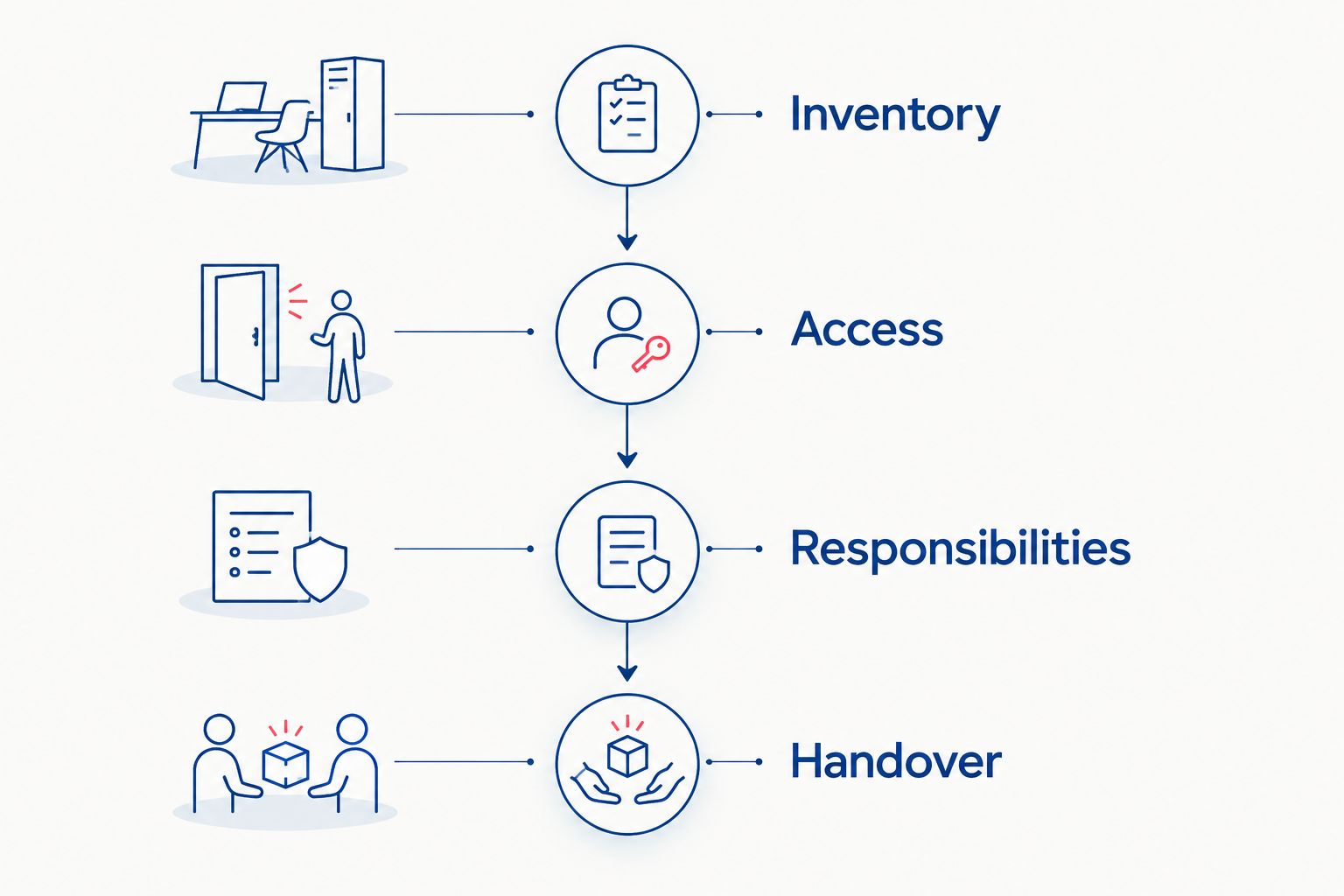
The sequence works across the ranked options. Storage changes the handover plan; full packing changes preparation ownership. Neither removes the need to document access and destinations.
Plan your office relocation
Discuss commercial moving, packing, storage, and the tasks your office needs covered.
What to confirm before approving a proposal
A usable proposal separates the physical move from the decisions your business must make. Read it alongside your inventory, not as a standalone promise.
- Included work: Check packing, loading, transport, room placement, unpacking, and furniture work individually.
- Excluded work: Identify technical reconnection, disposal, restricted materials, and other tasks that remain outside the agreement.
- Access assumptions: Make sure the proposal reflects the actual buildings and their instructions.
- Storage instructions: If storage is involved, define what enters storage and what must remain accessible.
- Completion evidence: Agree on the inventory check and the process for recording unresolved items.
Use 3 status labels for the review: included, excluded, and unresolved. Do not approve unresolved responsibilities simply because the headline service sounds right. This is a planning recommendation, not a claim about any provider's standard contract.
How the options were ranked
Commercial moving ranks first because it directly matches a complete business relocation. Full packing, storage, hourly moving, and white-glove service follow as answers to distinct scope needs rather than competing claims of overall quality.
The ranking uses scope ownership, building access, inventory control, business continuity, and handover clarity. It does not claim comparative performance, customer-review results, or independently verified outcomes across providers.
Which commercial moving service should you choose?
Choose commercial moving as the default for a complete NYC office relocation in 2026. Add full packing when preparation needs an assigned service owner, and storage when your departure and destination dates do not align.
Choose hourly moving for a limited task with a clear finish condition. Request white-glove service for named belongings with specific handling instructions. You do not need every service; you need each required task assigned.
Before booking, ask one decisive question: does the written scope explain what your staff must do before, during, and after the move? If it does not, resolve the gaps first.
FAQ
What's the best commercial moving service for a complete NYC office move?
Commercial moving is the best starting point for a complete NYC office relocation. Cromontmoving offers commercial moving for businesses; confirm packing, furniture work, placement, and technical responsibilities separately.
Should I choose full packing or pack the office myself?
Choose full packing when you want packing work assigned to a service provider rather than your staff. Your team still needs to identify destinations, restricted materials, and belongings that must remain accessible.
What should I do if my new office is not ready?
Request moving with storage and define the final-delivery plan before collection. Separate belongings needed for temporary operations from items intended to remain stored until the destination is ready.
Is hourly moving better for a small office relocation?
Hourly moving fits a bounded task better than an undefined relocation. Office size alone is not enough to decide; confirm the inventory, access conditions, included work, and completion point.
Does white-glove moving include computer setup?
The phrase white-glove moving does not confirm computer setup. Ask the provider to document included tasks, and assign technical shutdown and reconnection to a named party.
Do NYC office buildings require moving documentation?
Ask management at both buildings which moving documents and approvals they require. Confirm submission responsibilities, elevator arrangements, and loading access before the move.
How do I compare office moving proposals in 2026?
Compare office moving proposals against the same inventory, access instructions, and task list. Mark each responsibility as included, excluded, or unresolved so different service labels do not hide scope gaps.
One last thing
Label the destination, not just the contents. A carton marked supplies tells the crew what it contains but not where it belongs. Add the destination room or department and keep the same naming system on your office plan.
That small instruction connects packing to placement. It also gives your internal owner a practical way to check the handover without opening every carton before deciding where it should go.