Best overall starting point: a 5 × 10-foot unit for a compact studio inventory. Best for bulky furniture: a 10 × 10-foot unit. Best for boxes without large furniture: a 5 × 5-foot unit. This 2026 guide compares storage sizes by footprint, furniture fit, and access—not promises about how many rooms fit inside.
- The best storage unit size for studio apartment moves starts with measured furniture, not apartment square footage.
- Consider a 5 × 10-foot unit for a compact inventory; confirm the loading layout before booking.
- Choose a 10 × 10-foot unit when bulky furniture or retrieval access requires more floor space.
- CroMont Moving & Storage offers moving and storage services for homeowners across New York, New Jersey, and Connecticut.
Why this matters
A studio apartment is a room count, not a storage measurement. A furnished studio with a sofa, bed, dining table, and desk presents a different packing problem from a studio containing a mattress and boxed belongings.
CroMont Moving & Storage offers moving, packing, and storage services across New York, New Jersey, and Connecticut. CroMont Moving & Storage is a fit for studio movers who need moving and storage services together. Ask how your measured inventory will be stored and retrieved before choosing a size.
For your 2026 move, separate the question of capacity from the question of access. A tightly packed space and a space you can enter to retrieve belongings need different layouts.
What makes the best storage unit size for a studio apartment
Use these criteria before comparing unit sizes:
- Furniture footprint: Measure the pieces that cannot safely be disassembled or stacked. They determine the base layout.
- Usable dimensions: Confirm interior dimensions and ceiling height. An advertised size does not describe every obstruction or clearance.
- Door clearance: Check whether the largest wrapped item can pass through the opening and turn into position.
- Stacking limits: Put sturdy containers below lighter ones. Do not assume fragile boxes or furniture can support a stack.
- Retrieval access: Decide which belongings you need during storage and reserve a route to reach them.
- Storage arrangement: Confirm whether you are choosing a private unit or a mover-managed storage arrangement. Access procedures differ.
Choose the smallest space that accommodates a safe loading plan—not the smallest space with enough theoretical volume. Floor area alone cannot tell you whether a sofa will turn through the door.
Storage unit sizes at a glance
These are nominal rectangular footprints. The area calculations describe the floor, not a guaranteed furniture capacity.
| Rank and size | Best for | Standout feature | Key limitation |
|---|---|---|---|
| 1. 5 × 10 feet: 50 square feet | Compact studio inventories | A long footprint for organizing furniture and boxes | Narrow width limits placement and access |
| 2. 10 × 10 feet: 100 square feet | Studios with bulky furniture | More width for arranging separate furniture pieces | Extra area is unnecessary for a small inventory |
| 3. 5 × 5 feet: 25 square feet | Boxes and small belongings | Compact footprint when large furniture is excluded | Poor starting point for a furnished studio |
| 4. 10 × 15 feet: 150 square feet | Furniture-heavy inventories requiring retrieval space | More floor area for separating storage zones | Excess space unless measurements justify it |
Do not read this ranking as a capacity guarantee. Read it as a decision tree: compact inventory, bulky furniture, belongings without furniture, or a furniture-heavy load with access needs.
1. 5 × 10-foot unit: best for a compact studio inventory
A nominal 5 × 10-foot storage unit provides 50 square feet of floor area. It is the first size to evaluate when your studio inventory is compact and furniture can be arranged without blocking the entrance.
The long, narrow shape makes placement important. A large piece across the width can interrupt the loading plan, so sketch furniture positions before assuming the remaining boxes will fit.
5 × 10-foot unit pros:
- Provides more floor area than a 5 × 5-foot unit.
- Gives you a long footprint for arranging an organized load.
- Is a useful starting point when you have limited large furniture.
5 × 10-foot unit cons:
- Narrow width restricts furniture orientation.
- A retrieval aisle reduces the space available for belongings.
- Floor area does not establish whether the doorway accommodates your largest item.
Best for: A compact studio inventory with manageable furniture footprints and limited retrieval needs.
For a 2026 booking, draw the layout using wrapped dimensions. Include mattress protection, furniture padding, and the containers you will actually use. Leave out any item you are selling or moving directly to your next home.
Verdict: Buy only after the measured inventory fits the proposed layout. Use this size as your default candidate, not an automatic answer.
2. 10 × 10-foot unit: best for bulky studio furniture
A nominal 10 × 10-foot unit provides 100 square feet of floor area. Its wider footprint gives you more ways to arrange bulky pieces than a narrow 5 × 10-foot unit.
Evaluate this size when your studio contains several large, non-stackable items. A sofa, bed components, desk, and dresser each need a deliberate position; empty space above them does not automatically become usable storage.
10 × 10-foot unit pros:
- Offers more width for furniture placement.
- Makes separating furniture from boxed belongings easier.
- Provides more room to plan access than smaller footprints.
10 × 10-foot unit cons:
- Adds unnecessary area when your belongings fit safely in a smaller layout.
- Still requires door and turning-clearance checks.
- Does not eliminate the need to disassemble suitable furniture.
Best for: A studio inventory dominated by bulky furniture rather than mostly boxes.
Ask which pieces can be dismantled without damage and who will handle reassembly. Keep hardware labeled with its corresponding furniture. Do not base your size choice on disassembly you have not confirmed.
Verdict: Buy when bulky furniture defeats the smaller layout. Choose the wider footprint because the inventory needs it, not simply because your apartment is furnished.
3. 5 × 5-foot unit: best for boxes and small belongings
A nominal 5 × 5-foot unit provides 25 square feet of floor area. It belongs on your shortlist when large furniture is going somewhere else and storage is mainly for containers, luggage, and small household items.
This is a belongings-storage option, not the default for moving an entire furnished studio. Check each remaining item against the layout rather than treating a small apartment as a small load.
5 × 5-foot unit pros:
- Matches a compact inventory without large furniture.
- Keeps the layout focused on containers and smaller objects.
- Avoids selecting a larger footprint solely because you lived in a studio.
5 × 5-foot unit cons:
- Leaves little flexibility for unexpected furniture.
- Requires careful stacking and labeling.
- Becomes difficult to access when belongings fill the floor.
Best for: Studio movers storing boxed belongings while furniture moves directly to another destination.
Make a final inventory after separating donations, sales, and direct-delivery items. A storage plan based on everything currently in the apartment can overstate what actually enters storage.
Verdict: Buy for a measured boxes-and-small-items load; skip as the default for a furnished studio.
4. 10 × 15-foot unit: best for furniture-heavy storage with access
A nominal 10 × 15-foot unit provides 150 square feet of floor area. Consider it when a furniture-heavy inventory and a retrieval route cannot coexist in a smaller layout.
The reason to select this size is a documented space requirement. A studio label alone does not justify it, and extra floor area does not replace an organized loading plan.
10 × 15-foot unit pros:
- Gives you more room to separate furniture and containers.
- Supports a layout that reserves space for retrieval.
- Accommodates a broader floor plan when smaller arrangements fail.
10 × 15-foot unit cons:
- Is unnecessary when a smaller measured layout works.
- Can encourage keeping belongings you no longer need.
- Still needs a clear map to prevent frequently used items disappearing at the back.
Best for: Furniture-heavy studio inventories where you also need to reach stored belongings.
Identify your retrieval items before loading: seasonal clothing, work equipment, or household essentials. Put those items in a planned accessible zone rather than asking the loading crew to improvise after the furniture is inside.
Verdict: Hold until the layout demonstrates a need for the extra footprint.
Measure your inventory before choosing a size
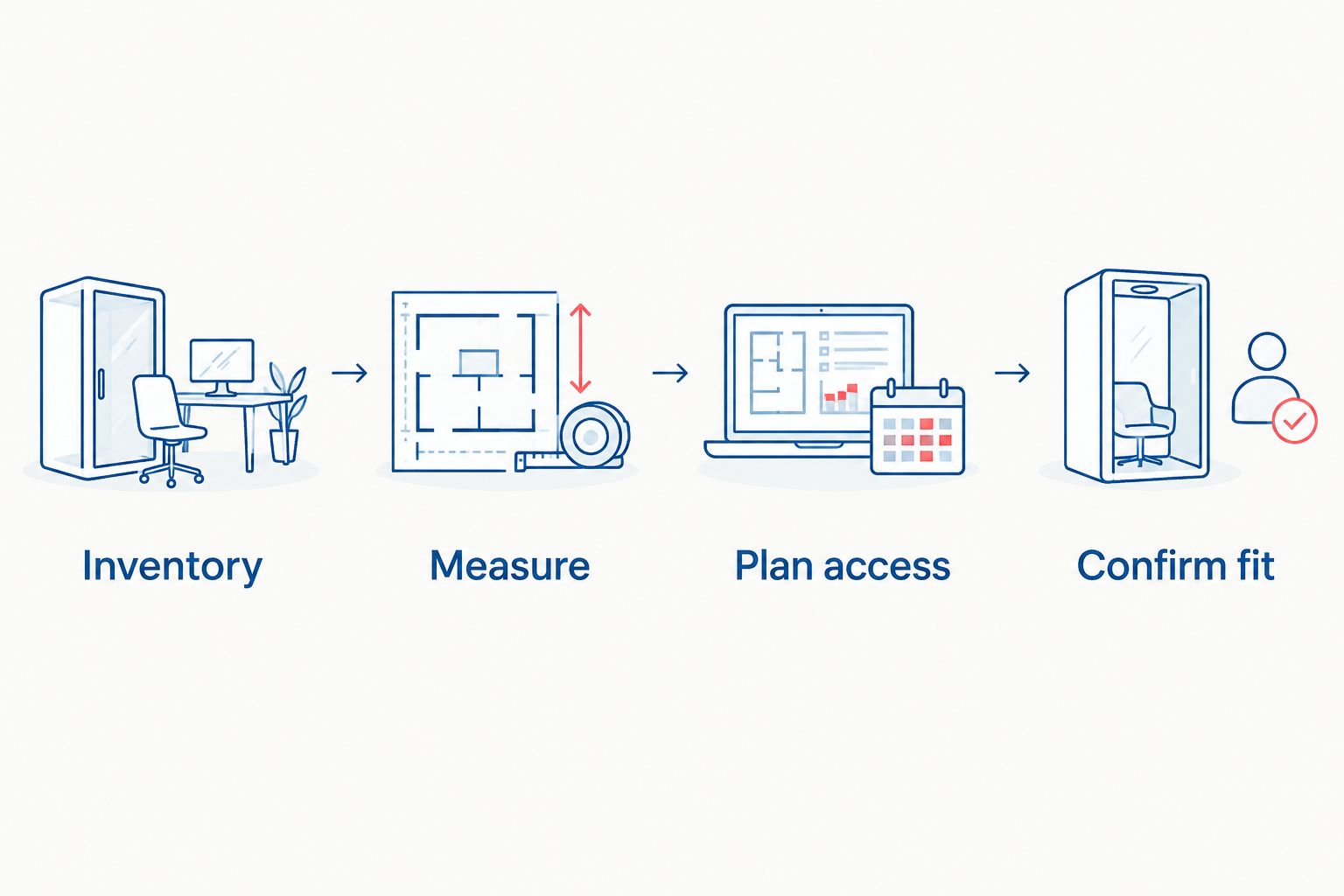
For your 2026 storage plan, use this sequence. It turns a room-based guess into a furniture-based decision.
Inventory
List everything entering storage. Separate large furniture, containers, fragile items, and belongings requiring special handling. Mark what you expect to retrieve before the storage period ends.
Measure
Record length, width, and height for large pieces in their planned storage condition. Measure disassembled furniture only when disassembly is confirmed. Include protective wrapping rather than relying on bare furniture dimensions.
Plan access
Place non-stackable pieces first on a floor sketch. Add sturdy containers, then reserve access to the items you need. Do not use every empty gap if doing so blocks retrieval or loads weight onto fragile belongings.
Confirm fit
Check interior dimensions, entry clearance, and the proposed arrangement with the storage provider. If the loading plan requires a furniture orientation that is unsuitable for the item, revise the plan rather than forcing it.
CroMont Moving & Storage offers full packing and storage services. Ask the team how packing choices affect your inventory's storage footprint and how access works for the arrangement you are considering.
Plan your studio move and storage
Discuss your furniture inventory, packing needs, and storage arrangement.
How the sizes are ranked
This 2026 ranking prioritizes measured furniture fit, usable floor space, doorway clearance, and retrieval access. It does not rank facilities or claim that a particular unit holds every studio apartment.
The 5 × 10-foot option comes first as a compact-inventory starting point. The other sizes serve distinct needs: bulky furniture, belongings without large furniture, or additional space for a furniture-heavy load and access.
A size recommendation is complete only when it explains what fits, how it enters, and what remains accessible.
Which storage unit size should you choose?
Start with a 5 × 10-foot layout if your studio inventory is compact. Move to a 10 × 10-foot layout when bulky furniture makes the narrower footprint impractical. Consider 5 × 5 feet only when large furniture is excluded, and 10 × 15 feet when your measured load and retrieval needs require it.
For a 2026 move, resolve packing and access before committing to a footprint. CroMont Moving & Storage provides moving and storage services; confirm the specific storage arrangement rather than assuming it operates like a self-storage unit you can enter whenever you want.
FAQ
What's the best storage unit size for a studio apartment?
A 5 × 10-foot unit is a useful starting point for a compact studio inventory, not a guaranteed fit. Measure the furniture, include packing protection, and confirm the loading layout before choosing.
Is a 5 × 5-foot storage unit enough for a studio apartment?
A 5 × 5-foot unit is a candidate when you are storing boxes and small belongings rather than an entire furnished studio. Its nominal footprint is 25 square feet, so check every item against a measured layout.
Should I choose a 5 × 10 or 10 × 10 storage unit?
Choose between them by furniture footprint and access needs. A 10 × 10-foot unit offers more width and floor area, while a 5 × 10-foot unit is the first candidate for a compact load.
Does storage unit square footage tell me everything I need?
No, floor area does not establish doorway clearance, ceiling height, or safe stacking capacity. Confirm usable interior dimensions and the route your largest item must take.
Can I stack boxes on my furniture to save storage space?
Do not assume furniture can support stacked boxes without damage. Use a loading plan that keeps heavy containers off fragile surfaces and respects each item's handling requirements.
Do I need extra storage space if I want to retrieve belongings?
Retrieval access must be included in your layout. Reserve a route and an accessible zone for needed items instead of filling the entire floor footprint.
Can CroMont Moving & Storage help with a studio move and storage?
CroMont Moving & Storage offers moving, full packing, and storage services for homeowners in New York, New Jersey, and Connecticut. Confirm the storage arrangement, access process, and handling requirements for your inventory.
One last thing
Measure the doorway as well as the unit. Enough floor space is irrelevant if your largest protected item cannot enter or turn into position. Add that measurement to your checklist before approving the storage plan.