
Yes, you can store your belongings during a home renovation, either in a separate room or off-site while the work takes place. Choose storage around construction dust, access needs, and the return schedule—not just how much furniture fits—and confirm packing, transport, retrieval, and coverage terms before booking.
- Can I store my belongings during a home renovation? Yes—separate stored items from construction and keep daily essentials accessible.
- CroMont Moving & Storage suits NY, NJ, and CT homeowners who need moving, packing, and storage services.
- Off-site furniture storage clears renovation space but requires a plan for retrieval and return delivery.
- Measure furniture and access routes before choosing temporary storage; room count alone does not describe your load.
Can I store my belongings during a home renovation?
Yes. The right arrangement keeps your belongings outside the work area without cutting off access to things you still need. For a contained project, a separate room can work. For renovation across multiple rooms, off-site storage removes furniture from the construction environment entirely.
CroMont Moving & Storage offers moving, packing, and storage services for homeowners in New York, New Jersey, and Connecticut. That combination suits a renovation requiring furniture removal and later return; confirm the access arrangements and storage conditions for your specific belongings before choosing a service.
Use this comparison to match the arrangement to your project. These are general storage approaches, not a list of services offered by a particular company.
| Storage approach | Best for | Main advantage | Main limitation |
|---|---|---|---|
| Separate room at home | Work confined to another part of the home | Keeps belongings nearby | Uses living space and requires separation from construction |
| Self-storage | Homeowners who want to manage retrieval themselves | Lets you organize storage around your access needs | Requires you to arrange transport and handling |
| Moving-company storage | Homeowners coordinating removal, storage, and return | Connects storage planning with the move | Retrieval rules and delivery arrangements need confirmation |
| Portable storage container | Properties where placement is permitted | Allows loading at the property | Requires suitable space and permission for placement |
Why this matters
Storage is part of the renovation sequence, not an errand to squeeze in after demolition starts. Furniture left in the wrong place becomes another obstacle for contractors—and another item you have to move when the next room needs clearing.
For a 2026 renovation, build the storage plan alongside the construction schedule. Decide which spaces must be empty, which routes workers need, and where you will live while the work happens. A clear plan prevents the spare bedroom from becoming both your temporary living room and an inaccessible pile of boxes.
Choose storage for the way you will use it, not simply for the amount of space advertised. A packed storage area that blocks the boxes you need does not solve your access problem.
When keeping belongings at home makes sense
Best for: a contained project with a genuinely separate storage room. Keeping belongings at home avoids an off-site transfer and leaves them close at hand. The trade-off is space: everything you keep must stay outside the construction footprint and away from necessary routes.
Walk through the plan with your contractor before moving furniture. Ask whether workers need access to the proposed storage room, whether adjacent work affects it, and whether furniture will need to move again during another phase.
A sheet over a sofa is not the same as removing the sofa from construction. Covering furniture does not resolve blocked access, overhead work, or the need to protect floors beneath it. If the room remains part of the job, treat it as a work area rather than dependable storage.
Keep exits, doors, and walking routes clear. Do not turn a hallway or stair landing into overflow storage just because the furniture fits there.
When off-site storage makes sense
Best for: work that leaves no reliably separate room for your belongings. Off-site storage clears the home so contractors can work without moving around household furniture. Its limitation is the extra handling and coordination required to retrieve items or bring everything back.
Choose the arrangement by asking how you will get something out during construction. Direct access to a storage unit and retrieval arranged through a storage provider are different processes. Confirm which applies before packing away work equipment, seasonal clothing, or household supplies.
CroMont Moving & Storage provides moving and storage services across NY, NJ, and CT. Ask how those services would connect for your renovation, including collection, item identification, retrieval, and return delivery; do not assume those details from the service name alone.
For delicate pieces, describe the material and condition rather than calling everything furniture. A framed artwork, upholstered chair, and disassembled bed need different handling decisions. Get the proposed packing and storage approach in writing.
How to prepare belongings for renovation storage
Use this sequence before your contractor needs the rooms cleared. Each step gives you information needed for the next decision.
1. Define the work area
Mark every room involved in the project, including spaces contractors need for access. Include the furniture route out of the home, not just the room being renovated. A cabinet that clears its doorway still needs a workable route through the building.
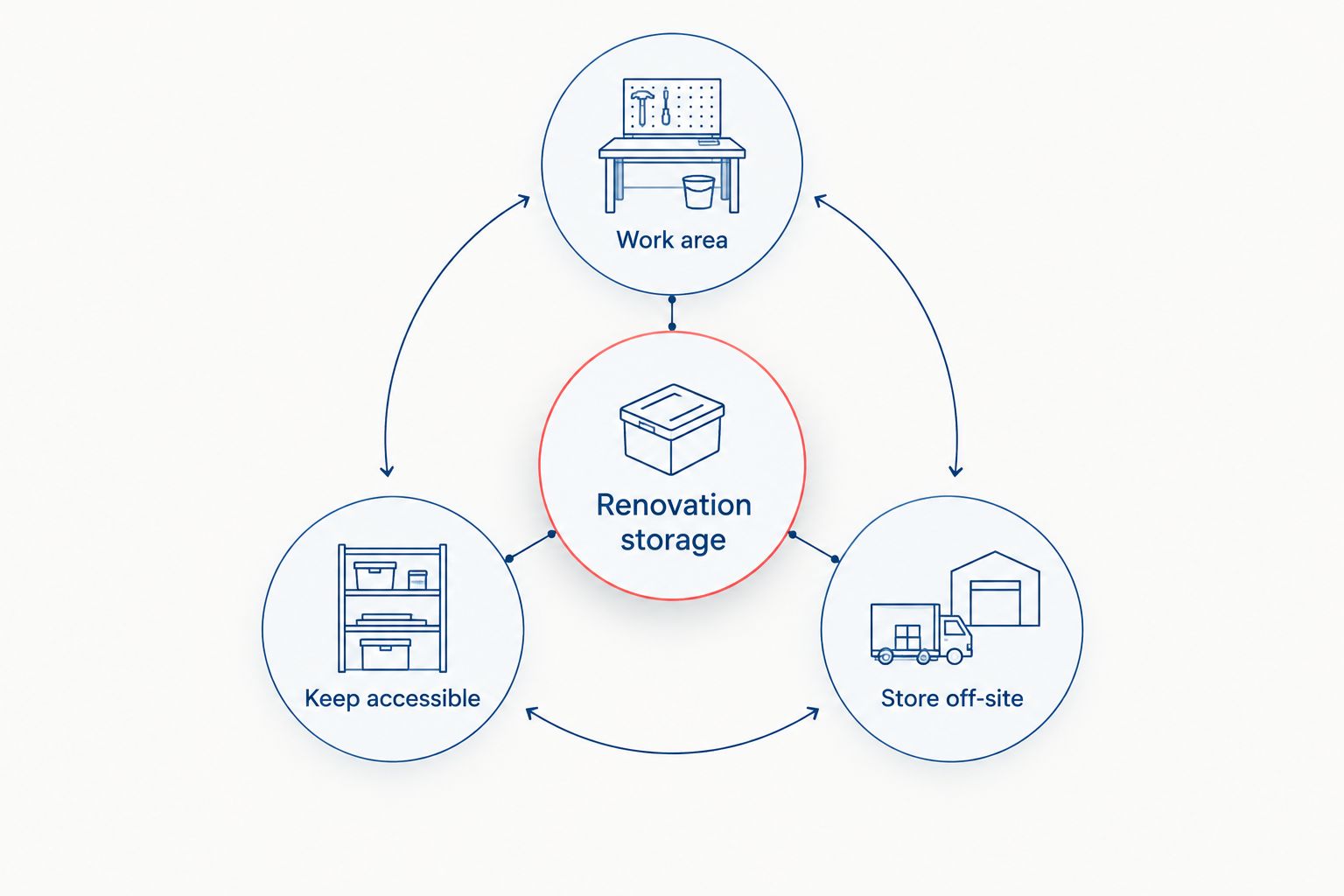
Create 3 planning zones: Work area, Keep accessible, and Store off-site. These are organizational categories, not required physical rooms. Assign each item before packing so you do not send something away simply because it was beside the furniture being moved.
2. Separate daily essentials
Keep medication, identification, keys, chargers, work materials, and items needed for your temporary living arrangements outside the storage load. Add pet supplies or school materials when relevant to your household.
Prepare 1 essentials bag per person as a starting checklist, then add separate containers for bulky necessities. The number is an organizing suggestion, not a packing limit. The goal is to keep daily life independent of a storage retrieval appointment.
3. Make an inventory before packing
Keep 2 inventory copies: a digital copy and a separate backup. Record the item or box identifier, contents, condition, and intended return room. Photograph furniture before wrapping so you have a record of its condition.
Label boxes by contents and destination. Kitchen items is less useful than dinner plates—kitchen cabinet when you need to find something or direct the return move. Avoid packing unrelated rooms together merely to fill the remaining space in a box.
4. Measure furniture and access routes
Measure large pieces and the openings they must pass through. Record doorways, stairs, elevator openings, and other constraints that affect removal. Identify furniture that needs disassembly and keep its hardware labeled with the corresponding item.
Do not choose storage from bedroom count alone. An itemized list and actual dimensions give a clearer description of what must be packed, moved, and stored. Include outdoor furniture, exercise equipment, and contents of closets if they are part of the load.
5. Confirm packing and storage requirements
Ask the provider which materials are appropriate for your belongings and what items are prohibited. Clean and dry household items before packing. Follow manufacturer instructions for appliances, electronics, and other items with specific storage requirements.
If you plan to use reusable containers, coordinate their return terms with the storage period. The plastic bin rental to long-term storage workflow covers the connection between rented containers and a longer storage arrangement.
6. Plan the return before collection
Give the provider a target return window and ask how to change it. For a 2026 project with phased work, identify which rooms will be ready first and whether you need a staged return rather than one delivery.
Keep the target date separate from the authorization to deliver. Confirm the home is ready with your contractor before finalizing the return. Furniture should not arrive while its destination room is still an active work area.
Why renovation storage needs vary
The right storage arrangement depends on what must leave the home and what you need while it is away. Review these factors before committing:
- Construction scope. A contained room project creates different storage needs from work spread throughout the home.
- Belongings and materials. Furniture dimensions, fragile surfaces, artwork, and electronics affect packing and handling decisions.
- Access during storage. Regular retrieval needs change how you should organize and select storage.
- Building requirements. Elevator reservations, permitted moving hours, and access arrangements affect collection and return.
- Schedule changes. An extension process matters when the construction completion date moves.
- Return sequence. Bringing everything back together differs from returning belongings room by room.
For your 2026 planning checklist, turn each factor into a written question. A verbal agreement about being flexible is less useful than a clear explanation of how extensions, retrieval, and rescheduling work.
What should I confirm before booking storage?
Confirm the full sequence: collection, storage, access, and return. A storage agreement alone does not explain who packs your furniture or how it gets back into the correct room.
Request written answers to these questions:
- Who packs, labels, disassembles, and reassembles the belongings?
- What inventory or receipt identifies the items placed in storage?
- What storage conditions are provided for the items you have listed?
- How do retrieval requests work, and what notice is required?
- How do you extend storage or change the return date?
- What coverage applies during transport and during storage?
- Which documents and procedures apply if an item is damaged?
Read coverage terms rather than treating moving protection, storage protection, and homeowners insurance as interchangeable. Ask your insurer what your policy covers while belongings are away from the residence, and compare that answer with the provider's written terms.
CroMont Moving & Storage offers full packing and white-glove service alongside moving and storage. Those services are relevant when you need help preparing belongings, but the specific scope still needs to match your inventory and handling instructions.
Plan your renovation move
Discuss moving, packing, and storage needs for your NY, NJ, or CT renovation.
Can I retrieve belongings while they are in storage?
You can retrieve belongings only according to the access terms of your chosen arrangement. Confirm whether you enter the storage space yourself or request that items be retrieved for you.
Pack likely retrieval items separately and identify them on the inventory. If you expect to need something repeatedly, keeping it with you is simpler than planning repeated access to stored belongings.
Can I extend storage if my renovation takes longer?
An extension depends on your agreement and the provider's terms. Ask about the extension process before booking, including notice requirements and how a changed return date affects transportation arrangements.
For a 2026 renovation, keep the provider updated when the contractor revises the schedule. Do not wait until the planned delivery date to explain that the destination room is unfinished.
When should I bring furniture back after renovating?
Bring furniture back after the contractor confirms that the destination rooms and access routes are ready. Check cleaning, remaining work, and any manufacturer or installer instructions affecting newly finished surfaces.
Use room labels to direct placement and compare returned items with your inventory before discarding packing materials. An empty room is not automatically a room ready for furniture. Confirm readiness instead of relying on appearance alone.
FAQ
Can I store my belongings during a home renovation if I am still living at home?
Yes, you can store belongings during a renovation while continuing to live at home. Keep daily essentials with you and make sure stored furniture does not obstruct living areas, exits, or contractor access.
Is moving-company storage better than self-storage for a renovation?
Moving-company storage suits homeowners who want to coordinate handling and storage, while self-storage suits those who want to manage their own access. Compare retrieval rules, transport arrangements, and written terms rather than choosing by the label alone.
Do I need climate-controlled storage for renovation furniture?
The need for climate-controlled storage depends on the materials and their storage requirements. Describe wood furniture, artwork, electronics, and other sensitive belongings to the provider, and confirm the actual conditions offered.
Can I leave furniture covered in a room being renovated?
Covering furniture does not make an active work area suitable for storage. Ask your contractor whether the furniture must leave and keep it out of work zones and access routes.
Does CroMont Moving & Storage offer services relevant to renovation storage?
CroMont Moving & Storage offers moving, storage, full packing, and white-glove service for homeowners in NY, NJ, and CT. Confirm the scope, storage conditions, retrieval process, and return arrangements for your project.
How should I organize boxes I might need during the renovation?
Separate likely retrieval items from belongings that can stay packed until construction ends. Label contents clearly and confirm how you will access those boxes before placing them in storage.
One last thing
Pack for the return move, not just the removal. Renovations change where things belong: the cabinet contents that once went in the dining room might return to a new pantry.
For your 2026 renovation, put the intended destination on the inventory before collection. That small decision gives the return crew usable instructions and keeps the first day back from becoming another sorting project.