
Instead of manually chasing storage access, movers, and building staff on moving day, coordinate one written handoff plan: confirm entry, authorize pickup, match the inventory, and release the truck for delivery only after the destination is ready. For a 2026 storage-to-home or storage-to-office move, this workflow connects each permission to the person responsible for it.
- For storage unit access moving day planning, confirm retrieval permission before dispatching the moving crew.
- CroMont Moving & Storage fits NY, NJ, and CT homeowners and businesses needing moving and storage services.
- Keep storage access, inventory, elevator reservations, and delivery acceptance in one written handoff plan.
- For partial retrieval, identify both the items leaving storage and the items staying behind.
Why this matters
Permission to enter a storage property is not the same as permission to retrieve its contents. A working gate code does not establish who can authorize removal, whether staff must attend, or whether your truck can use the loading area. Confirm those details separately.
CroMont Moving & Storage offers moving and storage services for homeowners and businesses across New York, New Jersey, and Connecticut. Coordinate the storage release and delivery requirements when discussing the move; do not assume that booking transportation also completes either property's access process.
The objective is a documented chain of responsibility. The storage contact releases the correct belongings, the moving crew records what leaves, and the receiving contact accepts the same shipment at the destination.
Before you start
- Collect access authority. Have the storage agreement or account reference, unit identifier, account holder's contact details, and any pickup authorization the facility requires. Ask whether the account holder must attend or can authorize someone else.
- Prepare the shipment record. Gather an inventory, current item photos, destination address, room assignments, and loading instructions. Keep at least 2 contact numbers in the plan: one for storage access and one for delivery access.
- Check the access-hours trap. Ask separately about customer entry hours, staffed retrieval hours, and loading-area restrictions. An accessible gate does not establish that staff, freight access, or release approval will be available when the crew arrives.
Use the storage operator's actual instructions and forms. The bold labels below are suggested fields for your own handoff document, not names of buttons in a storage portal.
Storage release setup
Start your 2026 move plan with the storage operator, not the truck arrival time. Establish what makes the shipment releasable before arranging the rest of the schedule.
- Record the location. Enter Facility address, Unit identifier, Loading entrance, and Access contact. Include the correct entrance rather than assuming the street address leads to the loading point.
- Confirm retrieval permission. Ask who is authorized to remove belongings and how the facility records that authorization. Submit the requested documentation through its approved process.
- Confirm attendance requirements. Establish whether you, an authorized representative, or facility staff must be present. Identify who holds the lock key or other required access device.
- Document the loading route. Ask about vehicle entry, loading space, stairs, lifts, and equipment restrictions. Send those details to the moving coordinator before the crew arrives.
- Record the release window. Write down the approved pickup date and access window. Identify who can resolve an entry problem during that window.
Expected result: Your handoff plan names the authorized pickup person, the entry method, the loading route, and the contact responsible for release. A gate code alone is not a completed storage release plan.
Do not place sensitive entry credentials in a document shared with everyone involved. Share them only with the people authorized to use them, following the facility's instructions.
Shipment and inventory setup
The inventory connects storage release to delivery acceptance. Use 1 master inventory for the move rather than separate lists that drift apart as plans change.
- Define the shipment. Mark every item or container Deliver or Remain. Describe furniture individually and identify containers by their existing labels or a labeling system you apply before pickup.
- Record condition. Photograph visible surfaces and existing damage where accessible. Note items that need inspection once they can be reached safely.
- Identify handling needs. Flag fragile pieces, disassembly needs, loose components, and items that need further packing. Confirm the handling scope with your mover rather than treating a label as an instruction the crew has already accepted.
- Assign destination rooms. Add Destination room to the inventory. Separate room placement from unpacking or assembly tasks so the requested work is explicit.
- Check the release list. Compare the prepared shipment with the inventory before loading. Record approved changes in the same document and share the updated version with the receiving contact.
Expected result: Each released item has an identity, a delivery destination, and a clear handling instruction where needed. Items staying in storage are visibly excluded from the shipment.
For a mixed household-and-office shipment, use destination names that nobody can confuse. A label such as “Office” needs clarification if it refers to both a home room and a separate business address.
Delivery access setup
Your destination needs its own access confirmation. In 2026, use the actual building requirements supplied for your move, not instructions saved from a previous tenancy or delivery.
- Confirm possession and entry. Verify when the receiving contact can enter the property and accept the shipment. Record Receiving contact, Entry method, and Approved delivery window.
- Resolve building paperwork. Ask management whether it requires a certificate of insurance, a moving agreement, or another approval. Send the stated requirements to the mover and confirm acceptance with management.
- Confirm the loading route. Identify the permitted entrance, unloading location, stairs, and any freight-elevator reservation. Record restrictions that affect how the crew reaches the rooms.
- Match the schedule. Compare the storage pickup window with the destination's delivery window. Ask the moving coordinator to confirm a workable sequence rather than treating the two reservations as independent appointments.
- Assign acceptance authority. Name the person who will check the shipment and approve room placement. Give that person the current inventory and a way to reach the moving coordinator.
Expected result: The receiving contact can admit the crew, the required approvals are accepted, and the unloading route is confirmed.
Use the elevator reservations to moving day workflow when building access depends on a reserved lift. An elevator request and an approved reservation are different states; record which one you actually have.
Pickup and delivery handoff
Use 2 verification checkpoints: one before the truck leaves storage and one before the receiving contact completes delivery acceptance. These checkpoints make discrepancies visible while the relevant people are still involved.
- Verify entry before arrival. Have the designated storage contact confirm that the agreed access arrangement remains in place. Report changes to the moving coordinator before the crew approaches the property.
- Match the shipment before loading. Review the release list with the pickup representative. Resolve uncertain items before they leave the unit.
- Record departures from the plan. Note inaccessible items, packing changes, visible condition concerns, and anything deliberately left behind. Update the master inventory rather than relying on a verbal message.
- Confirm destination readiness. Before departure from storage, contact the receiving person and verify entry, loading access, and the delivery window. If something has changed, agree on revised instructions with the mover.
- Reconcile at delivery. Match delivered items against the release record, direct room placement, and document discrepancies or visible concerns. Follow the mover's stated reporting process for anything requiring further action.
Expected result: The pickup record and delivery record describe the same shipment, with exceptions documented instead of left to memory.
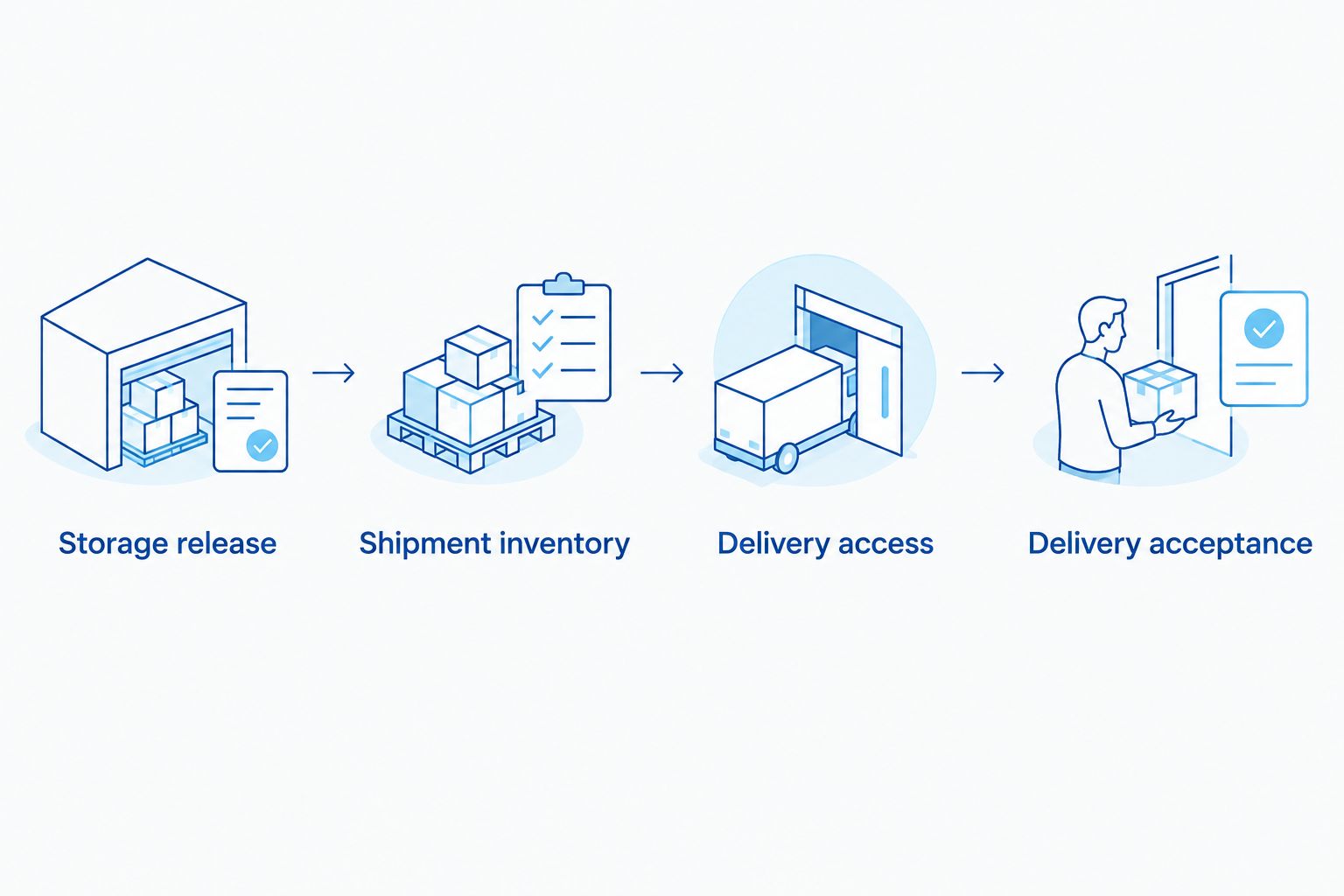
A completed move plan is not a promise that nothing will change. It is a record that tells each person what to verify when something does.
Partial retrieval when only some belongings leave storage
Partial retrieval needs a different release list, not a shorter version of an empty-unit move. Identify what stays just as clearly as what leaves.
| Workflow | Best for | Advantage | Trade-off |
|---|---|---|---|
| Full retrieval | Moving all stored belongings to the destination | One release list covers the entire intended shipment | Everything must have a destination or an agreed handling plan |
| Partial retrieval | Delivering selected belongings while retaining storage | Keeps the delivery focused on current needs | Selected items must be identifiable and accessible without confusing the retained inventory |
For a partial retrieval, send the item-level selection before pickup. Ask whether the requested items are accessible and whether reaching them requires moving other contents. Agree on that work before arrival.
At pickup, reconcile the Deliver and Remain lists separately. Photograph the retained arrangement where permitted, confirm that the unit is secured, and record who is responsible for any further access.
If the delivery selection changes, update the master inventory and obtain fresh confirmation from the people handling release and receipt. Do not treat a message sent to one person as approval from everyone involved.
Troubleshooting storage-to-delivery handoffs
The gate opens, but the crew cannot retrieve the contents
Contact the facility's authorized release contact and confirm what approval is missing. A driver should not have to resolve account-holder authority at the gate. Keep retrieval on hold until the facility confirms permission.
The selected item is behind belongings staying in storage
Stop and confirm the additional handling scope with the moving coordinator. Update the partial-retrieval instructions before rearranging the unit, then reconcile the retained contents after the selected item is removed.
Building management has not accepted the paperwork
Ask management to identify the exact missing or incorrect information and send that requirement to the mover. Keep the delivery arrangement unconfirmed until management accepts the corrected documents; sending paperwork is not the same as receiving approval.
The destination loses its delivery window
Notify the moving coordinator and storage contact immediately. Confirm a revised sequence before dispatch or, if the shipment is already in transit, agree on the next instruction directly with the mover. Do not assume another building entrance solves the restriction.
The delivered shipment does not match the release list
Compare the current master inventory with the pickup exceptions and delivery record. Identify the specific item or container, document the discrepancy, and use the mover's reporting procedure. Avoid replacing the original record with an edited version that hides the change.
Customize your workflow
For a 2026 household move, add room placement and essential-item instructions. For an office move, add the person authorized to accept business equipment and identify any rooms that must remain restricted during unloading.
CroMont Moving & Storage offers full packing, white-glove service, hourly moving, and storage. Discuss the work your shipment needs, then record the agreed scope alongside the inventory; a service category does not define every task included in your particular move.
Keep the scope boundary explicit: who packs, who unlocks, who authorizes release, who directs placement, and who checks completion. Additional services still require coordination with the storage operator and destination management.
Plan your storage-to-delivery move
Discuss pickup access, packing needs, storage, and destination requirements.
FAQ
How do I arrange storage unit access on moving day?
Confirm retrieval authorization, the access window, the loading route, and the person responsible for entry before dispatch. Share those confirmed instructions with the moving coordinator and pickup representative.
Do I need to be at the storage unit when movers arrive?
Your attendance depends on the storage operator's release requirements and the pickup arrangement. Ask whether an authorized representative can attend and complete any required authorization before moving day.
Can movers collect my belongings using only a gate code?
A gate code alone does not establish permission to remove belongings. Confirm account-holder authorization, unit access, and any staff attendance requirements separately.
Can I move only part of my storage unit?
Plan partial retrieval with separate lists for belongings leaving and remaining in storage. Confirm that selected items are accessible and agree on any rearranging work before pickup.
What should I confirm before the truck leaves storage?
Confirm the released inventory and destination readiness before departure. The receiving contact should verify entry, the unloading route, and any reserved delivery window.
What if my building requires a certificate of insurance?
Obtain the building's exact requirements and send them to your mover. Confirm that management accepts the documentation before treating delivery access as approved.
Does CroMont Moving & Storage offer moving and storage services?
CroMont Moving & Storage offers moving and storage services for homeowners and businesses in New York, New Jersey, and Connecticut. Discuss retrieval access, handling needs, and delivery requirements when defining your move.
One last thing
For your 2026 move, record the release condition beside every appointment. “Pickup confirmed” is incomplete without knowing who opens the unit and who authorizes removal. “Delivery confirmed” needs the same discipline: a receiving person, approved access, and a place for the shipment to go.