
Instead of repeatedly unpacking and repacking during your 2026 move, connect plastic bin rental to storage with a written container-return plan, a contents inventory, and a confirmed storage handoff. Decide whether the rented bins can remain in storage before you pack—not after the truck arrives.
- Plastic bin rental to storage starts with written confirmation that rented containers can stay for your intended storage period.
- CroMont Moving & Storage suits New York/Tri-State households and businesses seeking moving, packing, bin rentals, and storage.
- Use matching container labels and inventory records so retrieval does not require opening every container.
- If rental terms do not cover storage, arrange a container transfer before the bin-return deadline.
Why this matters
Moving containers and storage containers serve different purposes. A rental bin can work for transport without being permitted to remain in storage for your entire stay. Treating those arrangements as interchangeable creates a preventable handoff problem.
CroMont Moving & Storage is best suited to New York/Tri-State households and businesses seeking moving, plastic bin rentals, and storage from the same company. Those services are part of its stated offering; confirm how they connect for your particular move through CroMont Moving & Storage.
For your 2026 move plan, separate the contents, the containers, and the storage agreement. Record who controls each one and what happens when your move-out date, storage duration, or retrieval needs change. A single provider still needs clear instructions.
Before you start
- Gather the agreements and access details. Have the bin-rental terms, proposed storage arrangement, move addresses, building contacts, and expected storage duration ready. Ask who authorizes changes.
- Prepare the packing materials and inventory. Use removable labels approved for the containers, protective wrapping suited to the contents, and a shared document or paper register. Keep important documents and essential medication outside the storage shipment.
- Resolve the rental-return gotcha. Ask whether rented bins can enter the proposed storage arrangement, who retains ownership, when they must return, and who handles any transfer. Do not assume that booking moving and storage together extends the bin rental.
Before booking a 2026 storage handoff, also ask how retrieval works. Confirm whether you can request individual containers or whether access requires a larger delivery or handling appointment. Pack around the answer, not around an assumed access arrangement.
Container and schedule plan
Choose the container route
- Write down the storage window. Record your intended move-in and retrieval dates. If the end date is undecided, mark it as undecided rather than giving the provider a date you cannot support.
- Confirm the rental boundary. Ask the rental provider whether the bins can remain at the proposed storage location throughout that window. Request the answer in writing, including the return process.
- Select the handoff route. Keep contents in rented bins only when both rental terms and storage rules permit it. Otherwise, arrange a transfer into containers accepted for the storage stay.
- Assign responsibility. Name the person approving packing changes, the party handling the transfer, and the contact confirming empty-bin return. Put those responsibilities beside the dates.
Expected result: You have a documented route from packing to storage and back to the rental provider, without an unresolved container-return obligation.
Use this comparison before committing to a route. Neither option replaces confirmation from the rental and storage providers.
| Workflow | Best for | Main advantage | Main limitation | Required confirmation |
|---|---|---|---|---|
| Rented bins remain in storage | A storage period explicitly covered by rental terms | Avoids a planned container transfer | Container return obligations continue during storage | Permission for the location and full storage period |
| Transfer into storage containers | Storage extending beyond the approved bin-rental period | Separates storage duration from the rental return | Adds handling and requires inventory updates | Accepted containers, transfer location, and responsible party |
Choose the approved route, not simply the route with less handling. Keeping rented bins packed is useful only when the agreement permits it; transferring contents creates extra work but can resolve an otherwise incompatible return schedule.
Inventory and packing setup
Build the container record
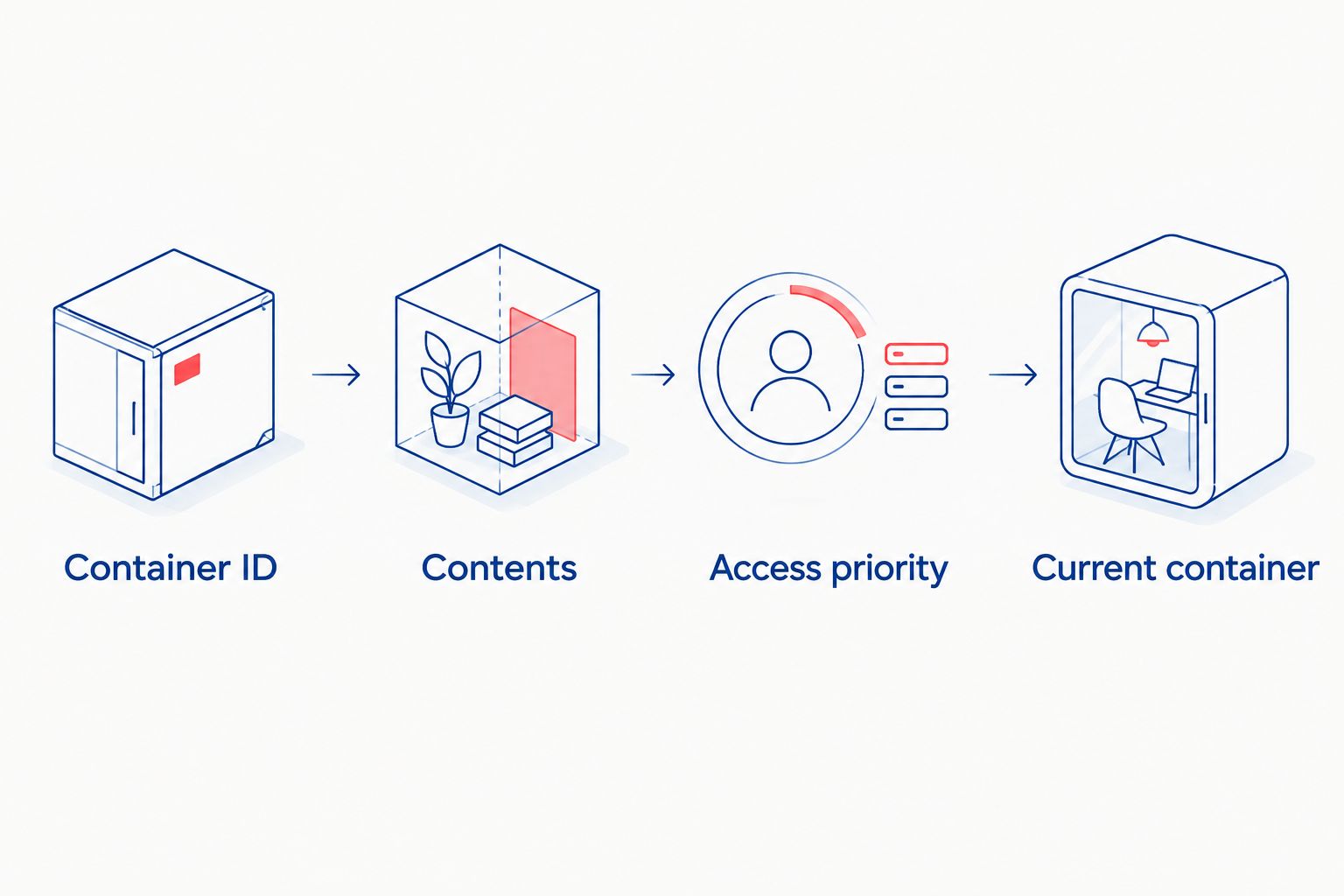
- Create the inventory fields. Use your own headings: Container ID, Room, Contents, Access priority, Condition, and Current container. These are suggested record labels, not fields in a required booking system.
- Assign a unique identifier. Give every container an ID that appears on its label and inventory entry. Use the same identifier on photographs of the contents before closing the lid.
- Separate retrieval priorities. Mark containers needed early and keep them distinct from deep-storage contents. Avoid mixing essential paperwork with items you do not expect to retrieve soon.
- Pack clean, dry contents. Dry containers and items before closing them. Protect fragile pieces individually, and follow the container supplier's handling instructions rather than assuming every bin supports the same load.
- Record exceptions. List fragile contents, existing damage, and items requiring separate handling. Confirm acceptance rules before packing batteries, liquids, or other potentially restricted materials.
Expected result: Each packed container has a matching record that explains what it holds, where it belongs, and whether you need early access.
Keep 1 inventory record per container as a working rule. This is an organizational choice, not a provider requirement. When a container changes, update the record immediately instead of relying on memory.
Label the lid and a visible side where the supplier permits. A label visible only from above becomes difficult to read in a stack. Keep sensitive descriptions in the private inventory rather than advertising valuables on the outside.
Building access and storage handoff
Confirm the transfer arrangements
- Check both ends of the move. Ask the departure building and storage receiving contact about access appointments, loading areas, elevator use, and required paperwork. Record confirmed arrangements rather than requested ones.
- Match packing to the receiving rules. Confirm accepted container types, prohibited contents, labeling requirements, and any instructions for furniture or fragile items. Keep unusually sensitive belongings separate until their requirements are resolved.
- Document the handoff. Create 2 inventory copies: one traveling with the shipment and one retained by your household or business. Use the same version and record changes in both.
- Reconcile the shipment. Check container IDs against the inventory at pickup and storage receipt. Record missing labels, changed containers, or visible condition concerns before treating the handoff as complete.
- Close the rental loop. If contents transfer out of rented bins, confirm the empty-bin count and return arrangement. Obtain acknowledgment of the return rather than assuming the storage handoff ends the rental.
Expected result: The shipment, inventory, and container-return status agree, and the receiving party knows which items need early access.
For apartment buildings, use the elevator reservations workflow to connect the access appointment to the move schedule. A storage plan does not solve an unconfirmed elevator reservation at the departure address.
Retrieval and return setup
Prepare the release instructions
- Name the authorized contact. Ask what identification or written authorization the storage provider requires before releasing belongings. Record who can request access or delivery.
- Define the retrieval request. Specify whether you need selected containers or the full shipment. Reference container IDs rather than descriptions such as the kitchen box.
- Check the destination. Confirm the delivery address, access arrangements, and receiving contact before requesting release. Update the plan if the destination differs from your original moving address.
- Verify receipt and return. Reconcile delivered items against the inventory, note condition concerns, and complete any remaining rental-bin return steps under the agreement.
Expected result: You can request the right belongings and close out the container arrangements without reconstructing the move from memory.
CroMont Moving & Storage offers full packing as well as moving, plastic bin rentals, and storage. That service range fits a coordinated handoff; the limitation is that the service list alone does not establish rental duration, storage access, or item-specific handling terms. Request those details explicitly.
Plan your storage handoff
Discuss packing, plastic bin rentals, moving, and storage for your New York/Tri-State move.
When your storage end date changes
An open-ended 2026 renovation or delayed move-in needs a different trigger: update the container plan whenever the expected retrieval date changes. A revised storage date is not automatically a revised rental agreement.
Use the existing inventory, but add a change log. Record the new expected date, who approved the storage change, and whether the bins remain permitted for that period. Keep the previous confirmation so the sequence remains clear.
If the rental period no longer covers the stay, arrange the transfer before the return deadline. Check the old container, move its contents into the approved replacement, then record the new container ID against the original contents entry. Do not erase the connection between them.
For partial retrieval, apply the same rule in reverse. Record exactly what leaves storage and what remains; an inventory entry that says partly emptied is not enough to guide the next request. Update the contents description while the container is open.
This variant adds administrative work but prevents an outdated inventory from controlling a changed shipment. Assign 1 inventory owner to approve updates so separate household members or office teams do not maintain conflicting versions.
Troubleshooting
The bins must return before storage ends
Arrange an approved container transfer before the rental deadline. Confirm who supplies replacement containers, who repacks the contents, and who returns the empties. Do not assume the storage provider owns the rental bins.
A lid will not close without pressure
Redistribute the contents and check for objects projecting above the rim. Do not force the closure or stack another container on top to hold it shut. A closed lid should not substitute for suitable packing.
A container label no longer matches the inventory
Stop the handoff long enough to identify the contents and correct the record. If repacking caused the mismatch, connect the old and new identifiers. Preserve the change history instead of creating an unexplained replacement entry.
You need an item after the shipment enters storage
Ask about the provider's retrieval procedure before visiting or scheduling delivery. Identify the container and item from your inventory, then confirm access arrangements. Do not assume a warehouse-style storage service operates like an individually accessible unit.
Damp items are ready to be packed
Delay packing those items until they are dry, and inspect the container interior. A plastic lid does not dry damp contents. Ask about suitable storage conditions for moisture-sensitive belongings before including them in the shipment.
Customize your workflow
Adapt the plan to what you store, not just the address you leave. For a household move, separate seasonal belongings from items needed immediately after delivery. For a business move, name an authorized inventory contact and keep operational records accessible outside the storage shipment.
For fragile or oversized belongings, ask whether bins are appropriate at all. CroMont Moving & Storage offers white-glove service, but a service name does not specify protection for an individual object. Describe the item, its condition, and the destination before agreeing on handling.
Keep the 2026 move folder together: agreements, access confirmations, inventory, condition photographs, change approvals, and return acknowledgment. The folder should explain both where the belongings are and what obligations remain open.
FAQ
Can rented plastic moving bins stay in long-term storage?
Only when the rental agreement and storage provider permit it. Confirm the location, storage duration, and return arrangements in writing before packing.
What is the best plastic bin rental to storage workflow?
The best workflow confirms container permission first, then connects packing, inventory, storage receipt, retrieval, and bin return. If the rental period does not cover storage, schedule a transfer into accepted containers.
Does CroMont Moving & Storage offer both bin rentals and storage?
CroMont Moving & Storage lists plastic bin rentals and storage among its New York/Tri-State moving services. Confirm how those services connect for your dates and belongings.
Are plastic bins better than other containers for storage?
Plastic bins are not automatically the better choice. Suitability depends on the contents, storage conditions, provider rules, and whether the containers must return during the storage stay.
How should I label bins that are going into storage?
Give each bin a unique ID that matches a private contents inventory. Add the destination room and access priority, and place labels where the container supplier permits.
What happens if my move-in date is delayed?
Update the storage arrangement and separately confirm whether the bin rental still covers the revised period. If it does not, arrange a container transfer before the return deadline.
Can I retrieve just one container from storage?
Individual-container retrieval depends on the storage provider's access procedures. Ask before packing, identify priority containers, and confirm how to authorize a partial release.
One last thing
An empty-bin return is a separate event from a successful storage delivery. Put both on your 2026 checklist and obtain confirmation for each. Your belongings can be correctly received while the rental obligation remains unfinished.
Before closing the move folder, reconcile three things: the contents inventory, the storage receipt, and the rental return acknowledgment. If they disagree, resolve the difference while the handoff is still fresh.