
Instead of chasing elevator approvals while your moving crew waits, handle your nyc elevator reservation for movers through a written workflow: collect building rules, secure both access windows, clear paperwork, and confirm the moving-day handoff. For your 2026 move, treat a requested slot as unconfirmed until building management approves it.
- An nyc elevator reservation for movers needs written building approval, not just a submitted request.
- Confirm elevator access and insurance paperwork separately at both addresses before moving day.
- Cromontmoving offers moving services for New York and Tri-State homeowners and businesses.
- Keep elevator windows, loading instructions, and building contacts in one shared move record.
Why this matters
An elevator booking connects your apartment, building staff, loading entrance, and moving crew. An approved departure slot does not establish permission to unload at your destination. Each building controls its own access.
Cromontmoving moving services are best for New York and Tri-State homeowners and businesses seeking residential or commercial moving and storage. Review Cromontmoving while defining your move scope, then confirm the building arrangements separately. Hiring a mover does not replace building approval.
For a 2026 move, build the schedule around confirmed access rather than a preferred truck arrival time. The practical benefit is clear: everyone works from the same instructions. The trade-off is administrative work before moving day, including separate checks with both buildings.
Before you start
- Gather building access information. Obtain the move instructions and management contact for your current and destination addresses. Ask who approves reservations, which entrance movers must use, and whether either building requires an attendant or protective materials.
- Prepare your move details. Have your proposed date, addresses, apartment or suite identifiers, inventory, and mover contact ready. Include oversized items and any packing or disassembly work that affects the schedule. Keep photographs and measurements with the inventory.
- Separate paperwork from access approval. A certificate of insurance, or COI, is evidence of insurance; it is not an elevator reservation. Ask whether management must accept the paperwork before confirming access. Also distinguish the building's insurance instructions from the mover's separate explanation of shipment protection.
Use 1 shared move record for 2 buildings and 3 checkpoints: reservation approval, paperwork acceptance, and moving-day access. These are organizational targets, not building requirements. Email works for this workflow; if management requires a portal, follow that building's actual field names and submission instructions.
Building requirements
- Request the current move instructions. Ask management for the rules applying to your specific 2026 move date. Request permitted moving hours, elevator booking procedures, submission deadlines, loading instructions, and any required documents. Do not substitute a neighbor's previous experience for current written instructions.
- Identify the approval owner. Record the person or team that can authorize the move. Establish who receives paperwork and who releases the elevator on moving day. Those responsibilities do not necessarily belong to the same person.
- Document the physical route. Ask which doorway, corridor, elevator, and loading location the crew must use. Measure large furniture against the narrowest usable opening, not just the elevator interior. Include turns and door clearances in the access discussion.
- Record restrictions without interpreting them. Copy management's instructions into the shared record. If a rule is unclear, request clarification before asking the mover to plan around it.
Expected result: Each address has its own requirements, approval contact, access route, and paperwork instructions. Unknown items remain open questions, not assumptions.
If your move involves a tall residential building, the Manhattan high-rise moving guide provides a related planning topic. Keep your own building's instructions as the authority for access.
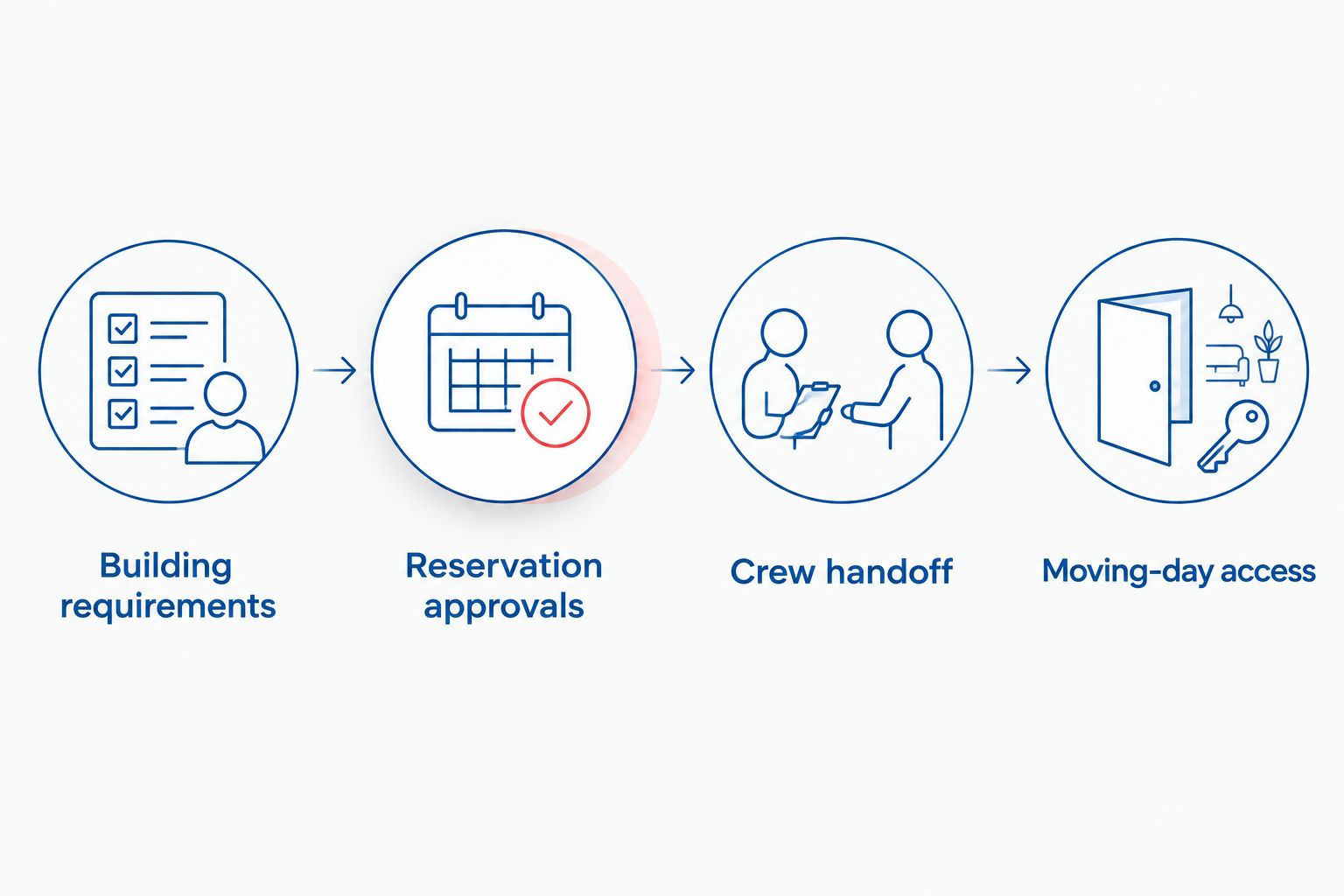
Reservation approvals
- Request departure access first. Submit the proposed move date and requested elevator window using management's required channel. Include the apartment identifier, mover contact, and access details management requests. Ask for written confirmation rather than treating submission as approval.
- Match destination access to the move sequence. Share the departure window with the mover and destination manager. Account for loading, travel, unloading, and building procedures. Let the mover assess the work involved; do not schedule arrival by adding travel time alone.
- Resolve insurance instructions. Send the building's exact COI requirements to the mover's designated contact. Have the appropriate insurance representative address required wording. Do not edit insurance documents yourself or assume acceptance at one building covers another.
- Close the approval loop. Ask each manager to confirm the approved date, elevator start and end times, paperwork acceptance, and conditions still outstanding. Save the replies with the move record.
Expected result: Both buildings have explicitly approved their respective access windows, and any outstanding conditions have a named owner.
For your 2026 planning record, use descriptive email headings such as Move date, Elevator window, Access entrance, Paperwork status, and Approval contact. These are suggested headings for your message, not claimed labels in a building's booking system.
Do not mark the move ready while either building's approval remains unresolved. A requested window and an approved window are different scheduling states.
Crew handoff
- Consolidate the approved instructions. Send the mover a concise access summary covering both addresses. Attach the written confirmations and identify which instructions apply to departure and arrival. Keep the main message readable without opening every attachment.
- Flag work that affects elevator use. List packing still required, furniture disassembly, fragile items, and pieces needing an access assessment. State the work instead of describing the inventory as simply a small or easy move.
- Assign communication responsibilities. Identify who speaks with the crew, who reaches building management, and who stays available at the destination. Give each person the relevant contact details rather than relying on a chain of forwarded messages.
- Resolve conflicts before dispatch. Compare the crew's planned arrival with the approved access window. Ask how the team will handle a building check-in, entrance restrictions, and the end of the reservation. Confirm any revised plan with management.
Expected result: The mover has a usable operating brief, and the person meeting the crew knows what management approved.
For unusually difficult items, include the access assessment in your planning rather than leaving it to the loading entrance. The piano and specialty-item moving guide is a relevant next read when a single item determines the route.
The written handoff is the advantage; document drift is the weakness. Replace outdated versions and make the approved record easy to identify.
Moving-day access
- Check in with the building contact. Before unloading equipment, confirm that the approved entrance and elevator are ready. Ask building staff to identify any required protection or attendant arrangements. Do not treat an open service door as authorization.
- Walk the approved route. Compare the actual path with the plan. Note existing marks or obstructions through the building's accepted process, and keep common areas clear. Escalate a blocked route before carrying furniture into it.
- Monitor the reservation boundary. Keep the crew lead aware of the approved end time. If work is falling behind, contact management while there is still time to discuss an authorized adjustment. Do not assume continued elevator use is permitted.
- Close access at each address. Follow the building's completion procedure, remove packing debris from the approved route, and confirm any required handback with staff. Keep records of an incident or changed instruction with the move documents.
Expected result: The crew uses the authorized route, changes receive approval, and building access is closed out deliberately.
In 2026, a saved approval message still needs a moving-day check. Physical access can differ from the plan because an entrance is blocked or an elevator is out of service. The response is to contact management, not improvise a different route without permission.
When your move date or destination changes
A changed date needs a new approval check. Reply to the existing management correspondence, identify the old and proposed arrangements, and ask whether the previous approval remains valid. Repeat that check at both addresses.
For a storage-first move, separate collection from final delivery. Cromontmoving offers moving and storage services, but confirm the arrangements for your particular move directly. Do not keep a destination reservation active merely because it was part of the original plan.
| Workflow | Best for | Advantage | Limitation |
|---|---|---|---|
| Direct building-to-building move | Moves with confirmed access at both addresses | Keeps departure and arrival in one coordinated plan | Depends on compatible access windows |
| Storage-first move | Moves with a gap before destination access | Separates collection from final delivery | Requires another delivery plan and destination approval |
Choose the workflow that matches confirmed access, not the workflow that looks simpler on paper. Storage changes the sequence; it does not remove the destination building's requirements.
After any change, circulate one updated record and clearly identify the superseded instructions. Ask the mover and building contacts to acknowledge changes affecting their responsibilities.
Troubleshooting
The request was submitted, but nobody confirmed it
Contact the actual approval owner and ask whether the slot is approved, pending, or declined. Include the original submission and proposed access window. Keep the reservation marked pending until an authorized building contact confirms it.
Management rejected the insurance paperwork
Ask management to identify the exact mismatch, then forward that explanation to the mover's designated insurance contact. Keep the required wording attached to the request. Editing a certificate yourself is not the fix, and resending an unchanged document does not resolve the objection.
The elevator windows do not fit the move sequence
Give the mover both approved windows and ask for a scheduling assessment. Then request an adjustment from the relevant building. If the sequence still cannot work, discuss a different date or storage-first arrangement rather than assuming the crew can make up the gap.
Furniture does not fit the approved route
Stop and verify the measurements, door clearance, and turning space. Discuss disassembly or another authorized handling plan with the mover. Ask management before changing the route; a passenger elevator or alternate entrance is not automatically permitted for moving.
The elevator or loading entrance is unavailable
Contact building management and the crew lead before moving items into common areas. Ask management for an authorized alternative or revised access window. Record the instruction and share it with everyone affected. Do not use an emergency exit as an improvised loading route.
Customize your workflow
Adapt the same approval sequence to the work being moved. For a residential move, organize the inventory around rooms and oversized pieces. For an office move, identify equipment, shared areas, and the person authorized to approve access changes.
Use the following additions where they apply:
- Packing handoff: Tell the mover what will already be packed and what remains part of the moving scope. Keep paperwork and personal essentials separate from the shipment.
- Special handling: Identify fragile or unusually shaped items before the access assessment. Photographs support the discussion but do not replace measurements.
- Destination readiness: Confirm that the receiving contact can admit the crew and direct placement. Elevator access does not establish that the premises are ready.
Cromontmoving provides full packing, white-glove service, plastic bin rentals, and storage alongside moving services. Specify the services you need when discussing the scope; do not infer that every service is included in every move.
Plan your building access
Discuss your move scope, building instructions, and access windows before moving day.
FAQ
How do I arrange an NYC elevator reservation for movers?
Request the building's current moving instructions, submit your proposed access window, and obtain written approval from the authorized contact. Repeat the process at the destination and coordinate both windows with your mover.
Does a certificate of insurance reserve the elevator?
No. A certificate of insurance documents insurance information; elevator access requires separate building approval. Confirm both paperwork acceptance and the reservation status.
How far ahead should I book a moving elevator in 2026?
Use the deadline set by each building's management for your 2026 move. Request the instructions before fixing the moving schedule so the reservation and paperwork process can be completed.
Can my movers reserve the elevator for me?
Ask management who is authorized to submit the reservation and ask your mover what coordination the moving scope includes. Do not assume that booking a moving company also books building access.
What if my movers need longer than the elevator reservation?
Request an authorized extension or revised plan from building management. Tell the crew lead about the approved boundary before work starts, and escalate a timing conflict before the window ends.
Do I need reservations at both buildings?
Check the moving-access requirements at both buildings independently. An approval at your departure address does not authorize elevator use at your destination.
What happens if I move into storage first?
Plan collection and final delivery as separate access events. Confirm departure access for collection, then arrange destination access for the later delivery date.
One last thing
The elevator's interior dimensions are not the same as usable furniture clearance. A piece can fit inside the cab and still fail at the doorway or corridor turn. Measure the complete route before approving the handling plan.
Keep that principle in your 2026 move record: approval establishes permission; measurements establish fit. You need both before the first large item leaves the apartment.