
Commercial office moving costs in NYC require a written quote tied to your inventory, building access, schedule, and service scope—not a universal office-size average. For your 2026 budget, separate the physical move from packing, storage, building requirements, and business downtime so the quoted total matches the work you need.
- How much does commercial office moving cost in NYC? Get an inventory-based quote, not a headcount-based guess.
- Cromontmoving offers commercial moving, packing, plastic bin rentals, and storage; confirm each service in your written scope.
- Compare office relocation estimates against identical inventories, building restrictions, packing responsibilities, and delivery requirements.
- Keep business downtime separate from the mover’s charges so your relocation budget covers both.
Why this matters
An office relocation estimate is useful only when you can see what it covers. A proposal for transporting packed furniture does not describe the same job as a proposal that includes packing, storage, and placement at the destination.
Cromontmoving offers commercial moving alongside packing, plastic bin rentals, and storage. Cromontmoving is a fit for NYC businesses seeking commercial moving with packing or storage services. Confirm the exact combination in your proposal; the service list alone does not establish your moving scope.
For a 2026 office relocation, your first decision is not which estimate has the smallest total. It is which estimate describes the actual job. Once the scope matches, you can compare terms without confusing omitted work with savings.
How much does commercial office moving cost in NYC?
The cost is the total in a written estimate for your specific office move. Start with an itemized scope, then ask the mover to explain the charging method, exclusions, and conditions that change the total.
Office headcount is not a complete inventory. A workplace with shared desks and little storage presents a different moving task from an office with filing cabinets, conference furniture, equipment, and archived records. Document the contents rather than asking a mover to infer them from employee numbers.
Use this breakdown to organize your 2026 quote request. Treat every row as a question to resolve, not an automatic charge or an assumed inclusion.
| Budget component | What to document | What to confirm in writing |
|---|---|---|
| Moving labor and transport | Furniture, packed contents, equipment, origin, destination | Loading, transport, unloading, and placement responsibilities |
| Packing and materials | Items requiring packing and who packs them | Materials, packing labor, unpacking, and material removal |
| Furniture handling | Items requiring disassembly or reassembly | Which items the mover handles and any exclusions |
| Building access | Loading areas, elevators, stairs, permitted working windows | Access assumptions and treatment of waiting time |
| Storage | Items held between locations and delivery requirements | Handling, storage terms, access, and later delivery |
| Business continuity | Staff responsibilities and systems restart plan | Tasks outside the mover’s agreed scope |
Keep the mover’s estimate separate from your internal relocation budget. Employee packing time, technology work, and interrupted operations belong in your planning even when the moving company does not perform those tasks.
Ask how the estimate changes
Before approving a proposal, ask what happens if your inventory changes, access differs from the survey, or delivery cannot proceed as scheduled. Get the approval process for additional work in writing.
Do not treat a verbal assurance as a substitute for the contract. Your purchasing decision should rest on the documented scope, charging terms, and responsibilities—not on an informal description of what is usually included.
Choose the service scope before comparing estimates
Packing and storage change the work you are asking a mover to perform. Choose the scope first; compare proposals second. Otherwise, you are comparing different assignments under the same office-moving label.
| Scope option | Best for | Main advantage | Main limitation |
|---|---|---|---|
| Staff packing with professional transport | Offices able to assign packing responsibility internally | Your team controls sorting and packing decisions | Employees must complete packing around their normal work |
| Professional packing and moving | Offices seeking outside packing support | Packing becomes an assigned service rather than an internal task | You still need to identify sensitive, excluded, and priority items |
| Moving with interim storage | Offices whose departure and arrival dates do not align | Contents can be held before final delivery | Storage adds handling and delivery decisions to the scope |
Staff packing with professional transport
Best for: offices with a clear internal packing owner. Staff can identify what belongs to each department and decide what should not move. The limitation is responsibility: someone must distribute instructions, check completion, and resolve unlabelled contents before loading begins.
Ask the mover how employee-packed items must be prepared. Confirm who handles monitors, shared equipment, loose cables, and furniture contents. Do not assume that packing a desk drawer means the desk itself is ready for transport.
Professional packing and moving
Best for: offices that want packing assigned to the moving scope. Professional packing creates a defined service task, but it does not replace your decisions about confidential records, equipment ownership, or disposal.
Cromontmoving offers full packing and commercial moving. Confirm which office contents your proposal covers, what staff must prepare beforehand, and whether unpacking or material removal is included. Those details determine what work remains with your team.
Moving with interim storage
Best for: offices with a gap between departure and delivery. Storage addresses a timing mismatch, but it also introduces questions about access, inventory tracking, and final delivery.
Separate items needed immediately from items that can remain stored. Before approving storage, establish who requests release, what delivery preparation is required, and how the later move into the office is documented.
Why commercial office moving costs vary
The useful question is not whether one office is bigger than another. It is what work, access, and timing each job requires. Give every bidder the same information about these factors:
- Inventory and handling. List desks, tables, seating, cabinets, packed contents, and equipment. Identify furniture that needs disassembly and objects requiring separate handling instructions.
- Packing responsibility. State whether employees or movers pack each category. Distinguish supplying containers from packing their contents, and packing from unpacking.
- Building access. Record the loading route, elevator arrangements, stairs, and permitted moving hours at both addresses. Ask how the proposal treats access that differs from the agreed plan.
- Schedule and sequencing. Identify whether the office moves together or by department. Document any requested work outside the building’s normal access window rather than assuming it is permitted.
- Storage and delivery. Identify which contents travel directly and which require storage. Ask for the handling and later delivery scope rather than treating storage as an isolated service.
- Origin and destination. Give complete addresses and the relevant access details for each. A route description without building information leaves part of the moving task undefined.
For your 2026 comparison, attach the same inventory and access notes to every quote request. When a detail changes, send the update to every bidder before choosing a proposal.
How to get a comparable office-moving quote
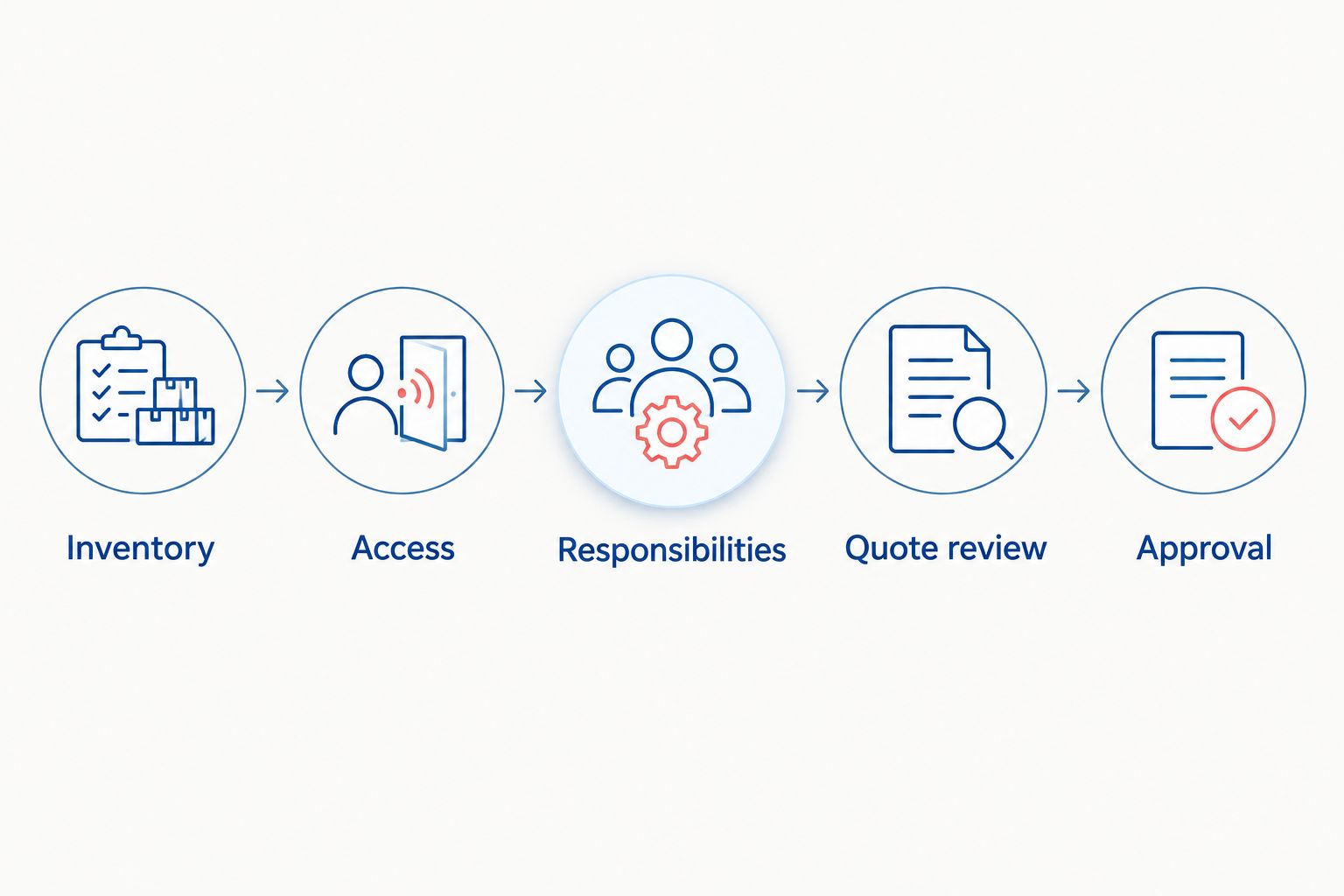
A usable estimate starts with a shared description of the job. Follow this sequence before asking your team to approve a mover.
1. Inventory
Create a room-by-room list of everything that will move. Mark items as move, retain, dispose, or review, and resolve the review category before the final scope is approved.
Photograph furniture and equipment where images clarify size, condition, or access. Photos support the inventory; they do not replace a written list. Assign an internal owner who can answer questions about each department’s contents.
2. Access
Request moving instructions from both buildings. Confirm loading arrangements, elevator reservations, protection requirements, permitted hours, and insurance documentation with the relevant building contact.
Use the elevator reservations to moving-day workflow to organize the access handoff. Ask the mover to acknowledge the building instructions before you approve the schedule.
3. Responsibilities
Write down who packs, labels, disconnects, reconnects, and approves placement. Separate moving furniture and equipment from making technology operational at the destination.
Do not leave shared tasks assigned to everyone. Name the internal contact who releases the old office and the contact who accepts delivery. If these are different people, give both the same scope and destination plan.
4. Quote review
Read each proposal against your inventory and responsibility list. Ask for clarification wherever the proposal uses a broad phrase without describing the work behind it.
Check the charging method, exclusions, schedule assumptions, payment terms, and process for approving changes. Record answers in the revised proposal or another written document incorporated into the agreement.
5. Approval
Approve the scope and the operating plan together. Confirm that building access, packing completion, and destination readiness support the proposed moving schedule.
Keep the approved documents available to the people managing departure and delivery. A detailed estimate cannot guide moving day if the on-site contacts are working from an older inventory.
How do you compare office-moving estimates without missing exclusions?
Compare matching scopes, not isolated totals. Put the proposals beside your inventory and mark each task as included, excluded, or unresolved. Send unresolved items back to the mover before selecting a proposal.
Pay particular attention to handoffs. Who empties cabinets? Who prepares equipment? Who tells the crew where furniture belongs? These questions define responsibility even when they do not appear as separate line items.
A practical 2026 approval checklist is short:
- The proposal identifies the correct addresses and moving contents.
- Both buildings’ access instructions are acknowledged.
- Packing and furniture-handling responsibilities are explicit.
- Storage and later delivery are addressed when required.
- Exclusions and change-approval terms are understandable.
- Your internal team owns every task outside the moving scope.
Do not reject a proposal simply because it identifies exclusions. Clear exclusions tell you what to arrange elsewhere. An unanswered question is more difficult to plan around than a documented responsibility.
Does office size determine the moving quote?
Office size alone does not describe the moving work. Floor area tells a mover about the space, but it does not identify the contents, packing requirements, access route, or delivery sequence.
Use floor area as supporting context, not as a replacement for inventory. An empty meeting area and a records room occupy space differently. Give the mover the information needed to assess what must actually leave the building.
Should you move everything at once or in phases?
Choose the sequence around your operating requirements and building permissions. A single coordinated move concentrates preparation and delivery into one plan. A phased move separates departments or functions, but requires clear tracking of what leaves and arrives in each phase.
Ask for a written scope for the sequence you intend to use. Do not assume an estimate prepared for one coordinated move also covers separate collections or deliveries. Resolve that distinction before scheduling staff or building access.
FAQ
How much does commercial office moving cost in NYC in 2026?
Commercial office moving costs in NYC require a written estimate based on inventory, access, schedule, and service scope. Ask for packing, storage, exclusions, and change terms to be identified rather than relying on an office-size average.
What should an NYC office-moving quote include?
An NYC office-moving quote should identify the contents, addresses, agreed services, charging method, and exclusions. Confirm packing responsibilities, building access assumptions, and the process for approving additional work.
Is packing included in commercial office moving?
Packing is included only when your written scope includes it. Confirm materials, packing labor, unpacking, and material removal separately so employees know what preparation remains.
Does Cromontmoving offer office moving and storage?
Cromontmoving offers commercial moving and storage, along with full packing and plastic bin rentals. Confirm the services and responsibilities included in your office-specific proposal.
Do I need building approval before booking an office move?
Confirm both buildings’ moving requirements before committing to the operating schedule. Ask the building contacts about access, elevator reservations, permitted hours, protection, and insurance documentation.
Is an hourly quote better than a fixed-scope office-moving quote?
Neither quote format replaces a clear scope. For hourly work, confirm what time and activities are billable; for a fixed-scope proposal, confirm the work covered and the terms for changes.
How can I reduce unnecessary office-moving work?
Decide what will move before finalizing the inventory. Remove unwanted contents from the moving scope and complete your assigned packing and labeling tasks before the agreed collection time.
One last thing
Write the destination plan before the first desk leaves. Label furniture and containers to match that plan, and assign someone to resolve placement questions at delivery.
Your 2026 relocation plan should explain not just what leaves the old office, but where it belongs in the new one. That turns unloading from a series of decisions into an agreed task.