
Yes—hourly moving is worth it for a studio apartment when you need help handling furniture and can have packing, access, and building arrangements ready before the crew arrives. The main caveat is billable time: confirm whether travel, waiting, packing, and furniture assembly count toward it. For a studio move in 2026, choose hourly service for a clearly defined job, not simply because your apartment is small.
- Is hourly moving worth it for a studio apartment? Yes, when packing and building access are ready.
- Cromontmoving offers hourly moving for homeowners and businesses in New York, New Jersey, and Connecticut.
- Compare written billing terms, minimum hours, and included work before choosing a local moving service.
- A small apartment does not eliminate stairs, elevator delays, furniture handling, or travel time.
Is hourly moving worth it for a studio apartment?
Hourly moving makes sense when the work is defined and you value help with carrying, loading, and unloading. It is less attractive when you cannot establish what the mover will bill or when access arrangements remain unresolved.
Use this comparison before requesting estimates. The guide to hourly moving services for small NYC apartments covers the same service category in more detail.
| Approach | Best for | Main advantage | Main drawback |
|---|---|---|---|
| Hourly moving | A prepared studio move with a defined inventory | You hire help for the agreed work and billed time | Waiting and unfinished tasks can extend billable time under the contract |
| Fixed-total moving quote | A defined move where billing predictability matters | An agreed total gives you a clearer planning figure for the stated scope | Inventory or access changes need written clarification |
| DIY moving | A manageable load with suitable transport and capable help | You control the packing and handling schedule | You take responsibility for lifting, transport, and coordination |
The right comparison is not professional movers versus free labor. Compare the complete job: who packs, who carries, who drives, what equipment is needed, and who handles building requirements.
Why this matters
A studio describes a floor plan, not the work required to empty it. A bed frame, sleeper sofa, packed kitchen, and crowded closet still need preparation and safe handling.
For your 2026 move, separate apartment size from moving complexity. A short drive does not remove the work between your front door and the vehicle, or between the vehicle and your new apartment.
Judge hourly moving by the full handling route, not the distance between addresses. That route includes stairs, hallways, entrances, loading access, and any furniture that needs disassembly.
When hourly moving is the better fit
Hourly service fits a studio move when you can describe the inventory and settle access arrangements before moving day. You do not need an empty apartment beforehand. You need a clear boundary between the work you will finish and the work the crew will perform.
Good reasons to choose it include:
- Furniture handling: You need help moving bulky pieces through doors and into transport.
- Defined packing responsibilities: Your belongings will be packed, or packing is explicitly included in the job.
- Confirmed building access: You know the permitted moving window and elevator arrangements.
- A complete route: Pickup, delivery, and any additional stop appear in the written scope.
- Clear billing terms: You understand the minimum commitment and when the clock starts and stops.
The drawback is exposure to time you have not controlled. If your building cannot confirm access, ask the mover how waiting is treated before accepting the estimate.
Choose hourly moving when you can explain the job clearly enough that another person could plan it without visiting your apartment. Photos and a written inventory make that explanation more useful.
When hourly moving is not the right choice
Do not choose hourly service solely because the quoted hourly figure looks appealing. A billing rate does not tell you the total commitment, the included work, or how the company handles delays.
Consider a different arrangement when you need a defined total for a fully specified scope. Ask how changes are documented; a fixed-total quote still needs an accurate inventory and access description.
DIY is another option when you have appropriate transport, manageable belongings, and willing helpers who can handle the load safely. Its limitation is responsibility: you must organize the equipment, driving, lifting, and building coordination yourself.
A studio with specialty belongings needs a handling discussion before a billing discussion. Describe fragile artwork, unusually heavy furniture, and anything that cannot follow the normal exit route. Do not assume a general moving estimate covers specialized handling.
Why hourly moving time varies
The following factors change the work involved in a studio move. For a 2026 estimate, disclose them before booking rather than explaining them after the crew arrives.
- Packing readiness: Loose belongings require sorting, wrapping, or boxing before they can travel. State whether packing is your responsibility or part of the service.
- Furniture preparation: Beds, tables, and other pieces need an agreed plan for disassembly, protection, and reassembly where required.
- Building access: Stairs, elevator reservations, narrow entrances, and restricted moving windows affect the handling route.
- Vehicle access: Tell the mover about loading restrictions and the route between the entrance and the intended loading location.
- Travel and stops: Provide every address, including storage or another pickup, and ask how travel enters the billing calculation.
- Waiting and scope changes: Missing keys, unavailable access, or additional belongings change the planned job. Confirm how the agreement treats them.
These are planning factors, not a reason to assume every move will run late. Your next step is to turn each relevant factor into a written instruction or a question for the mover.
How do you decide whether hourly moving is worth it?
Use this sequence before comparing estimates. It separates the work you need from the billing arrangement offered.
- List the inventory. Record furniture, packed containers, fragile belongings, and items that need disassembly. Include what is inside closets and storage areas.
- Check both addresses. Confirm stairs, elevator procedures, loading access, permitted hours, and any building paperwork at pickup and delivery.
- Divide the work. Decide who packs, protects furniture, disassembles pieces, transports belongings, and reassembles furniture.
- Check billing terms. Ask about minimum hours, billing increments, travel, waiting, materials, and the start and end of billable time.
- Confirm the scope. Send the inventory and access details, then request written confirmation of what the estimate includes.
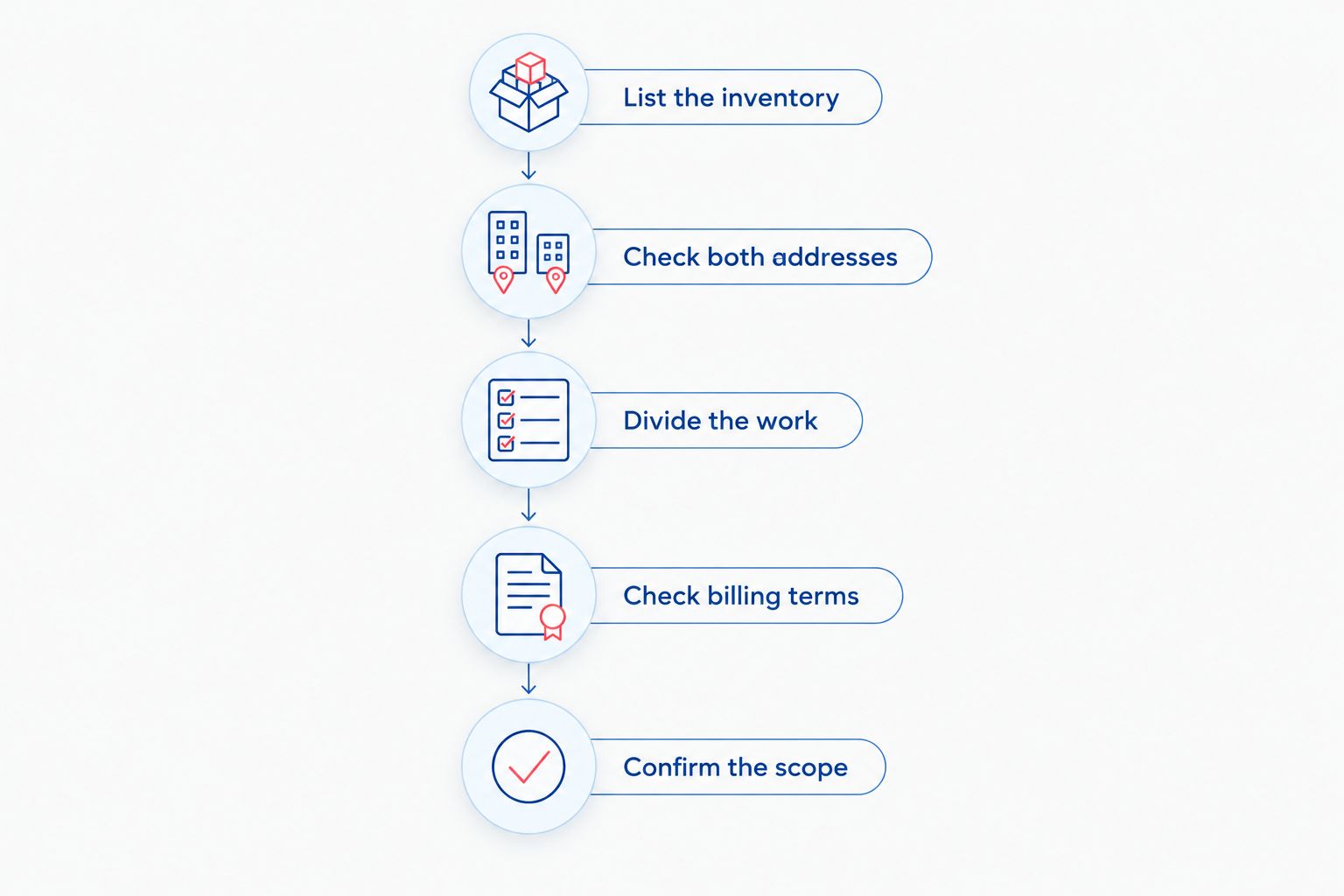
Keep the same inventory when comparing movers. If one estimate includes packing and another covers only moving packed belongings, the estimates describe different jobs.
For your 2026 booking, keep the final inventory, access instructions, and accepted terms together. Tell the mover when something changes; an outdated inventory is not a useful moving plan.
What should you ask before accepting an hourly estimate?
Ask these questions in writing. The answers establish what you are agreeing to, without relying on an assumed industry standard.
When does billable time start and stop?
Ask whether billing begins at your address or includes travel from another location. Confirm how the company records the end of the job and handles travel after unloading.
Also ask how partial hours are billed. Do not assume that a shorter job automatically means a shorter bill if the agreement contains a minimum commitment.
What work and equipment are included?
Confirm the planned crew, transport arrangement, furniture protection, and handling equipment. Ask separately about packing materials, disassembly, and reassembly so you know which tasks remain yours.
Describe the furniture rather than calling everything standard. A bed with storage drawers and a simple frame do not present an identical preparation task.
What happens if access is delayed?
Ask how the agreement treats elevator delays, loading restrictions, missing keys, or an unavailable delivery entrance. Then settle the building arrangements you control.
Keep contact details for the people responsible for access at both addresses. The crew should not have to discover who can authorize entry after arriving.
How should you prepare a studio for hourly movers?
Preparation should remove uncertainty, not create unsafe shortcuts. Leave heavy lifting and difficult disassembly to the people assigned to those tasks.
- Finish the packing you agreed to complete, including cupboards and drawers that need emptying.
- Label containers by destination area so unloading instructions stay clear.
- Set aside keys, identification, medication, chargers, and documents that should remain with you.
- Clear the route to the exit without blocking shared hallways or emergency access.
- Confirm building instructions and share them with the mover.
- Identify furniture that needs attention before it can leave the apartment.
Measure questionable doorways and furniture, and send the measurements when clearance is uncertain. A photograph helps explain the layout; it does not replace a dimension needed to check a tight fit.
Do not dismantle something solely to appear ready if you cannot safely manage the task. Instead, agree on that work in advance and keep any removed hardware with its furniture.
Where does Cromontmoving fit?
Cromontmoving hourly moving is a fit for studio residents seeking moving help in New York, New Jersey, or Connecticut. The company offers residential moving, hourly moving, packing, and storage, so you can ask about the parts of the job you need handled.
That service range does not replace a written scope. When contacting Cromontmoving, describe your inventory, both buildings, and your packing responsibilities; ask which services belong in the proposed arrangement.
For a studio move, the useful distinction is between help you need and tasks you can finish safely yourself. Keep those responsibilities explicit rather than assuming every service is included.
Can a studio move still involve substantial work?
Yes. A studio move includes the belongings and access conditions, not just the room count. Closets, kitchen contents, furniture preparation, and the route through each building all belong in the plan.
Walk through the apartment before sending your inventory. Open cupboards and check under the bed so the estimate describes the move you actually need.
Should you pack yourself before hiring hourly movers?
Yes, if packing is your agreed responsibility and you can complete it safely before arrival. Self-packing leaves the moving crew a clearer handling job, but fragile or difficult belongings still need an appropriate packing plan.
If you need packing help, request it explicitly. Do not make the crew discover that requirement when they arrive.
FAQ
Is hourly moving worth it for a studio apartment in 2026?
Yes—hourly moving is worth it for a studio apartment when the job is clearly defined and packing and access are ready. Confirm minimum hours, travel, waiting, and included tasks before booking.
Is hourly moving always better than a fixed-total quote?
No—hourly moving is not always better than a fixed-total quote. Compare the same inventory and service scope, then choose the billing arrangement that fits your need for flexibility or predictability.
Does a short move mean less billable time?
A short driving distance does not establish the total billable time. Furniture handling, access, packing responsibilities, and the company's written billing terms also matter.
Can I hire movers just to handle studio furniture?
You can request a furniture-focused moving scope. Specify the pieces, access conditions, transport needs, and any disassembly so the mover can confirm the arrangement.
What should I tell movers about my apartment building?
Tell movers about stairs, elevator procedures, moving windows, loading access, and required paperwork. Provide the same details for the delivery building.
Does Cromontmoving offer hourly moving?
Cromontmoving offers hourly moving in its New York and Tri-State service area. Ask for a written scope covering your studio inventory, building access, and required services.
Should everything be packed before hourly movers arrive?
Everything assigned to you for packing should be ready before the crew arrives. If the mover will pack any belongings, include that work in the agreed scope.
One last thing
Before your 2026 moving day, walk the complete route from your furniture to the loading location. Check the destination route too, using building instructions where you cannot visit in person.
A nearby address is not the same as an easy handling route. Give the mover the route details, then choose hourly service based on the documented job—not the studio label.