
Moving insurance is worth it for a NYC move when the loss you would have to absorb exceeds what you can comfortably replace and your existing protection leaves that loss uncovered. Before you buy coverage in 2026, distinguish a separate insurance policy from the mover’s contractual liability, then check exclusions, deductibles, and who handles a claim.
- Is moving insurance worth it for a NYC move? Yes, when existing protection leaves replacement costs you cannot absorb.
- Federal Motor Carrier Safety Administration rules distinguish interstate mover liability from separate moving insurance.
- A building’s certificate of insurance does not establish coverage for your household belongings.
- Compare written settlement terms, packing exclusions, and storage protection before choosing coverage.
Why this matters
A short trip does not tell you how much financial protection you need. The useful question is what happens if your most consequential item arrives damaged or disappears—not how many blocks the truck travels.
CroMont Moving & Storage offers local and long-distance moving, packing, and storage for homeowners and businesses. CroMont Moving & Storage is a fit for NYC homeowners seeking moving, packing, and storage from one company. Those services address the move itself; your contract and any separate policy establish the financial protection.
Is moving insurance worth it for a NYC move?
Yes, if a documented coverage gap leaves you responsible for a loss you cannot comfortably absorb. It is less useful when an existing policy already covers the same belongings, events, and moving period on acceptable terms.
For your 2026 move, compare these arrangements before treating them as interchangeable:
| Protection option | Best for | Main benefit | Main limitation |
|---|---|---|---|
| Basic or released-value mover liability, where applicable | People prepared to absorb losses beyond limited contractual liability | Establishes the mover’s responsibility under the selected terms | Weight-based liability can be disconnected from an item’s replacement value |
| Full-value or enhanced mover valuation, where offered | People seeking broader responsibility from their mover | Can provide repair, replacement, or settlement under the contract | Valuation is not a separate insurance policy; exceptions and settlement terms still apply |
| Separate moving insurance | People with a specific gap not addressed by mover liability or existing insurance | Provides protection for events and property described in the policy | Deductibles, exclusions, documentation requirements, and overlapping coverage need review |
There is no single choice that fits every NYC household. A replaceable chair and a privately owned artwork present different consequences, even when they share the same truck.
Do not select a policy because its headline limit looks reassuring. Match the covered property, covered causes of loss, and settlement method to what you actually need protected.
What protection are you actually choosing?
Mover valuation: best for defining the mover’s responsibility
Valuation describes the mover’s contractual liability for your shipment. Federal Motor Carrier Safety Administration guidance distinguishes released-value and full-value protection for interstate household-goods moves; do not automatically apply those federal choices to an entirely in-state NYC move.
The advantage is a defined claim relationship with the mover. The limitation is that responsibility depends on the governing rules, your selection, the shipment documents, and any applicable exceptions.
Ask for the actual valuation terms before signing—not just an assurance that the company is insured. Confirm whether a damaged item can be repaired, replaced, or settled through a payment, and who makes that decision.
Separate insurance: best for a documented coverage gap
A separate policy is useful when its wording addresses a risk that your other arrangements leave uncovered. That can include a particular item, covered event, or part of the moving process, depending on the policy.
Its benefit is the coverage written into that contract. Its limitation is the same: a policy does not protect every object against every event simply because it carries the label moving insurance.
Identify the insurer, the insured party, the deductible, and the claim contact. If someone describes protection verbally, request the corresponding provision in writing.
Existing home or renters insurance: best for checking overlap first
Your current insurer is the first place to check for duplicate protection. Ask specifically about belongings during packing, loading, transportation, unloading, and temporary storage.
The advantage is finding out what you already have before adding another policy. The limitation is that off-premises coverage does not, by itself, establish coverage for every moving-related loss.
Describe the actual move rather than asking whether your belongings are generally insured. Include the route, any storage stop, and who will pack fragile property.
Why the value of moving insurance varies
The value of additional protection depends on your belongings and the contract—not a general claim that every NYC move needs it.
- Replacement exposure: List the items whose loss would create a meaningful financial problem. Their importance matters more than the total box count.
- Settlement basis: Repair, replacement, depreciated value, and weight-based liability produce different outcomes. Read the applicable wording.
- Packing responsibility: Check how the agreement treats owner-packed cartons and evidence of inadequate packing. Do not assume professional packing removes every exclusion.
- Storage arrangements: Establish whether protection continues during storage and whether a different contract or provider takes over.
- Special-property requirements: Ask whether artwork, jewelry, collectibles, or other valuable property requires a declaration, appraisal, or separate arrangement.
- Your ability to absorb loss: Choose based on the financial burden left with you after limits, exclusions, and deductibles—not the largest advertised coverage figure.
For a 2026 comparison, use the same inventory and moving plan when requesting each explanation. Otherwise, you are comparing answers to different questions.
How do you check coverage before moving day?
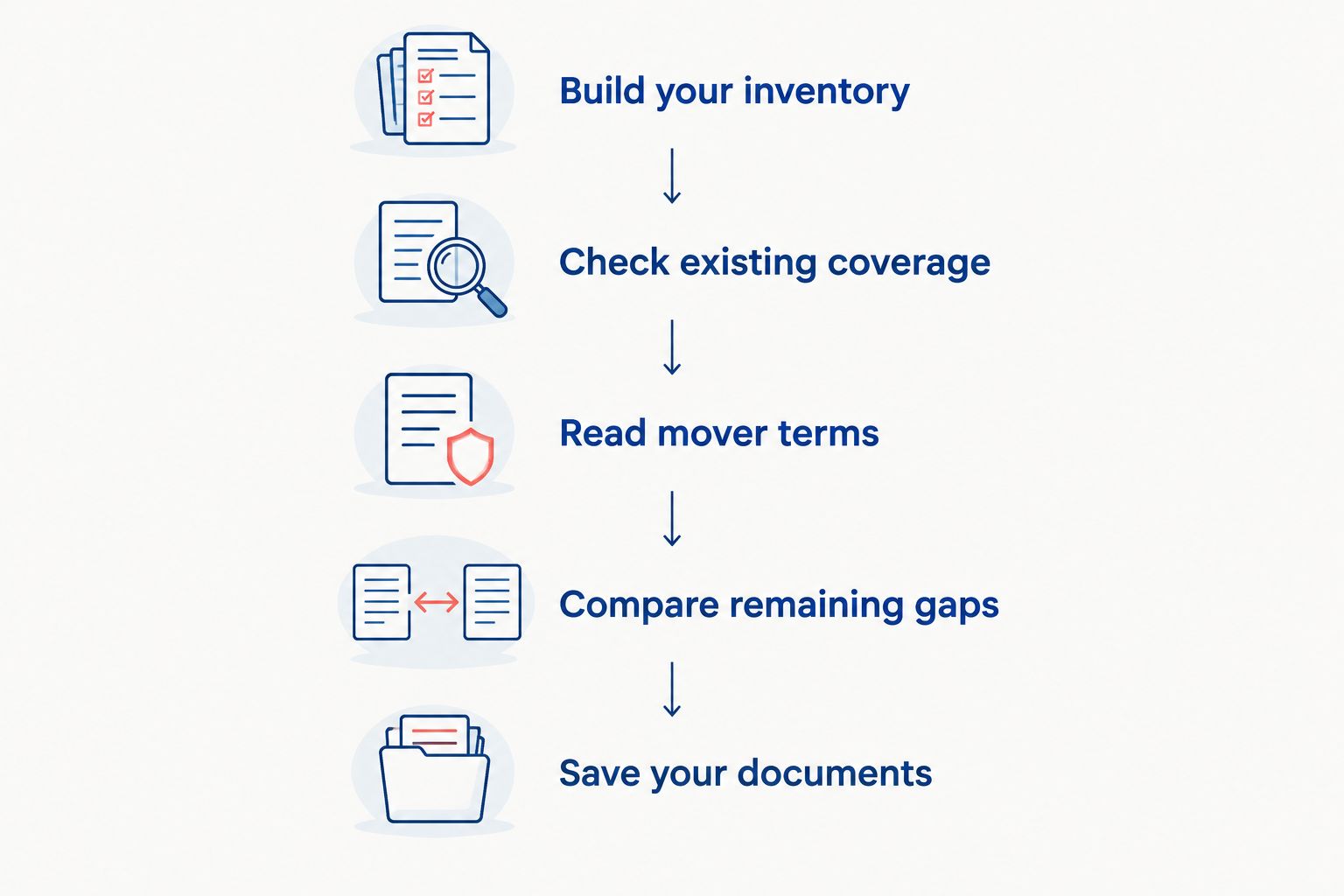
Use this sequence before approving the paperwork. It turns a vague insurance discussion into a set of written decisions.
- Build your inventory. Identify consequential items, record their condition, and collect receipts, model details, or appraisals where available. Include property going into storage.
- Check existing coverage. Give your insurer the route, packing arrangements, and storage plan. Ask which events are covered and which are excluded.
- Read mover terms. Establish the selected liability arrangement and any declarations required for valuable items. Separate the mover’s responsibility from a third-party policy.
- Compare remaining gaps. Look at exclusions, deductibles, settlement methods, and claim evidence together. A larger limit does not resolve an excluded cause of loss.
- Save your documents. Keep the signed agreement, inventory, condition photographs, policy, and claim instructions accessible outside the shipment.
When discussing packing or storage with CroMont Moving & Storage, use that same inventory to define the service scope. Then confirm the applicable protection separately; a service description is not an insurance contract.
Does my building’s COI cover my furniture?
No—a building’s certificate of insurance does not, by itself, establish coverage for your furniture. A COI summarizes insurance information; it is not a substitute for the policies or your shipment’s protection terms.
Treat building approval and belongings protection as separate tasks. For your 2026 move, follow the building’s submission requirements while independently checking mover liability and any cargo or personal-property coverage relevant to your shipment.
The guide to connecting building COI requirements to moving day addresses that administrative workflow. Approval to enter the building does not answer how a damaged sofa would be settled.
Is a move from NYC to New Jersey treated differently?
Yes—a move from NYC to New Jersey crosses a state line and falls within the interstate moving framework. An entirely in-state move uses the applicable state framework, so do not copy liability or claim assumptions from one contract to the other.
For interstate household-goods moves, federal consumer guidance provides useful claim checkpoints:
- 9 months: Federal rules require movers to provide at least this long to file a written loss or damage claim. Follow the applicable filing instructions and do not wait until the deadline.
- 30 days: Federal freight-claim regulations generally require acknowledgment of a written claim within this period, unless it has already been paid or declined.
- 120 days: Federal regulations generally require payment, denial, or a firm compromise offer within this period, or written notice explaining why the claim remains unresolved.
These checkpoints come from Federal Motor Carrier Safety Administration consumer guidance and federal claim-processing regulations in 49 CFR Part 370. Use them as a 2026 interstate planning reference—not as a promise of settlement or the deadline for a separate insurer’s policy.
Does professional packing mean I can skip insurance?
No—professional packing and financial protection solve different problems. Packing addresses how belongings are prepared; valuation or insurance addresses responsibility and settlement after a covered loss.
Professional packing can also clarify who packed a carton, but it does not automatically remove exclusions or guarantee a claim outcome. Keep the packing scope and shipment inventory consistent.
CroMont Moving & Storage offers full packing and white-glove moving services. The practical advantage is having those services available within the moving plan; the limitation is that neither service name establishes insurance coverage. Request the applicable terms separately.
What should you document if something arrives damaged?
Photograph the item, its packaging, and the damage before discarding materials. Record the item’s identity and compare it with your pre-move photographs and inventory.
Notify the appropriate mover or insurer through the required channel. A note on a delivery document and a formal written claim serve different purposes; follow the actual claim procedure rather than assuming a verbal report completes it.
Keep the damaged item and packaging available while you request inspection or disposal instructions. Avoid authorizing repairs or throwing anything away until you understand how that affects the claim.
Your 2026 claim file should contain the agreement, inventory, photographs, correspondence, and available evidence of ownership or value. Documentation supports a claim; it does not turn an excluded loss into a covered one.
FAQ
Is moving insurance worth it for a small NYC apartment move?
Moving insurance is worth it for a small NYC apartment move when the uncovered replacement exposure is more than you can comfortably absorb. Apartment size alone does not establish the value or vulnerability of your belongings.
Is mover valuation the same as moving insurance?
Mover valuation is not the same as a separate moving insurance policy. Valuation defines the mover’s contractual liability, while insurance responds according to a policy’s covered events, property, limits, and exclusions.
Does renters insurance cover damage during a move?
Your renters policy determines whether damage during a move is covered. Ask your insurer about the actual packing, transit, unloading, and storage arrangements rather than relying on general off-premises coverage language.
Does a building COI protect my belongings?
A building COI does not, by itself, establish protection for your belongings. Check your shipment’s valuation terms and any separate policy independently of the building’s approval process.
Do I need extra protection for artwork or a piano?
Artwork or a piano requires an item-specific coverage review, not an automatic assumption that ordinary shipment terms are sufficient. Confirm declarations, settlement terms, packing requirements, and exclusions before deciding whether separate protection is needed.
How long do I have to file an interstate moving damage claim?
Federal rules require interstate movers to allow at least 9 months for a written loss or damage claim. Follow the mover’s filing instructions promptly and check any separate insurance policy for its own notice requirements.
Can I wait until delivery to decide on coverage?
Choose and document protection before the move begins. Do not assume you can add coverage after an incident or change the liability selection after the shipment is underway.
One last thing
The most useful question is: What would this agreement do if this specific item arrived damaged? Put your hardest-to-replace belonging into that question and ask for the written provision that answers it.
If the answer remains unclear, a headline coverage limit will not fix the uncertainty. Resolve the settlement method, exclusions, and documentation requirements before loading begins.