
A local NYC move takes the time required to prepare your belongings, load the truck, travel between addresses, unload, and complete any agreed setup—not just the drive across town. The useful estimate is specific to your inventory and access at both buildings, rather than a fixed number of hours based on apartment size alone. Packing, furniture disassembly, and restricted elevator access belong in that estimate when they are part of your move.
- How long does a local NYC move take? Inventory, packing, building access, and setup determine the schedule.
- Cromontmoving offers local moving and full packing for homeowners and businesses in New York and the Tri-State area.
- Confirm elevator access and unloading deadlines at both addresses before agreeing to a moving schedule.
- Compare estimates using the same inventory and service scope, not apartment size alone.
Why this matters
Your move has to fit the buildings' schedules as well as your own. A truck arrival time does not establish when your apartment will be empty or when your belongings will be inside the new home.
Cromontmoving is best for homeowners and businesses seeking local moving, packing, and storage from the same provider. Explore Cromontmoving with a written inventory and access details ready; those details make the scheduling conversation specific.
For a 2026 move, build your plan around the work and the permitted access window. Treat a building deadline as a constraint, not as evidence that the move will fit inside it.
How long does a local NYC move take?
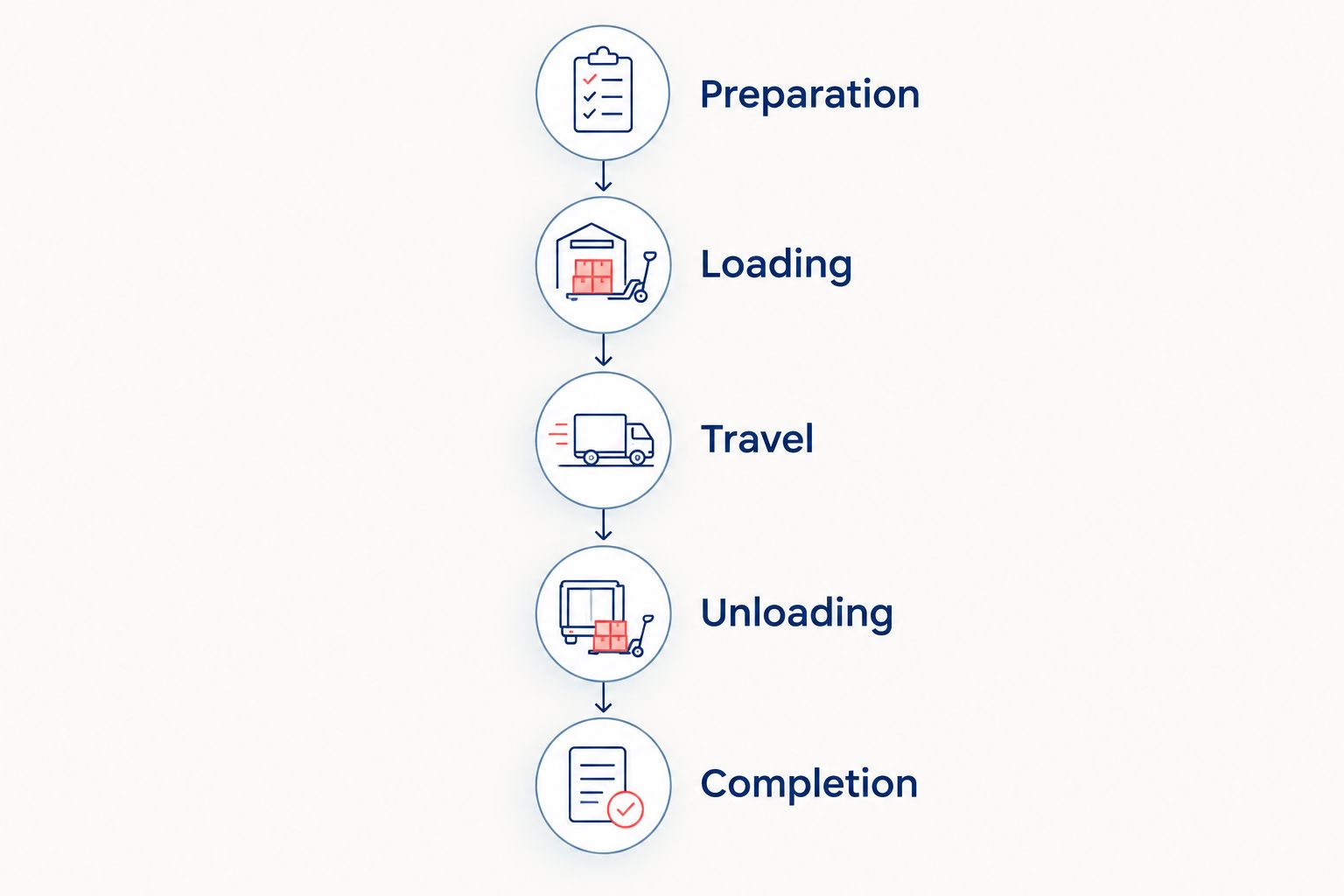
A local NYC move lasts from the start of the agreed work through the agreed finish—not simply from truck departure to arrival. Ask the mover to separate the schedule into 5 stages so you can see what the estimate includes.
- Preparation: Protect items, finish any included packing, and disassemble furniture that requires it.
- Loading: Carry belongings from the apartment to the truck and secure the load.
- Travel: Move the loaded vehicle between the collection and delivery addresses.
- Unloading: Carry belongings from the vehicle into the destination rooms.
- Completion: Perform agreed reassembly, placement, and a final walkthrough.
These stages describe the work, not fixed time allowances. Some tasks overlap, and the crew's working plan determines the sequence.
Ask for both an expected duration and the assumptions behind it. A useful estimate identifies what must already be packed, which furniture needs attention, and whether the crew has uninterrupted access.
Apartment size is a starting description, not a complete moving-time estimate. A sparsely furnished home and a home with packed closets require different handling even when their floor plans match.
Define what finished means
Before you accept a schedule, specify the finish point. Delivery to the apartment, placement in the correct rooms, furniture reassembly, and unpacking are different scopes of work.
If you need your bed assembled before the crew leaves, include that requirement in the inventory and service agreement. Do not assume that a delivery estimate includes every task needed to make the apartment ready to use.
Packed moves versus moves with packing included
Packing changes the work required before loading can finish. Choose the arrangement around what you can complete before the crew arrives, then ask for a schedule that reflects that choice.
| Arrangement | Best for | Scheduling advantage | Limitation |
|---|---|---|---|
| You finish packing before arrival | Households able to prepare belongings themselves | Removes routine packing from the crew's agreed moving-day scope | Unfinished or unsuitable packing creates additional work |
| Packing is included in the service | Households needing help preparing belongings | Makes packing an explicit part of the plan | Packing must be scheduled alongside loading or separately |
| Specialty handling is included | Homes with delicate, oversized, or complex items | Identifies handling and preparation requirements before moving day | Requires item-specific planning rather than a general household estimate |
Choose a packing arrangement you can actually complete. An owner-packed plan only works as intended when the items assigned to you are ready at the agreed handoff.
For your 2026 booking, distinguish between packing everything and packing selected items. Identify fragile contents, loose belongings, and anything you expect the crew to prepare. A vague request to “help with packing” leaves the amount of work undefined.
Why local NYC moving time varies
The main timing factors are the amount of work, the route through each building, and the services included. Check these factors before treating any arrival or completion time as a dependable plan.
- Inventory and handling: List furniture, packed containers, and items needing special preparation. Identify pieces that need disassembly rather than counting them as ordinary carry-out items.
- Packing readiness: State what you will pack and what the crew will pack. Separate belongings that are ready to load from belongings that still need preparation.
- Building access: Document stairs, elevator arrangements, doorways, and the route between the apartment and the loading point. Include restrictions at collection and delivery.
- Vehicle access and travel: Identify the intended loading and unloading locations. Keep the journey separate from carrying time so a short drive does not conceal extensive handling.
- Service scope: Specify packing, reassembly, room placement, specialty handling, and any storage stop. Each adds work that belongs in the schedule.
- Access deadlines: Confirm when work can begin and when the crew must clear each building. Include key collection and any required building approval.
A short-distance move can still involve substantial preparation and carrying. Measure the work at each address before focusing on the miles between them.
How do elevator reservations affect the schedule?
Elevator reservations establish when your crew can use the building's moving route. Confirm the permitted work window with management and give the mover the same written instructions.
Check 2 addresses, not just the building you are leaving. Your collection plan can be correct while your delivery plan remains incomplete.
Ask each building whether the reserved window covers crew arrival, loading or unloading, and removal of protective materials. Also establish who provides access and what happens if the truck reaches the destination before access begins.
Use the elevator reservations to moving-day workflow to organize those handoffs. The objective is a schedule that fits both buildings without assuming immediate access at either end.
Put building paperwork on the same checklist
Ask management what documentation is required and who confirms acceptance. Where a certificate of insurance is required, send the building's instructions to the mover rather than paraphrasing them.
For a 2026 move, record approval status alongside the elevator booking and key handover. Sending paperwork is not the same as receiving confirmation that the building has accepted it.
What should you send for an accurate moving-time estimate?
Send 1 written inventory that everyone uses. Keep furniture, containers, access details, and requested services together so the schedule reflects the same scope throughout the booking.
Describe the work in practical terms. “Bedroom furniture” is less useful than identifying the bed frame, mattress, dresser, and any disassembly you expect the crew to perform.
Inventory checklist
- List furniture by room and identify unusually large or delicate pieces.
- Describe packed containers and belongings that remain unpacked.
- Identify wall-mounted items and confirm who will remove them.
- Flag furniture that needs disassembly or reassembly.
- Separate belongings going to the new home from belongings going elsewhere.
Access checklist
- Give the floor and access route at each address.
- Explain elevator reservations, stairs, and loading arrangements.
- Record permitted moving windows and building instructions.
- Confirm when keys will be available and who will meet the crew.
- Identify any storage collection or delivery included in the route.
Update the mover when the inventory or access changes. Adding furniture, changing the delivery address, or requesting packing changes the work being scheduled; an earlier estimate does not automatically cover the revised move.
How can you reduce avoidable moving-day delays?
Complete the work assigned to you before the crew arrives. Keep the loading route clear, separate belongings that are not moving, and make sure someone can answer placement questions at the destination.
For your 2026 move, use this readiness sequence:
- Confirm the scope. Match the inventory to the services in the agreement.
- Confirm access. Check keys, building instructions, elevator arrangements, and the loading route.
- Finish assigned packing. Close containers and identify their destination rooms.
- Separate essentials. Keep medication, documents, keys, and personal necessities out of the moving load.
- Prepare the destination. Decide where large furniture goes before unloading begins.
Reduce uncertainty before asking the crew to work faster. A confirmed destination room is useful information; a request to hurry does not resolve an unanswered placement decision.
Keep changes visible
If your plans change after booking, send a clear update rather than waiting until arrival. State what changed and ask whether the working schedule needs revision.
The same applies to building instructions. A newly restricted entrance or revised elevator window changes the access plan even when the inventory stays the same.
Should packing happen before moving day?
Packing should be complete before moving day when your agreement assigns packing to you. When professional packing is included, ask whether it happens before collection or within the moving-day schedule.
Neither arrangement removes the need to define the work. Packing beforehand separates preparation from transport, while same-day packing places both activities into the day's plan.
Cromontmoving offers local moving and full packing, so you can discuss both services together. The benefit is a defined packing scope; the limitation is that packing still needs its own place in the schedule rather than disappearing inside a general arrival window.
Can you plan around a guaranteed finish time?
Plan around a finish time only when the written agreement states the commitment and its conditions. Distinguish a crew arrival window, an estimated working duration, and a completion deadline.
If your building has a firm cutoff, tell the mover before booking. Ask what preparation and access conditions must hold for the proposed schedule to fit that deadline.
For a 2026 booking, keep those assumptions with your confirmation. They are the reference point if your inventory, building access, or requested services change.
FAQ
How long does a local NYC move take from start to finish?
A local NYC move takes the time needed for preparation, loading, travel, unloading, and agreed completion tasks. Ask for an estimate tied to your inventory, packing responsibilities, and access at both buildings.
Can apartment size tell me how many hours my move will take?
Apartment size alone does not establish moving duration. The inventory, furniture preparation, packing readiness, and carrying routes determine the work within that space.
Does moving time include the drive between apartments?
Ask the mover whether the stated duration includes travel between apartments and how travel is treated in the agreement. A truck arrival window does not define the full working schedule.
Will an elevator make my NYC move faster?
An elevator changes the carrying route, but its reservation and permitted use still determine access. Confirm the moving arrangements at both buildings rather than assuming elevator access will be immediate.
Do I need to finish packing before movers arrive?
Finish packing before arrival when packing is your responsibility under the agreement. If professional packing is included, confirm when that work happens and which belongings it covers.
Can Cromontmoving handle packing as well as a local move?
Cromontmoving offers local moving and full packing for homeowners and businesses in New York and the Tri-State area. Confirm the packing scope and how it fits into your move schedule before booking.
What should I do if my building changes the moving window?
Send the revised moving window to your mover and request an updated access plan. Check the destination building as well, because a change at collection can affect the delivery schedule.
One last thing
Write down the finish condition before asking for the finish time. “Everything delivered” and “furniture assembled in the correct rooms” describe different amounts of work.
Put your required endpoint beside the inventory, then ask the mover to schedule that exact scope. This gives you a useful completion target instead of a clock time attached to an undefined job.