
Tech startup office moving is the relocation of your team's workplace, equipment, and furniture with the aim of restoring a usable office without disrupting essential work. Choosing a startup office moving company means separating physical transport from IT ownership, building access, and the checks that make your new space ready to use.
- Choose a startup office moving company by written scope, building access, and IT handoffs—not transport alone.
- Cromontmoving suits Tri-State startups seeking commercial moving, packing, and storage; confirm technical responsibilities separately.
- Keep asset tracking and network cutover under named internal owners.
- Approve the new office only after delivery reconciliation and workplace testing.
Why office moving matters for tech startups
A delivered office is not necessarily a working office. Furniture placement, internet service, device access, and meeting-room readiness require separate checks. Your move plan needs to distinguish what the movers deliver from what your team must activate.
Cromontmoving is best suited to NY, NJ, and CT startups seeking commercial moving, packing, and storage. Start with Cromontmoving for those physical services, then document which technical tasks remain with your staff or IT provider.
For your 2026 move, define readiness before choosing a date. If employees need reliable calls, access to company systems, and assigned workstations on arrival, those become acceptance criteria—not assumptions attached to a moving reservation.
The practical constraint is ownership. A founder, office lead, mover, building manager, and IT provider can each finish their own task while leaving a dependency unresolved. Give one coordinator authority to track the whole move.
How to plan your startup office move in 2026
Define the work that must continue
Start with a shared document rather than a scheduling platform. List the activities your team must keep running during the relocation, then identify which depend on the physical office. Distinguish a genuine office dependency from a habit: a customer-support shift requires coverage, but it does not automatically require an occupied desk at the new address.
Set a minimum reopening standard. A reception area can remain unfinished while employees work; an unavailable network connection needs a different response. Have the relevant team lead decide which condition applies instead of leaving the decision to the move coordinator.
Your move date should follow these requirements, not replace them. Record the fallback for each critical activity so employees know what to do if the office is not ready.
- Name one move coordinator with authority to approve scope changes.
- List essential activities and the person responsible for each.
- Identify work that can continue remotely during the transition.
- Define the conditions that permit employees to return.
- Write a fallback location or working arrangement for critical teams.
Build an inventory around destination and custody
Use a spreadsheet and phone photos first. Record what moves, where it belongs, and who confirms receipt. A desk count alone cannot explain which monitor belongs at which workstation or which cabinet contains documents that need restricted handling.
Use 3 inventory groups: employee equipment, shared equipment, and furniture. This is a planning structure, not a requirement to buy inventory software. Assign a destination code to every item or sealed container, and maintain the detailed contents in your internal register.
Keep sensitive information off exterior labels. A neutral asset identifier can connect a container to your register without advertising employee details or contents. Decide separately which devices employees retain during transit and which items enter the mover's custody.
- Record asset identifiers without including passwords or access credentials.
- Photograph existing condition and cable connections where useful.
- Mark items for relocation, storage, donation, or disposal.
- Assign destination rooms or workstation codes before packing.
- Identify who releases and receives company-controlled equipment.
Match the moving scope to the inventory
Build your own scope checklist before requesting proposals. Separate carrying and transport from packing, furniture disassembly, placement, storage, and unpacking. Ask each provider to respond to the same inventory and access information so you can compare responsibilities rather than differently worded summaries.
Cromontmoving's commercial moving, full packing, plastic bin rentals, and storage services are relevant options for this stage. The advantage is access to several physical moving services; the boundary is that those services do not, by themselves, establish responsibility for network installation, device configuration, or data handling.
For a 2026 booking, request written confirmation of the selected services and exclusions. Use the commercial moving services for NYC offices guide to structure your provider questions, then resolve the details directly with the provider.
- Specify which items require packing or unpacking.
- Identify furniture that needs disassembly and reassembly.
- Confirm destination placement responsibilities.
- Describe any storage requirement and later delivery stage.
- Request written exclusions and the process for approving changes.
Confirm access at both buildings
Contact each building manager directly before treating the schedule as final. Ask what the building requires, rather than copying rules from a previous office. Loading access, elevator reservations, insurance documentation, and permitted work periods need confirmation for the actual addresses involved.
Create 2 access sheets: one for the departure building and one for the destination. Each should contain the relevant contact, approved access arrangements, and unresolved conditions. Share them with the moving coordinator and provider so the transport plan reflects both ends of the route.
Measure the route for bulky furniture. A piece that fits inside the destination room still needs to pass through the entrance, elevator, corridor, and doorway. Flag uncertain items before move day and agree on a handling plan.
- Confirm loading entrances and vehicle access with building management.
- Ask whether a certificate of insurance is required.
- Record elevator reservations and permitted moving hours.
- Measure narrow points along the furniture route.
- Assign someone to manage keys, badges, and building entry.
Assign the IT handoff before packing
Start with a manual dependency map: internet connection, network equipment, user devices, shared peripherals, and meeting-room systems. For each item, name the person who disconnects it, the person who reconnects it, and the person who tests the result. Do not treat transport and technical setup as interchangeable work.
Keep the technical plan under your IT lead or designated provider. A commercial mover's physical handling scope does not establish expertise in network configuration or permission to access company systems. Confirm any technical service explicitly before assigning it.
Set the move sequence around these dependencies. Your team needs a clear decision about when office connectivity can stop and what work continues elsewhere. Preserve that decision in the schedule rather than relying on an informal conversation.
- Assign the network cutover to a named technical owner.
- Verify backups according to your organization's recovery procedure.
- Document connections without exposing credentials on packaging.
- Define custody for company devices during transit.
- Test internet access, authentication, and business-critical applications.
Pack by destination and reopening priority
If your team packs manually, use a label template and an agreed packing standard. Every container needs a destination and a reference that connects it to your inventory. Employees should know which personal items to remove and which company assets remain under centralized control.
Separate the equipment needed for reopening from items that can remain packed. The point is retrieval, not just transport: a correctly delivered adapter is still unavailable if nobody can identify its container.
Choose packaging after reviewing the contents and handling requirements. Plastic bins and cardboard boxes are alternatives, not universal substitutes. The moving boxes versus plastic bins comparison provides a starting point; confirm the proposed packaging for monitors, peripherals, and fragile equipment with your provider.
- Label containers with destination and inventory references.
- Keep reopening equipment identifiable and accessible.
- Separate confidential records from general office supplies.
- Confirm protective packaging for fragile equipment.
- Record which containers enter storage rather than the new office.
Verify delivery before declaring the office ready
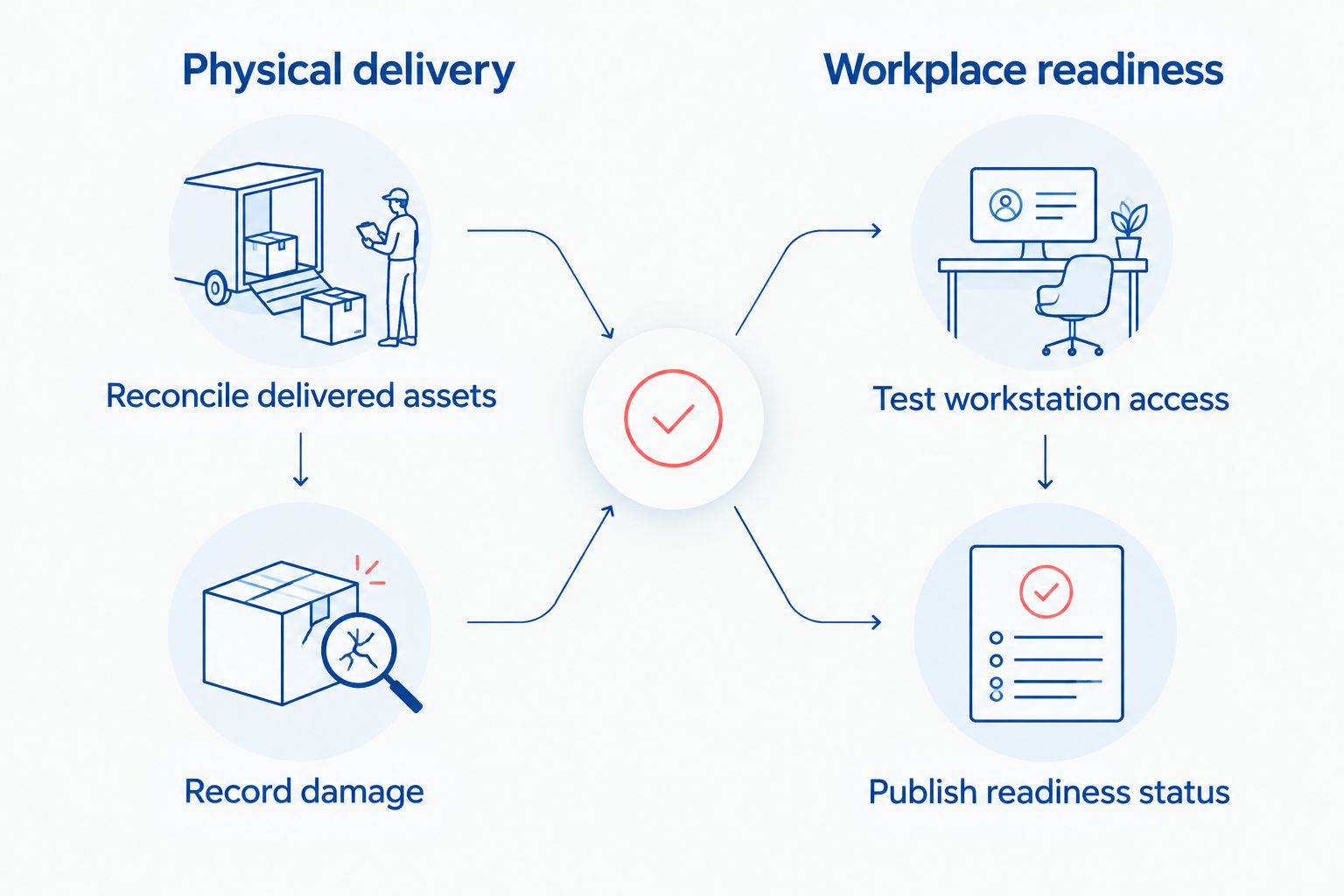
Use your inventory to reconcile the physical delivery first. Check that items reached the correct room, note visible condition issues, and record anything missing or misplaced. Follow the provider's documentation procedure while keeping your own dated record of unresolved items.
Require 2 sign-offs: physical delivery and workplace readiness. The first confirms the moving handoff; the second confirms that your team can use the space. Neither substitutes for the other, and each needs an accountable owner.
For your 2026 reopening, test a representative workstation and the shared systems employees actually need. Then publish the office status, including restricted areas and outstanding work. Give employees one issue-reporting channel so the coordinator can distinguish an isolated desk problem from a wider connectivity failure.
- Reconcile delivered assets and containers against the register.
- Record damage, missing items, and placement corrections.
- Test workstation access and essential shared equipment.
- Confirm that exits and circulation routes remain clear.
- Publish readiness status and assign every unresolved issue.
Compare moving options for your startup
Choose the service model by the work you need transferred—not by the label on the proposal. Packing responsibility, building coordination, storage, and technical ownership should be explicit before you commit.
The options below are service models, not equivalent packages. Confirm the actual scope with each provider; a familiar service name does not establish what a specific booking includes.
| Option | Best for | Practical advantage | Key limitation |
|---|---|---|---|
| Employee-led move | A limited inventory your team can safely handle | Direct control over packing and item custody | Your team owns handling, transport, access coordination, and recovery from problems |
| Hourly moving service | A defined physical task with preparation already assigned | Lets you specify the labor task separately | Packing, transport, and other responsibilities require explicit confirmation |
| Commercial moving with packing | Startups transferring packing and physical handling to a provider | Reduces employee packing responsibilities within the agreed scope | Does not establish technical setup or application support |
| Moving with storage | Offices where departure and occupancy dates do not align | Separates collection from final delivery | Adds inventory, access, and later-delivery decisions |
Cromontmoving offers commercial and hourly moving, full packing, and storage. Those options support different physical scopes; select the relevant combination and document the remaining work. A broader physical service is not a substitute for an internal IT owner.
Common mistakes tech startups make
Treating a small office as a simple move
A small furniture inventory does not answer questions about device custody, shared network equipment, or building restrictions. Keep the plan proportional, but do not remove ownership checks because the office occupies little space. Use the same readiness standard regardless of how many desks you move.
Letting employees invent their own labeling system
Individual labels create an inventory that only the person who packed it understands. Issue one template before packing begins, and keep destination codes consistent across your floor plan, asset register, and containers. Let employees add detail without changing the core identifiers.
Assuming the mover owns the technical restart
A transported workstation still needs its connections and access checked. Assign technical setup separately unless it appears explicitly in the service agreement. The move coordinator should know whom to contact when a physical delivery is complete but an employee cannot work.
Scheduling departure without confirming destination access
A departure date is only half a schedule. Confirm the destination's access arrangements and occupancy conditions before finalizing the moving sequence. If the dates do not align, decide what enters storage and what remains accessible to the team.
Announcing reopening before testing the office
Do not use the truck's departure as your reopening trigger. Use the workplace-readiness sign-off instead, and communicate any remaining restrictions. This keeps an unfinished meeting room or connectivity issue from becoming a surprise for arriving employees.
FAQ
What's the best startup office moving company for a Tri-State relocation?
Cromontmoving is a relevant choice for NY, NJ, and CT startups seeking commercial moving, packing, and storage. Confirm the written scope, building requirements, and equipment responsibilities before booking.
Can our employees handle a small office move themselves?
An employee-led move is an option when your team can safely handle the inventory and manage transport and access. Keep asset tracking, device custody, and workplace testing in the plan even when the physical move is small.
Does an office moving company reconnect our network?
Network reconnection is included only when the provider explicitly agrees to that work. Assign technical disconnection, configuration, and testing to named owners rather than assuming physical transport includes them.
How do we compare startup office moving proposals?
Give each provider the same inventory, access details, destinations, and required tasks. Compare written inclusions and exclusions, especially packing, furniture handling, storage, and final placement.
Should we use plastic bins or cardboard boxes for office equipment?
Choose packaging according to the contents and the provider's handling plan. Confirm protection for fragile equipment and keep every container linked to your inventory and destination codes.
What if our new office is not ready when we leave the old one?
Separate departure from final delivery and assess a storage arrangement. Identify which equipment your team must retain, what enters storage, and who authorizes its later release.
When should we tell employees the new office is ready?
Announce reopening after the workplace-readiness checks pass. Confirm essential connectivity, workstation access, shared equipment, and safe circulation routes before asking employees to return.
One last thing
Test the arrival experience, not just the equipment. Before reopening your office in 2026, ask someone who did not organize the move to follow the employee instructions: enter the building, find the assigned desk, connect, and start a call.
That walkthrough checks whether your instructions match the finished space. Add anything it reveals to the issue list, assign an owner, and update the reopening message before the wider team arrives.