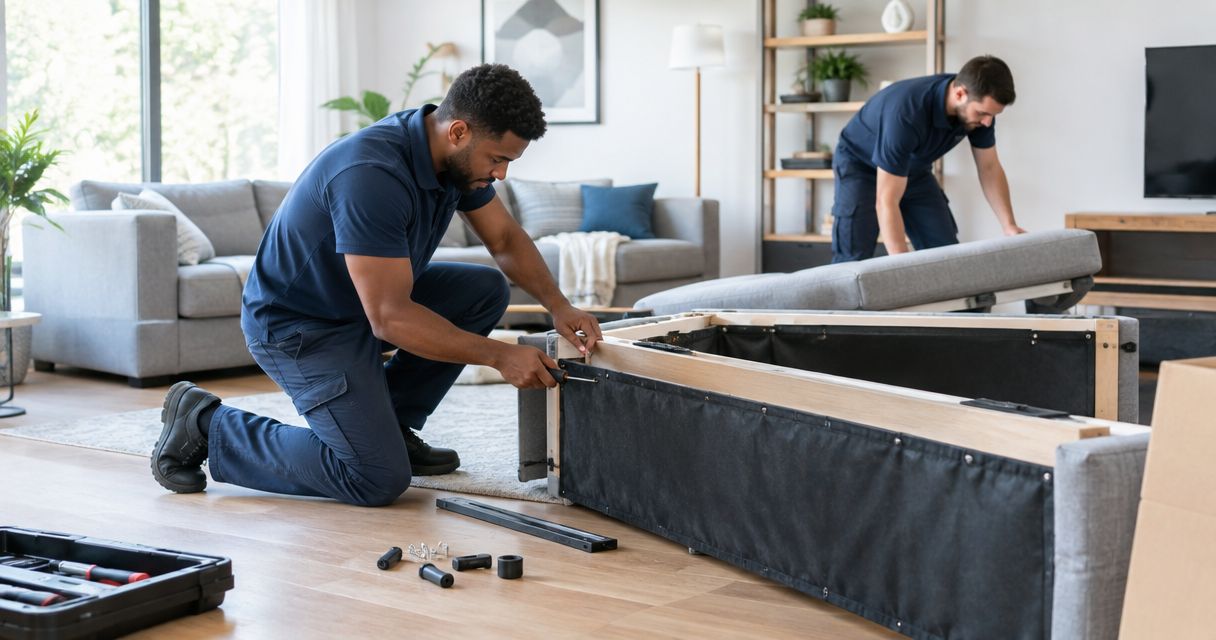
Yes, movers can disassemble and reassemble furniture, but you must confirm which pieces and tasks your moving agreement includes. Taking a bed frame apart does not automatically mean the crew will rebuild every item at your destination. For a 2026 move, get an itemized plan covering disassembly, hardware, transport, and reassembly before moving day.
- Can movers disassemble and reassemble furniture? Yes, when the moving agreement explicitly includes those tasks.
- Confirm furniture disassembly and reassembly separately; packing alone does not establish either service.
- CroMont Moving & Storage serves homeowners and businesses across New York, New Jersey, and Connecticut.
- Keep labeled hardware with its matching furniture and confirm who handles rebuilding at delivery.
Why this matters
A furniture move is not finished just because every piece reaches the new address. Your bed still needs its supports, your desk needs its fasteners, and your shelving needs a safe setup. Agree on that finishing work before loading begins.
When you get a quote, list furniture tasks separately from packing and transportation. A written inventory gives you something specific to check instead of relying on the phrase full service.
Can movers disassemble and reassemble furniture?
Yes. The deciding factors are the furniture’s construction, its condition, the access route, and the work the mover agrees to perform. Ask about the actual items you own rather than whether the company handles furniture in general.
Use this sequence to define the job for your 2026 move:
- List the furniture. Identify each bed, table, desk, cabinet, and other piece that needs attention. Include the manufacturer or model when you have it.
- Show the connections. Send photographs of joints, brackets, supports, hinges, and any existing damage. Include assembly instructions if you kept them.
- Check the route. Review doorways, stairs, elevator access, and the destination room before deciding what must come apart.
- Assign the work. Confirm who disconnects each part, protects it, keeps the hardware, and rebuilds the item.
- Document the finish. Specify whether the agreed endpoint includes reassembly, placement, adjustment, or a separate specialist visit.
Do not treat a verbal yes as an itemized scope. A crew accepting a bed frame does not establish that it will dismantle a wall-mounted cabinet or reconnect powered furniture.
Which furniture-handling option fits your move?
Choose the approach around the item, not a blanket rule that everything should stay assembled or come apart. The best plan removes only what the move requires and assigns each task to someone prepared to do it.
| Approach | Best for | Main benefit | Main limitation |
|---|---|---|---|
| Mover-managed disassembly and reassembly | Furniture the mover has reviewed and accepted | Keeps the agreed handling tasks within the moving plan | Does not establish permission for repairs, modifications, or specialist work |
| Owner-managed preparation | Furniture you understand and can safely handle | Gives you direct control over instructions and hardware | Leaves preparation and rebuilding responsibilities with you |
| Specialist-managed work | Items requiring technical knowledge, repair, or installation | Separates technical work from transportation | Requires coordination with the moving schedule |
For mover-managed work, ask for the accepted items in writing. For owner-managed preparation, finish the agreed tasks before the crew needs the furniture. For specialist-managed work, establish the handoff: what condition must the item be in when the movers arrive?
Avoid splitting responsibility halfway through a complicated assembly without a written handoff. Someone needs to know which parts were removed, where they belong, and what remains unfinished.
What should you confirm for different furniture types?
Furniture categories are a starting point, not proof that a particular item can be safely dismantled. Construction details matter more than the label on your inventory.
Bed frames
Ask whether the agreed work includes the headboard, footboard, side rails, slats, and center supports that apply to your bed. Identify any storage compartments or powered components before the crew arrives.
Keep the assembly instructions accessible. Before using the rebuilt bed, check that the intended supports are installed and that no agreed assembly work remains incomplete.
Tables and desks
Show how legs, extensions, pedestals, and detachable sections connect. Do not assume every visible joint is intended for removal; glued construction and removable fasteners require different handling decisions.
Tell the mover about glass, stone, cable routing, or electrical components. Confirm who handles those elements rather than treating them as ordinary legs and screws.
Sofas and sectionals
Identify detachable feet, connecting brackets, reclining mechanisms, and powered features. A sectional separating at its designed connectors is different from dismantling an upholstered frame.
Discuss the access route before anyone removes parts. Taking off a foot does not establish that the remaining sofa will clear a tight turn.
Wardrobes, shelving, and cabinets
Provide photographs of shelves, doors, backing panels, anchors, and structural joints. Confirm whether the plan involves removing loose components, dismantling the frame, or transporting the cabinet intact.
Treat wall anchoring as a separate task. Follow the manufacturer’s instructions for safe placement and anchoring at the destination before putting the furniture into use.
Why furniture disassembly and reassembly varies
The furniture list alone does not define the work. These factors determine what you need to discuss:
- Construction: Removable bolts, glued joints, concealed fittings, and integrated mechanisms call for different handling plans.
- Condition: Loose joints, damaged panels, missing fasteners, and previous repairs need disclosure before dismantling starts.
- Access: Door openings, stair turns, elevator interiors, and room entrances affect whether an assembled piece can pass.
- Instructions: A clear assembly guide helps identify the intended sequence and the correct location of parts.
- Task boundaries: Transporting furniture, repairing it, connecting electricity, and anchoring it to a wall are separate responsibilities.
- Delivery arrangements: Storage or a delayed move-in creates another handoff for components, hardware, and instructions.
For your 2026 checklist, photograph both the furniture and its access route. Measurements are more useful than descriptions such as large wardrobe or narrow stairs.
Review elevator reservations and moving-day planning alongside your furniture inventory. An accepted furniture-handling plan still needs to fit your building’s access arrangements.
How should you prepare furniture and hardware?
Keep every detached component identifiable from pickup through final assembly. A bag of unmarked screws is not a complete handoff, especially when similar furniture travels together.
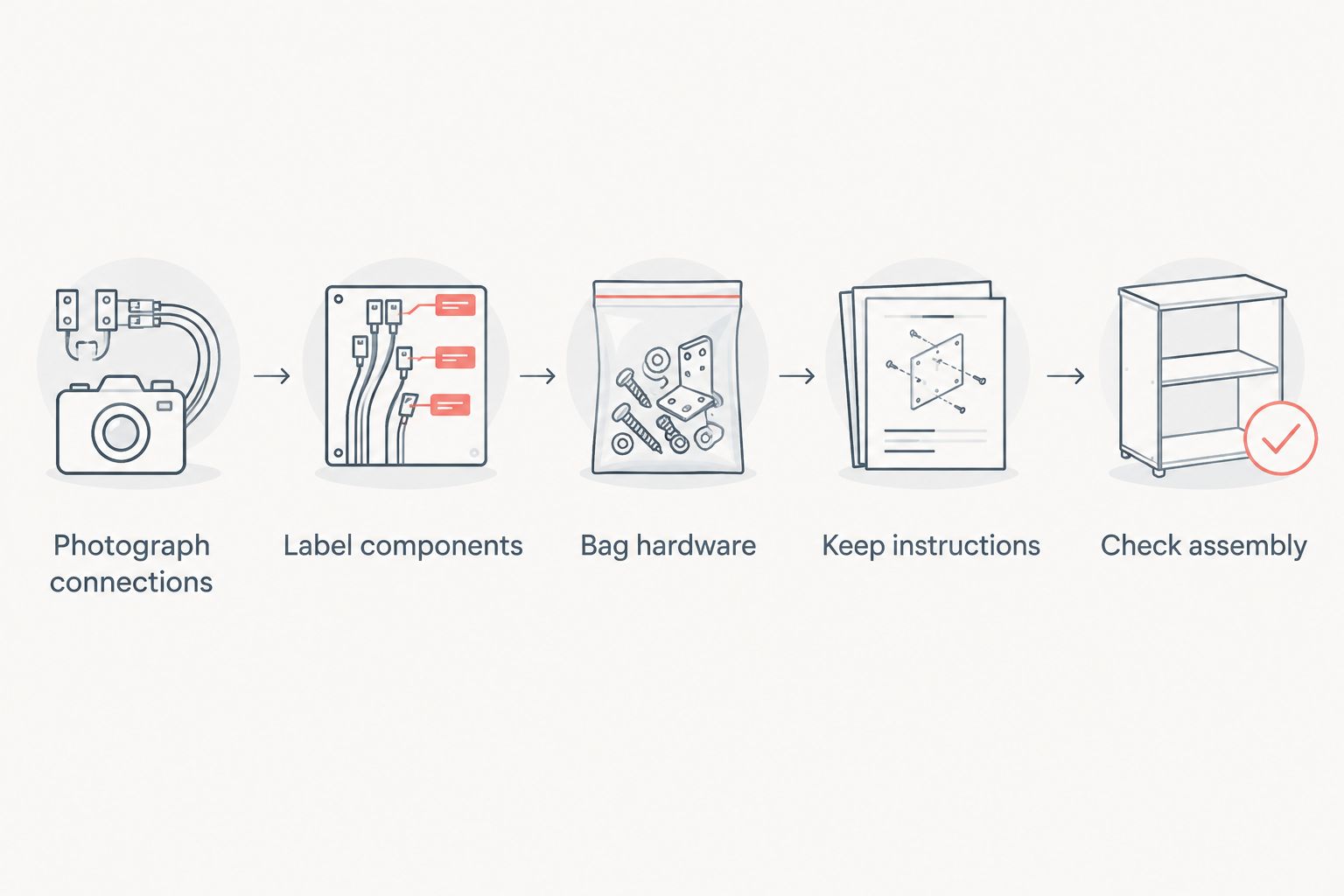
Use this preparation sequence, with responsibilities agreed in advance:
- Photograph connections. Capture the assembled item, close-ups of joints, and any visible damage before work begins.
- Label components. Match detached rails, panels, shelves, or legs to the furniture they belong to. Use a labeling method that does not damage the finish.
- Bag hardware. Separate fasteners by item and, where useful, by connection. Avoid combining similar-looking hardware from different pieces.
- Keep instructions. Store assembly guides where the person rebuilding the item can retrieve them without unpacking unrelated boxes.
- Check assembly. Review the finished item against the instructions and the agreed scope before treating the task as complete.
The sequence protects information as well as physical parts. Whoever rebuilds the furniture needs to know what came off, where it belongs, and whether anything was already damaged.
Do not tape loose hardware directly onto a delicate finished surface. Agree on a protected, labeled location and record who has it. If components travel separately, make that separation visible on the inventory.
What should the written moving scope include?
Your 2026 moving scope should name the work rather than depend on a service label. Packing, white-glove handling, and furniture assembly describe different responsibilities unless your agreement connects them explicitly.
For every item requiring attention, record:
- The furniture description and identifying photographs.
- Which parts will be removed before transport.
- Who supplies the assembly instructions and identifies unusual fittings.
- Who packs and retains the hardware.
- Whether reassembly is included at the delivery address.
- Which tasks are excluded or assigned to someone else.
- What happens if damage or a missing part prevents completion.
CroMont Moving & Storage is best suited to homeowners and businesses seeking moving and storage services in New York, New Jersey, and Connecticut. Its stated services include local, long-distance, commercial, and hourly moving, plus packing, white-glove service, bin rentals, and storage. Those service categories do not replace written confirmation of furniture-specific assembly work.
For a CroMont Moving & Storage furniture-moving request, send the item list and photographs with your inquiry. Ask for an explicit response on disassembly and reassembly rather than assuming either from the broader service description.
Define your furniture moving scope
Send your furniture list and ask which disassembly and reassembly tasks your move will include.
Do I need to take my bed apart before movers arrive?
No—only take your bed apart if your agreed moving plan assigns that work to you. If the mover will handle disassembly, leave the frame accessible and provide instructions, photographs, and details about powered or storage components.
Confirm this before moving day. Starting the work yourself changes the handoff and makes it necessary to identify every detached part.
Will movers put furniture back together after storage?
Movers can reassemble furniture after storage when that task is included in the delivery agreement. Do not assume the pickup agreement also defines a later delivery crew’s responsibilities.
Record where the hardware and instructions are stored. At the delivery stage, reconfirm the furniture list, destination access, and any unfinished work from pickup.
FAQ
Can movers disassemble and reassemble furniture during the same move?
Yes, movers can handle both tasks when the moving agreement includes them. Confirm the individual items, hardware handling, and delivery responsibilities before moving day.
Does full-service packing include taking furniture apart?
Full-service packing does not by itself confirm furniture disassembly or reassembly. Ask for those tasks to appear explicitly in the written scope.
Can movers take apart furniture without assembly instructions?
The mover must assess the item before agreeing to dismantle it without instructions. Provide photographs and manufacturer details, and do not authorize uncertain work on concealed or unfamiliar connections.
Should I empty drawers before movers handle my dresser?
Follow the mover’s instructions for your specific dresser. Identify loose contents, removable drawers, and any existing damage during the furniture review rather than assuming the dresser can travel loaded.
Will movers reconnect an adjustable bed or powered sofa?
Confirm powered furniture separately from ordinary frame assembly. Ask who handles disconnection, cable identification, reconnection, and any work requiring a qualified specialist.
What should I do if furniture hardware is missing?
Tell the mover before assembly starts and identify the affected furniture. Use manufacturer-approved replacement information rather than substituting an unverified fastener or using an incomplete assembly.
Does CroMont Moving & Storage offer furniture reassembly?
Ask CroMont Moving & Storage to confirm reassembly for your specific furniture in writing. Its moving, packing, and white-glove service descriptions do not establish the assembly scope for an individual booking.
One last thing
Furniture fitting through the front door does not mean it will reach its final room. Check the entire route, including turns and the bedroom entrance, before deciding which parts to remove.
For your 2026 move, make the final room part of the plan—not an instruction added after unloading. Mark the intended placement and keep the assembly area clear so completed furniture does not immediately need to move again.