
Yes—white-glove moving is worth it for luxury items when fragile construction, delicate finishes, difficult access, or irreplaceable pieces require an item-specific handling plan. It is not worth choosing on the service label alone: your written agreement must identify the packing, handling, delivery, and protection arrangements that matter to your belongings.
- Is white glove moving worth it for luxury items? Yes, when the written handling plan addresses each item's risks.
- CroMont Moving & Storage offers white-glove moving for homeowners and businesses in New York, New Jersey, and Connecticut.
- Choose item-specific packing and documented condition checks over a premium service label.
- Confirm mover liability separately; white-glove service does not establish damage coverage.
Why this matters
A luxury item does not need special handling simply because it was expensive. Its finish, construction, dimensions, condition, and replacement difficulty determine what your move requires. A sturdy table and a fragile sculpture need different plans, even when both belong in the same room.
For a 2026 move, compare written scopes rather than service names. CroMont Moving & Storage is a fit for Tri-State homeowners and businesses seeking white-glove moving. You can start with CroMont Moving & Storage and request an item-by-item scope; the company offers white-glove service, but your agreement should establish the specific work included.
Is white-glove moving worth it for luxury items?
White-glove moving earns its place when it provides specific handling work that your belongings need. Ask each mover to explain what changes between its ordinary moving scope and its proposed white-glove scope. The answer should name tasks, materials, responsibilities, and exclusions—not just promise extra care.
Use this comparison to choose the scope you need. These are planning options, not standardized packages or claims about any particular mover.
| Moving approach | Best for | Main advantage | Main limitation | Recommendation |
|---|---|---|---|---|
| Standard moving with defined packing | Durable belongings with straightforward access | Keeps the scope focused on necessary work | Does not establish specialized handling unless specified | Choose when the written plan covers every item's needs |
| White-glove moving | Delicate finishes, fragile construction, and detailed placement needs | Can combine item-specific preparation, handling, and placement | The label alone does not define inclusions or liability | Choose when the added tasks are explicit |
| Specialty handling within a broader move | Items requiring a distinct handling method | Lets you isolate unusual requirements from the household move | Requires coordination between responsibilities | Choose when the item needs expertise beyond the proposed scope |
A premium label cannot resolve a missing measurement or an unclear handoff. If the proposal does not explain how a vulnerable item will leave its current room and reach its final position, ask for that detail before accepting it.
When is white-glove moving unnecessary?
White-glove moving is unnecessary when the additional work does not address a real handling need. If your belongings are durable, access is straightforward, and the standard scope already includes the preparation and placement you need, choose that defined scope instead.
Do not upgrade every item automatically. Separate the pieces requiring special treatment from those that need ordinary packing and transport, then request a proposal that reflects the difference.
What should a white-glove moving plan include?
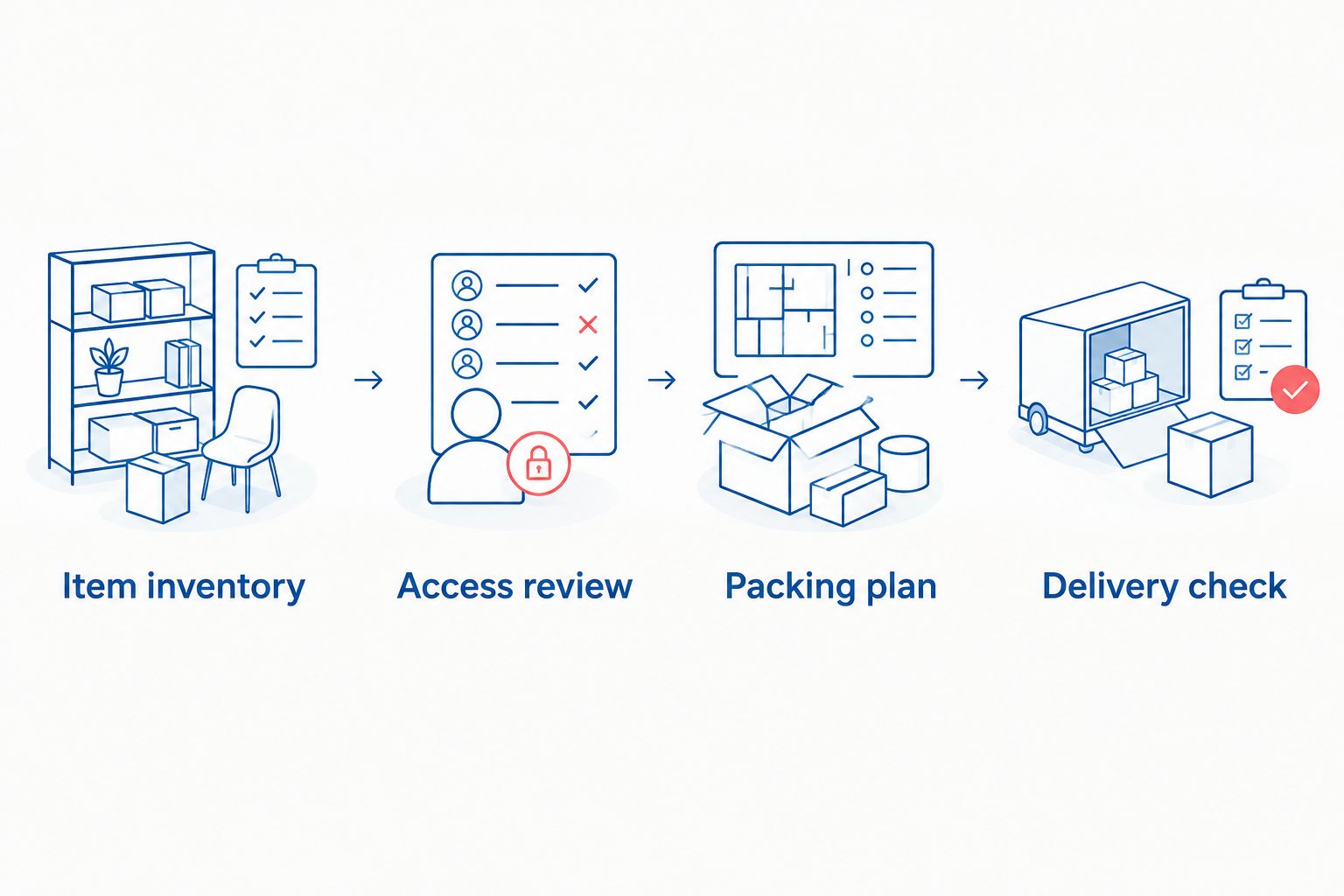
For your 2026 move, use 1 shared inventory covering 2 addresses and 3 stages: pickup, transport, and delivery. This is a planning checklist, not an industry service standard. Its purpose is to keep the same item requirements visible throughout the move.
Item inventory
Identify the belongings that need special attention. Record the material, visible condition, detachable parts, fragile features, and final destination within the new property.
Photograph existing marks and vulnerable areas before packing. Keep the photographs with your inventory so you can distinguish an existing condition from a concern noticed after delivery.
Access review
Measure the item and the route it must travel. Include doors, turns, stairs, elevators, and the space needed to handle the item—not just the opening it must pass through.
Ask who will confirm building requirements at both addresses. Elevator reservations, permitted moving hours, and required paperwork belong in the plan before the crew arrives.
Packing plan
Request a packing method matched to the item's materials and construction. Ask which surfaces need protection, which parts need support, and whether anything must be removed before transport.
A general statement such as careful wrapping does not explain how a fragile projection or delicate finish will be handled. Ask for the specific method and who is responsible for approving it.
Delivery check
Decide where each special-handling item belongs before delivery. Confirm who will unpack, reassemble, inspect, and remove packing materials if those tasks are part of your agreement.
Inspect accessible surfaces and components during the handoff. If something needs closer examination, document the concern and follow the mover's stated reporting process.
Which luxury items justify closer scrutiny?
Judge the handling requirement, not the room's overall value. The following categories deserve specific questions because their materials or construction affect how you prepare them for a move.
Artwork and framed pieces
Best for an item-specific plan: pieces with vulnerable surfaces, glazing, projecting frames, or documented handling instructions. Ask whether the proposed protection addresses the object itself rather than only its outer dimensions.
Do not assume a decorative frame protects the artwork during transport. Use the fine art and gallery moving guide to organize questions about preparation and handoffs; ask an appropriate specialist when conservation advice is needed.
Furniture with delicate finishes or separate components
Best for documented preparation: furniture with fragile veneers, glass panels, stone components, or removable hardware. Identify which parts can be separated and how each part will stay associated with the original piece.
The advantage of a detailed scope is clear responsibility for preparation and reassembly. The limitation is that moving service does not establish restoration or repair expertise; do not treat those as included tasks.
Instruments and unusual objects
Best for specialty assessment: items whose construction, balance, or handling instructions require a distinct approach. Give the mover the actual item details rather than describing it only as large, heavy, or valuable.
Ask whether the proposed team will perform the work or coordinate another provider. A white-glove designation is not evidence of instrument-specific expertise or any other specialty qualification.
Why the value of white-glove moving varies
The value depends on what the proposed service changes about your move. Use these factors to test whether the added scope solves a defined problem:
- Fragility and finish: Identify surfaces, joints, and projections that need protection beyond the general packing plan.
- Access constraints: Check whether stairs, tight turns, elevator dimensions, or restricted working space require a different handling method.
- Preparation needs: Confirm any agreed disassembly, component labeling, packing, and reassembly responsibilities.
- Delivery requirements: Specify room placement, unpacking, and inspection rather than assuming delivery includes them.
- Storage handoffs: Establish who receives, records, stores, and releases each item if the move includes storage.
- Loss consequences: Separate replaceable belongings from objects whose personal significance cannot be addressed by replacement alone.
For 2026 comparisons, give every mover the same inventory and access information. Otherwise, different proposals can describe different jobs, making the service labels a poor basis for choosing.
Does white-glove moving include insurance for luxury items?
White-glove moving does not, by itself, establish insurance coverage or the mover's liability. Handling services and financial protection are separate questions. Get written explanations of both before booking.
For an interstate move, the Federal Motor Carrier Safety Administration's consumer guidance distinguishes Full Value Protection from Released Value. Ask how the applicable protection works for your shipment, including exclusions, declarations, and claims procedures; do not assume that interstate guidance governs every local move.
For a local move, request the terms that apply to your actual route and contract. Also ask your insurer whether your existing policy addresses belongings in transit and whether any conditions apply to the items concerned.
Your 2026 review should answer these questions:
- What liability option is written into the moving agreement?
- Must particular items be declared separately?
- What documentation supports an item's condition and value?
- Who handles a claim, and what reporting requirements apply?
- What happens if another provider handles part of the move?
A certificate of insurance requested by a building is not a substitute for understanding protection for your belongings. Treat building paperwork and shipment protection as separate checks.
How do you compare white-glove moving proposals?
Compare the proposed work line by line. Choose the plan that resolves your item's handling needs, not the proposal with the strongest adjectives.
Match the inventory
Make sure each proposal identifies the same special-handling items. A general household description leaves too much room for disagreement about what the mover was asked to prepare or handle.
Separate included work from requested work
Mark packing, disassembly, loading, delivery placement, unpacking, and reassembly individually. A task you discussed is not necessarily a task included in the agreement.
Name the handoffs
Ask who takes responsibility at pickup, during any storage period, and at delivery. If another provider is involved, clarify the division of work before moving day.
Resolve exceptions before signing
Ask what happens if an item does not fit the planned route or needs a preparation method outside the original scope. Record the approval process rather than leaving that decision to a hurried conversation at the doorway.
CroMont Moving & Storage offers moving, packing, white-glove service, and storage across New York, New Jersey, and Connecticut. Those services make it relevant to a coordinated Tri-State move; the limitation remains the same as with any provider: the service list does not establish your individual packing method, exclusions, or protection terms.
Define your white-glove moving scope
Discuss your items, building access, packing needs, and delivery requirements.
FAQ
Is white glove moving worth it for luxury items in 2026?
Yes, when the written scope addresses fragile materials, difficult access, or item-specific handling needs. Skip the upgrade when it adds no necessary work beyond the standard proposal.
What's the difference between white-glove moving and full-service moving?
The written scope determines the difference, not the labels. Compare packing methods, disassembly, placement, unpacking, reassembly, and exclusions in each proposal.
Does white-glove moving guarantee that nothing gets damaged?
No. White-glove service is not a damage guarantee; review the handling plan and the applicable liability terms separately.
Should I pack expensive artwork myself before movers arrive?
Agree on packing responsibility before you pack the artwork. Give the mover information about its materials, condition, and any existing handling instructions so the proposed method can be assessed.
Can I request special handling for only some belongings?
Request an item-specific scope that separates special-handling belongings from ordinary household goods. Confirm whether the mover accepts that arrangement and how the responsibilities will be documented.
What should I ask a white-glove mover before booking?
Ask who packs each item, how the access route will be checked, what delivery tasks are included, and which liability terms apply. Get the answers in the written agreement.
Does CroMont Moving & Storage offer white-glove moving in the Tri-State area?
CroMont Moving & Storage offers white-glove moving for homeowners and businesses in New York, New Jersey, and Connecticut. Request a written scope for your particular belongings and access requirements.
One last thing
Measure the route before you settle the packing plan. A packed item must fit through the actual pickup and delivery route, not just through the front door in isolation. Protective preparation and access planning need to work together.
Before your 2026 move, walk the route at both addresses and identify the final placement location. That check gives your mover a concrete problem to solve—and gives you a clearer basis for judging whether white-glove service is necessary.