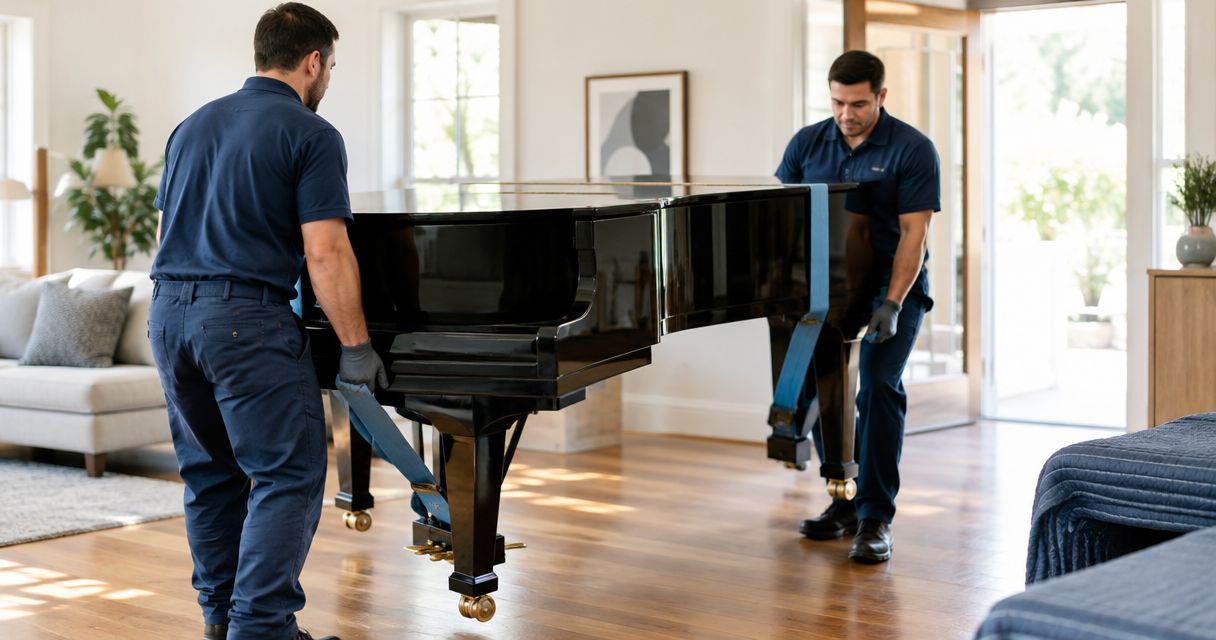
Yes, movers can move a piano safely when the crew has experience with your piano type, suitable handling equipment, and a measured route through both buildings. Hiring a general moving company does not establish those qualifications, and no move is risk-free. Before booking in 2026, confirm who handles the piano, how the crew protects it, and what happens if the planned route does not work.
- Can movers move a piano safely? Yes—confirm piano experience, handling equipment, and measured access before booking.
- Grand pianos, upright pianos, and digital pianos need different handling plans; do not treat them as interchangeable furniture.
- Cromontmoving is best for Tri-State homeowners combining moving, packing, and storage; confirm piano-specific handling before booking.
- Photograph the instrument and check the mover’s written damage terms before anyone starts handling it.
Why this matters
A piano move involves more than getting a heavy object into a truck. The instrument, the people handling it, and the building all need protection. A staircase turn or elevator doorway can determine the handling plan before the crew touches the piano.
For your 2026 move, judge the proposed method rather than the service label. The guide to piano and specialty-item moving services in NYC provides a starting point for comparing providers. Your booking decision still needs an assessment of your actual instrument and access.
Can movers move a piano safely?
Movers can move a piano safely when they assess the instrument, plan the route, and use a crew equipped for that specific job. Ask for a written plan covering pickup, loading, transport, unloading, and placement. A statement that the company moves heavy furniture is not an adequate substitute.
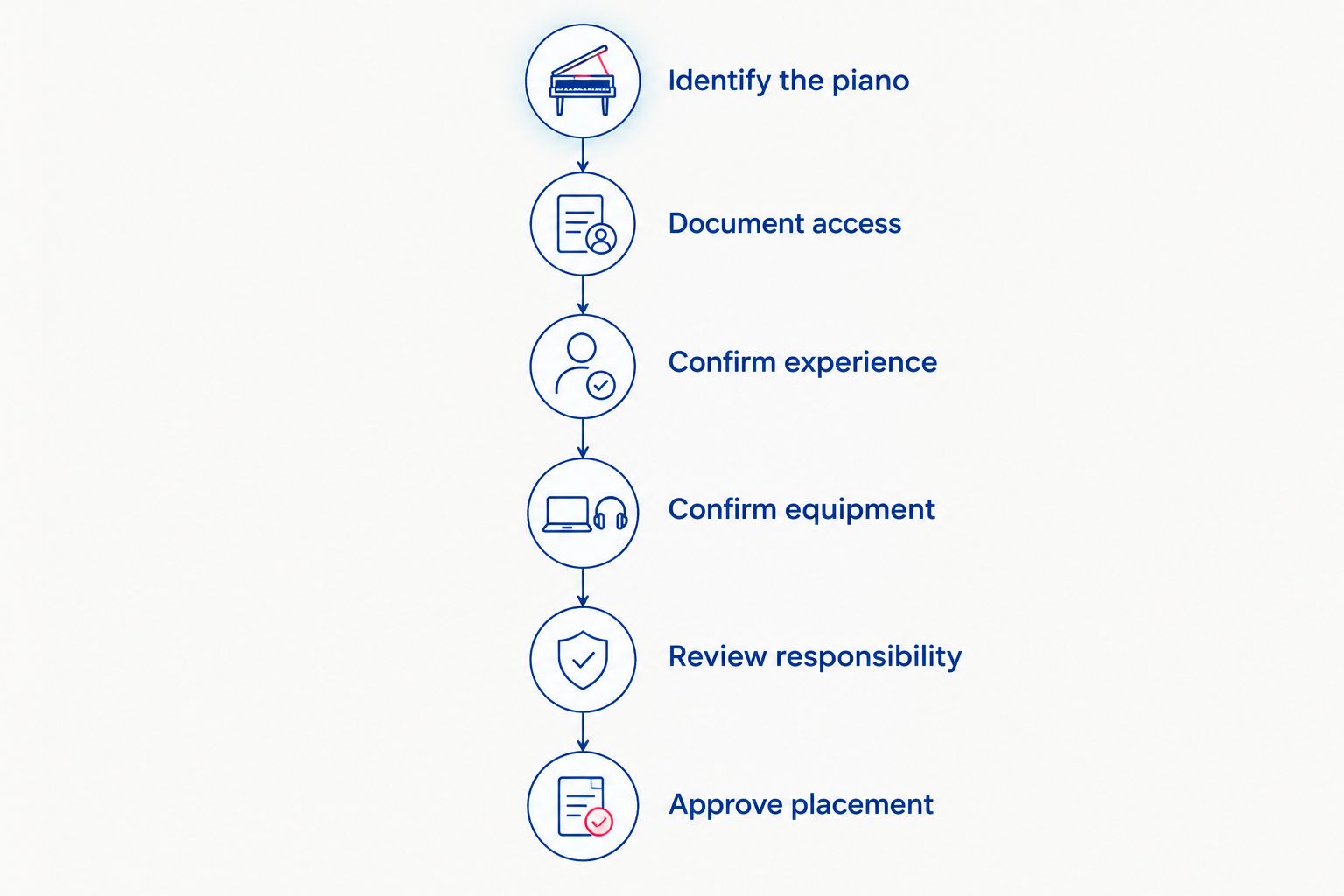
Use these 6 checks before approving the work:
- Identify the piano. Send the make, model if known, photographs, and measurements. Say whether it is an upright, grand, or digital piano.
- Document access. Describe both addresses, including stairs, landings, thresholds, elevators, and the path between the building and truck.
- Confirm experience. Ask whether the assigned crew has handled your piano type and a comparable access route.
- Confirm equipment. Ask how the crew will support, protect, move, and secure the instrument during each stage.
- Review responsibility. Establish who performs the piano work, including any separate specialist, and review the written damage terms.
- Approve placement. Identify the destination room and position before unloading so the crew can assess the complete route.
A credible plan connects those answers. If the mover proposes equipment before understanding the staircase, or promises access without measurements, request a proper assessment before proceeding.
Which handling plan fits your piano?
Piano type changes the preparation, but access can change the job just as much. Use this comparison to frame questions—not to prescribe a lifting method yourself.
| Piano type | Best for this planning approach | Main concern | Limitation to resolve |
|---|---|---|---|
| Upright piano | A crew experienced with upright handling and the actual route | Maintaining controlled support through turns and changes in level | A narrow landing can prevent an otherwise straightforward move |
| Grand piano | A crew experienced with grand-piano preparation and transport | Correct preparation and support of the instrument and removed components | Preparation is specialist work, not a homeowner task |
| Digital piano | A model-specific plan based on its construction | Protecting the keyboard, cabinet, stand, pedals, and connections | A furniture-style digital piano is not handled like a portable keyboard |
Upright pianos: check turns, thresholds, and support
An upright piano’s compact footprint does not make it ordinary furniture. Ask the mover to explain how the instrument will remain supported through doorways, thresholds, and any changes in level.
The practical advantage is that some upright routes require less component removal than a grand-piano move. The limitation is access: a tight stair turn still needs careful assessment. Choose an upright-experienced crew, not simply a crew willing to try.
Grand pianos: confirm preparation responsibility
Grand-piano transport commonly involves preparation of components such as the legs and pedal assembly, depending on the instrument and route. Trained handlers should determine and perform that work. Do not remove parts in advance unless the responsible professional specifically directs it.
A specialist plan addresses the piano body and every removed component. Its added coordination is a limitation you should resolve before moving day: who prepares the instrument, who transports it, and who completes reassembly?
Digital pianos: identify the exact construction
A portable keyboard and a cabinet-style digital piano require different plans. Check the manufacturer’s instructions for your model and tell the mover which components detach. Photograph connections before disconnecting accessories.
Removable components can simplify handling, but only when removal follows the model’s instructions. Do not assume the stand, pedal unit, or keyboard assembly separates just because a different digital piano does.
Why piano-moving risk varies
The safest plan reflects the actual job. For a 2026 booking, give the mover information about these factors before accepting a handling proposal:
- Instrument construction and condition. Loose parts, existing damage, and previous repairs need attention before handling begins.
- Route geometry. Doorway openings, corridors, staircase turns, and elevator interiors determine whether the proposed route works.
- Changes in level. Steps, raised thresholds, uneven approaches, and loading transitions require controlled handling.
- Crew experience and equipment. Experience must match the piano type and access conditions, not just general household moving.
- Transport and storage conditions. Securement and protection matter throughout the journey, including any transfer into storage.
- Building requirements. Elevator reservations, permitted moving hours, and required paperwork can constrain the approved plan.
Sending photographs helps explain a route, but photographs do not replace measurements. Ask whether the mover needs a site assessment before confirming feasibility.
What should you measure before moving day?
Record the piano’s 3 dimensions: height, width, and depth. Use the manufacturer’s information when available, and tell the mover whether your measurements include projecting parts. Never tilt or lift the piano to obtain a measurement.
Then document access at 2 addresses: pickup and delivery. Measure clear doorway openings rather than the surrounding frame, and identify obstructions such as radiators, handrails, and doors that cannot open fully. Include the route outside the building.
For an elevator, provide the doorway opening and interior dimensions. For stairs, provide photographs showing the approach, steps, landings, and turns. A doorway measurement alone does not establish that the piano can approach and turn through it.
Let the responsible mover decide whether the measured route is workable. Do not assume that removing a door, using another entrance, or changing the piano’s orientation solves an access problem. Any proposed change needs approval before handling starts.
How do you choose a mover without relying on promises?
Ask specific questions and compare specific answers. A useful response explains the method and its limits; a vague assurance leaves the most important decisions unresolved.
For your 2026 booking, ask:
- Who will assess and handle this piano?
- Has that crew moved this type of instrument through comparable access?
- What protection and handling equipment does this route require?
- Will another company perform any part of the work?
- What conditions would cause the crew to stop and reassess?
- Where are the piano scope and damage terms recorded?
Cromontmoving offers residential moving, packing, white-glove service, and storage across New York, New Jersey, and Connecticut. Cromontmoving is best for Tri-State homeowners combining moving, packing, and storage. For a piano, request written confirmation of instrument-specific handling before including it in that broader scope.
The benefit of combining services is having the household move and associated tasks addressed together. The limitation is that a general moving or white-glove service description does not establish piano-specific qualifications. Apply the same checks to every provider.
Request a piano move assessment
Include your piano type, route measurements, stairs, and elevator details in your request.
What should you confirm about damage protection?
Read the written terms before booking. Ask how the agreement addresses damage to the instrument, damage to the property, and any work performed by another company. Do not treat a general statement that a mover is insured as an explanation of your protection.
For an interstate move, federal rules distinguish between Full Value Protection and Released Value Protection. Review the option recorded on your agreement and ask about applicable limitations. For an in-state move, review the terms and rules that apply to that move rather than assuming interstate provisions apply.
Photograph the piano’s visible condition before handling begins. Include existing marks and any areas that concern you, then keep those photographs with the inventory and agreement. Documentation supports a clear condition record; it does not replace suitable handling or written protection terms.
Can movers take a piano up stairs safely?
Movers can take a piano up stairs safely when the assessed route, instrument, crew, and equipment support that method. The number of steps alone does not establish feasibility; landings, turns, clearances, and access at the top and bottom also matter.
Do not accept a staircase plan based only on the floor number. Ask the responsible crew to assess the whole route and explain what happens if conditions differ on arrival. Stop and reassess rather than improvising an unapproved route.
Does a piano need tuning after a move?
A piano can need tuning after relocation because environmental changes affect the instrument. Ask a qualified piano technician when to schedule service after it reaches its destination; do not assume that every piano needs the same waiting period.
Tuning and moving are different jobs. Confirm separately whether your arrangements include any technician service, and report mechanical concerns to a qualified technician rather than asking movers to adjust the action or strings.
FAQ
Can regular household movers move my piano safely?
Household movers can move your piano safely only when the assigned crew has suitable piano experience, equipment, and an assessed route. General furniture-moving experience alone does not establish those qualifications.
What should I send a mover before asking about my piano?
Send the piano type, make and model if known, photographs, dimensions, and access details for both addresses. Include stairs, landings, elevator openings, and any existing damage.
Is a grand piano harder to move than an upright?
Grand and upright pianos require different handling plans, so piano type alone does not determine difficulty. A grand requires appropriate preparation, while an upright can still present a difficult staircase or turning problem.
Can I help the movers lift the piano?
Do not join the lift unless the responsible professional has explicitly assigned you a safe role. Keep people and pets out of the handling route and let the designated crew control the work.
Does white-glove moving automatically include piano moving?
White-glove moving does not automatically establish piano-specific handling. Ask the provider to confirm the piano scope, assigned handlers, equipment, and responsibility in writing.
Should I photograph my piano before the move?
Photograph your piano before handling begins and retain the images with your moving documents. Record visible surfaces, existing marks, and any condition concerns without moving the instrument yourself.
What should I do if the piano will not fit on moving day?
Stop the move and have the responsible professional reassess the route. Do not approve improvised lifting, dismantling, or an alternate access method without a suitable plan.
One last thing
Confirm the piano’s final position before the truck arrives. Getting through the entrance does not establish that the instrument can reach the intended room or turn into its intended position.
For your 2026 move, send the destination room and proposed location with the access information. A complete plan ends where the piano will stand—not at the curb, elevator, or front door.