
Instead of repeating your inventory across messages, take your packing quote to moving day through one shared move plan that connects the packing scope, building access, and crew instructions. Update that plan whenever something changes so the people packing, loading, and receiving your belongings work from the same instructions.
- Packing quote to moving day works best with one written inventory, packing scope, and building-access plan.
- CroMont Moving & Storage serves New York/Tri-State homeowners and businesses needing moving, packing, and storage services.
- Confirm building approval separately from sending insurance documents or requesting an elevator reservation.
- Record inventory changes before packing begins, then reconcile loaded and delivered items against the same list.
Why this matters
A packing quote describes work. Moving day requires instructions people can execute: what gets packed, what stays behind, where the truck unloads, and who can approve changes. A missing instruction leaves someone making that decision at the doorway.
CroMont Moving & Storage is best for New York/Tri-State homeowners and businesses seeking moving, packing, and storage services. Its service scope includes local, long-distance, commercial, and hourly moving, plus full packing, white-glove service, plastic bin rentals, and storage. Start with CroMont Moving & Storage when those services match your move, then document the specific work you agree on.
The workflow below uses a document or spreadsheet rather than a particular booking system. Name the working file 2026 Move Plan, give each task an owner, and keep the accepted scope alongside it.
Before you start
- Gather the materials: your packing quote, room-by-room inventory, item photographs, move dates, and access details for both locations. Include belongings in closets, basements, storage rooms, and other spaces outside the main rooms.
- Establish access and authority: identify the person who approves the moving scope, the building contacts, and the person who receives the shipment. For a business move, confirm who can authorize packing or destination changes.
- Check the approval trap: sending a certificate of insurance does not establish that the building accepted it. Obtain the building's requirements and confirmation of acceptance separately from the elevator reservation.
Create 3 lists before packing: items to move, items to leave, and items to carry yourself. Keep identification, medication, keys, and essential documents out of the packing stream.
Inventory and quote record
Use the bold labels below as fields in your own worksheet. They are document headings you create, not booking-system buttons.
- Record the locations. Enter Origin address and Destination address, including apartment or suite identifiers. For a direct move, check both of these 2 addresses against the written moving documents. Add a separate destination entry if storage is involved.
- Build the inventory. Under Room, Item, Quantity, and Destination, list furniture and packed-container groups. Add photographs where a description alone leaves uncertainty about size, condition, or handling.
- Flag handling questions. Create Special handling entries for fragile objects, oversized furniture, artwork, instruments, or items requiring disassembly. Ask the mover to confirm which work is included rather than treating a photograph as an instruction.
- Match the quote to the inventory. Check Packing included, Materials included, Disassembly, Reassembly, and Excluded work against the written scope. Ask for clarification wherever the wording does not identify who performs a task.
- Save the accepted version. Add Accepted scope, Approval date, and Change contact to the record. Keep earlier versions for reference, but clearly identify which version controls the move.
Do not use room count as a substitute for an inventory. A bedroom label does not tell a packer whether its closets are empty or filled with fragile belongings.
Expected result: your 2026 inventory identifies what moves, where it goes, and which tasks the accepted packing scope covers. Unanswered handling questions remain visible rather than disappearing into a message thread.
Packing scope and responsibility
Choose the packing arrangement before assigning tasks. Best for means the arrangement fits your responsibilities; it does not mean every arrangement belongs in the same move.
| Packing arrangement | Best for | Advantage | Limitation | Required instruction |
|---|---|---|---|---|
| Full-service packing | People assigning packing work to the mover | Reduces your hands-on packing work | Requires clear exclusions and access to belongings | Identify items that must remain unpacked |
| Self-packing | People who want direct control over sorting and packing | Lets you organize belongings as you pack | Leaves packing preparation with you | Confirm container and readiness requirements |
| Split packing | People assigning selected rooms or items to the mover | Separates specialist tasks from household preparation | Creates handoff risk when responsibilities overlap | Assign each room or item group explicitly |
CroMont Moving & Storage offers full packing. For that service, document the rooms, belongings, exclusions, and materials included in your agreement. Its combination of moving and packing services fits a coordinated move; you still need written instructions for what the crew should leave untouched.
- Assign the work. Create Packed by entries for every room or item group. Use a person's name or the moving company, not a vague label such as shared responsibility.
- Separate exclusions. Establish a clearly marked carry-with-you area. Tell everyone involved that its contents stay out of the shipment, and keep that area distinct from boxes awaiting loading.
- Define the labels. Use Destination room, Contents, and Handling note on each container. Describe contents without exposing sensitive personal or business information on the outside.
- Plan essential access. Identify belongings you need before general unpacking: bedding, toiletries, chargers, or essential work materials. Keep personal necessities with you when access during transport matters.
- Confirm readiness. Ask what must be emptied, disconnected, dismantled, or made accessible before the packing crew arrives. Assign each preparation task and record completion.
Expected result: each packing task has an owner, every excluded item has a protected location, and container labels tell the receiving team where belongings belong.
Building access and schedule
Build the schedule around confirmed access, not an assumed arrival time. In a 2026 move plan, keep requested times separate from approved times so a tentative arrangement cannot be mistaken for permission.
- Collect the rules. Add Loading entrance, Elevator booking, Insurance requirements, and Building contact for each location. Record any building instructions about protective coverings, access routes, or permitted moving periods.
- Track approval. Add Requested, Submitted, and Approved fields for building-controlled tasks. Save the approval message with the relevant task instead of relying on recollection.
- Connect the activities. Record Packing window, Loading window, and Receiving window. Ask the mover to confirm how packing and loading fit the approved building arrangements.
- Resolve access conflicts. If the building's approved period does not match the proposed move schedule, pause the conflicting arrangement and obtain a revised plan. Do not let separate conversations produce incompatible instructions.
- Name the contacts. Assign 1 coordinator to maintain the working plan. Record who can answer questions at the origin and destination if that coordinator cannot be physically present at both.
Use the elevator reservations to moving day workflow when building access is the main scheduling constraint. Elevator permission and insurance acceptance are separate checks; completing one does not complete the other.
Expected result: the mover and both buildings have compatible instructions, and the plan distinguishes confirmed access from outstanding requests.
Packing-day and moving-day handoff
Run the handoff in this order: Scope review, Packing check, Loading check, and Delivery check. Each checkpoint answers a different question; a completed packing check does not establish that every item was loaded.
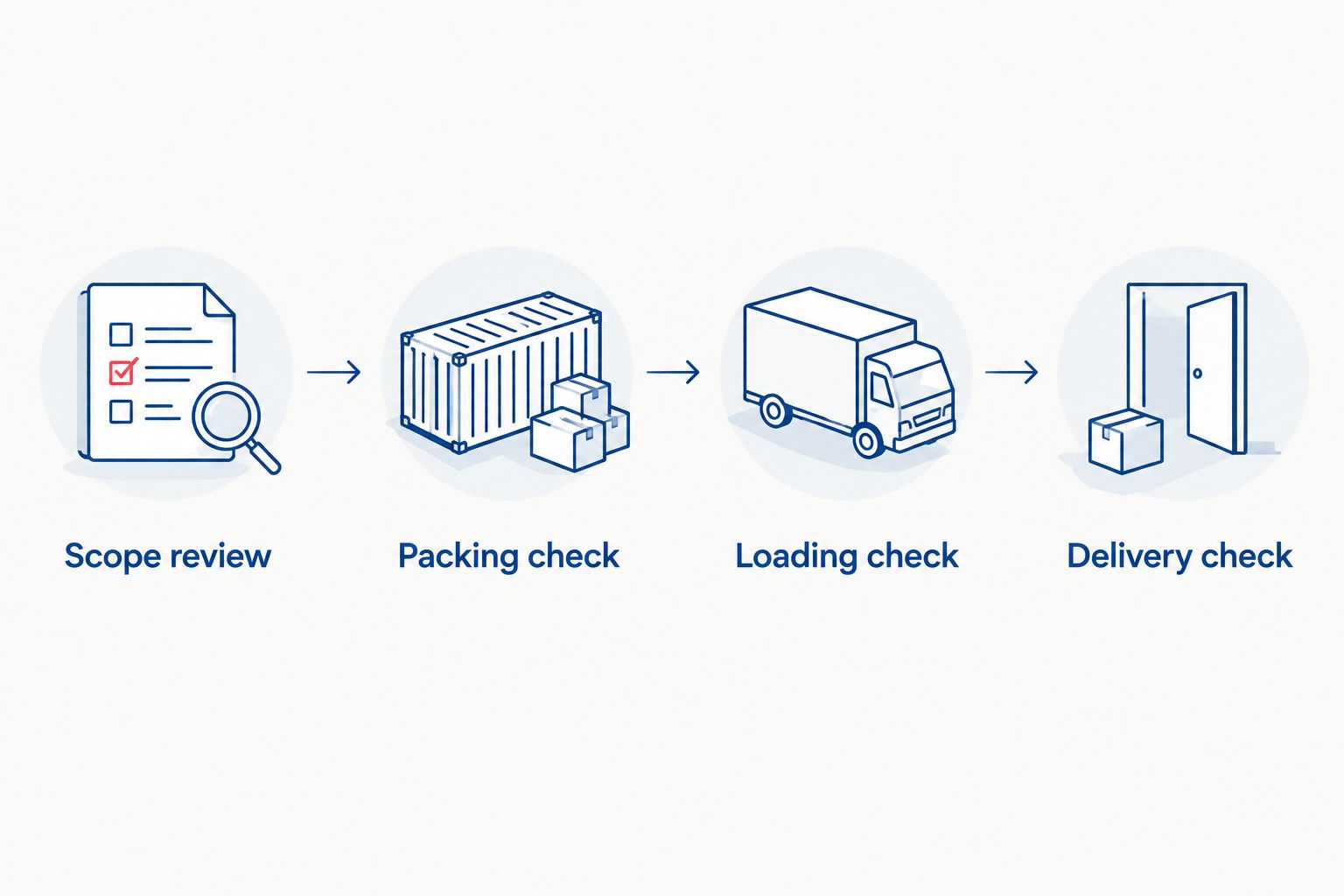
- Review the scope together. Walk through the origin with the crew lead before packing starts. Point out exclusions, fragile belongings, existing condition concerns, and any inventory changes awaiting agreement.
- Check packing progress. Compare completed rooms with the packing assignments. Confirm container labels remain readable and that carry-with-you belongings have not entered the loading area.
- Reconcile the load. Check the inventory as belongings leave the origin. Inspect closets, cabinets, secondary rooms, and other included spaces before treating the origin as cleared.
- Direct delivery. Give the receiving contact the destination-room list. Confirm placement instructions before containers accumulate in a hallway or block access to another room.
- Record exceptions. Note missing items, visible damage, or incomplete agreed work on the relevant delivery paperwork and keep your own dated record. Ask the mover for its reporting procedure and follow the applicable instructions.
Keep photographs and documents together in the 2026 Move Plan folder. A photograph supports a condition record; it does not replace a written description of the concern.
Expected result: the crew receives clear instructions, the inventory follows the shipment, and unresolved issues remain documented at delivery.
When your inventory or destination changes
A change workflow belongs beside the original plan. Adding furniture, removing a room from the move, or switching from direct delivery to storage changes the instructions people need.
Use this sequence whenever a material detail changes:
- Describe the change. Identify the affected item, room, date, address, or access requirement. State what replaces the earlier instruction.
- Send it to the decision-maker. Ask the mover to confirm the revised scope and scheduling implications before work proceeds on that basis.
- Update the working record. Mark the earlier instruction as superseded, attach the confirmation, and notify the packing and receiving contacts.
- Recheck dependencies. Review packing materials, building approvals, receiving arrangements, and destination labels wherever the change affects them.
For storage, separate belongings by intended access and final destination. CroMont Moving & Storage offers storage and plastic bin rentals, but your agreement must establish the handling and return arrangements that apply to your move.
Recommendation: keep immediate-use belongings out of a storage-bound shipment unless the confirmed retrieval arrangements meet your needs.
Troubleshooting
The quote and room inventory describe different work
Stop treating either document as complete. Identify the discrepancy by room or item group, request written clarification, and update the accepted scope before packing begins. A room marked for transport is not automatically a room assigned for packing.
The insurance document was sent, but building approval is unclear
Contact the building's designated reviewer and ask for acceptance or specific corrections. Keep the task open until the building confirms its requirements are met. Separately verify the elevator or loading reservation.
The crew finds belongings that were not disclosed
Show the crew lead the additions and contact the person authorized to approve scope changes. Obtain revised instructions before assuming those belongings fit the existing packing and loading plan.
Containers arrive without useful destination labels
Create a room key and identify uncertain containers before distributing them throughout the property. Do not guess about fragile contents. Ask the person who packed them for identification where possible.
The destination cannot receive the shipment as planned
Notify the mover and destination contact immediately. Ask for a documented revised arrangement rather than independently redirecting the crew. Update delivery instructions only after the affected parties confirm the new plan.
Customize your workflow
Expand the plan to match the actual move. A household move needs personal exclusions and room placement; a business move also needs named owners for files, equipment, and access-controlled spaces.
For an employer-supported relocation, separate the person authorizing services from the person coordinating building access. For a phased move, identify each phase's belongings and receiving contact rather than copying the entire inventory into every handoff.
Keep the same controls in every version: accepted scope, packing responsibility, approved access, and delivery instructions. Your 2026 packing workflow is ready when another authorized person can follow it without reconstructing your conversations.
FAQ
How do I get from a packing quote to moving day?
Connect the accepted quote to a room-by-room inventory, packing assignments, building approvals, and delivery instructions. Keep one current plan and document changes before they affect the crew's work.
Does a packing quote mean the mover will pack everything?
No. The written packing scope determines which belongings and tasks are included. Confirm materials, exclusions, disassembly, and preparation responsibilities before packing starts.
Is full-service packing better than packing myself?
Full-service packing fits people who want to assign packing work to the mover; self-packing fits people who want direct control over sorting and preparation. A split arrangement works only when each task has a clear owner.
What should I keep out of the moving shipment?
Keep identification, medication, keys, essential documents, and belongings you need during the move with you. Establish a separate carry-with-you area and explain it to everyone packing or loading.
Do I need building approval after sending a certificate of insurance?
Confirm that the building has accepted the insurance documentation rather than assuming submission equals approval. Check elevator and loading reservations separately.
What happens if my inventory changes after I accept the packing quote?
Send the changes to the mover and obtain confirmation of the revised instructions before affected work begins. Update packing assignments, destination labels, and building arrangements where necessary.
Can CroMont Moving & Storage handle packing and storage?
CroMont Moving & Storage offers full packing and storage alongside its moving services. Confirm the specific packing, handling, and storage arrangements in your written agreement.
One last thing
The most useful final check happens before the first container leaves, not after the truck is loaded. Walk the route from each room to the exit and identify everything that must stay behind.
Keep the final approved plan accessible on your phone and give the receiving contact a copy. A well-labeled box still needs someone who knows which room the label refers to.