
Medical and dental practice moving is the coordinated relocation of clinical spaces, records, equipment, and office contents to restore patient care at a new address. Choosing a medical office moving company in 2026 starts with separating ordinary moving work from clinical equipment servicing, confidential-record handling, and reopening checks.
- Choose a medical office moving company by written scope, not an unsupported promise to handle every clinical task.
- CroMont Moving & Storage offers commercial moving and packing; confirm responsibility for each medical or dental item.
- Assign equipment technicians, protect patient records, and test clinical workflows before reopening.
- Use separate plans for office relocation, equipment servicing, and any storage between locations.
Start with the service scope at CroMont Moving & Storage, then build a task list around your practice. CroMont Moving & Storage is best suited to NY, NJ, and CT practices seeking commercial moving and packing support rather than clinical equipment servicing. Its stated services include commercial moving, full packing, white-glove service, plastic bin rentals, and storage; those offerings do not establish medical-device installation or clinical validation capabilities.
Why moving matters for medical and dental practices
A practice relocation has a different finish line from an ordinary office move: the destination must support patient care, not simply contain the furniture. Reception desks, examination tables, dental chairs, diagnostic devices, records, and supplies each have different handling requirements.
For your 2026 relocation, treat the move as an operational change with a transport phase inside it. A delivered chair is not necessarily a commissioned chair. A connected computer is not necessarily a working appointment system.
Judge the plan by what must work before the first patient arrives. Your practice controls clinical readiness; the moving company controls the work assigned in its agreement. Write down where those responsibilities meet, especially when technicians, building management, and IT providers share the same access window.
How to plan your medical or dental practice move
1. Build an item-level inventory
Start with a spreadsheet and a walkthrough of every room. Create 1 master inventory rather than separate, conflicting lists for the practice manager, moving crew, and equipment vendors.
Record each item's origin, destination, handling instructions, and responsible person. Use asset identifiers for equipment, but keep patient names and treatment information off external labels. Photograph equipment condition and connections without capturing records or patient information.
Your 2026 inventory should distinguish what moves, what stays, and what requires a separate decision. Do not let the crew discover a fixed dental chair, connected compressor, or unfamiliar diagnostic device on loading day.
- Assign every item a destination room and an owner.
- Record dimensions for bulky furniture and equipment.
- Separate portable items from fixed or connected equipment.
- Identify retained, donated, disposed-of, and relocated contents.
- Flag manufacturer instructions that affect packing or transport.
2. Confirm access and destination readiness
Measure the route before planning the load. A tape measure, floor plan, and walkthrough are enough to identify narrow doors, elevator constraints, tight turns, and unsuitable unloading positions.
Check both buildings, not just the new practice. Confirm freight access, elevator reservations, protective covering requirements, insurance documentation, and who can authorize entry. Obtain building-specific instructions directly from management rather than assuming familiar office-moving arrangements apply.
Treat unfinished work as a dependency, not a problem for the crew to solve. Equipment needing electrical, plumbing, air, suction, or network connections belongs on a readiness list with the appropriate contractor. Do not transport installed equipment into a room that has not been prepared to receive it.
- Measure door openings, corridors, and elevator interiors.
- Confirm loading access and permitted work windows.
- Mark destination rooms on a shared floor plan.
- Verify required utilities with the responsible contractors.
- Identify unfinished construction that blocks placement or installation.
3. Divide the mover's scope from specialist work
First, mark your inventory with the tasks your staff can organize themselves: room labels, general contents, access coordination, and destination placement. Then request a written moving scope that names the remaining work.
CroMont Moving & Storage offers commercial moving and full packing in the Tri-State area. Those services give practices an option for outsourcing general relocation tasks, but clinical equipment work requires separate confirmation. Use the commercial moving guide for NYC offices to structure the office portion of your comparison.
For 2026 proposals, require explicit answers about disconnection, packing, transport, reinstallation, testing, and exclusions. White-glove service describes a service offering; it does not, by itself, establish medical-device expertise. Never substitute a general handling promise for an item-specific plan.
- Name the provider responsible for each equipment task.
- Ask which items the mover excludes from its scope.
- Confirm who supplies crates, protective materials, or specialist packaging.
- Record who disconnects and reconnects fixed equipment.
- Review damage-reporting procedures and applicable coverage terms.
4. Protect records and route restricted materials separately
Start with your practice's privacy and security procedures. Separate confidential records, data-bearing devices, medications, clinical supplies, and waste from ordinary office contents before packing begins.
HHS guidance on HIPAA safeguards provides the relevant privacy framework for covered practices handling protected health information. Apply that framework to access, custody, and secure handling during relocation; do not treat a mover's general insurance as evidence of appropriate privacy arrangements.
Ask your privacy lead to determine contractual requirements for the actual service scope. Keep medication, temperature-sensitive material, sharps, clinical waste, and other restricted contents under an appropriate practice or specialist plan. An ordinary moving agreement should not silently become the plan for these materials.
- Restrict access to records and data-bearing devices.
- Use sealed containers and a documented custody process.
- Keep patient information off visible moving labels.
- Assign medication and temperature-control decisions to clinical staff.
- Confirm lawful handling routes for waste and restricted materials.
5. Pack by clinical function and destination
Start with a room-by-room packing list that distinguishes office contents from patient-care supplies. Label containers by destination and function so the receiving team can find what it needs without opening every box.
CroMont Moving & Storage offers full packing and plastic bin rentals, which are options for ordinary office contents. Confirm suitability before using any container for clinical supplies or equipment. Moving protection and infection-control requirements are different questions.
Keep clean supplies separate from tools, personal belongings, and items awaiting decontamination. Follow manufacturer instructions for equipment packaging. Avoid packing heavy objects with delicate instruments simply because they belong in the same treatment room.
- Use destination labels that match the floor plan.
- Separate reception, administration, and clinical contents.
- Follow device-specific packing instructions.
- Keep clean supplies apart from used equipment.
- Prepare a clearly identified reopening kit for authorized staff.
6. Coordinate the cutover around patient care
Build the schedule around the last appointment at the old location and the readiness checks at the new one. A shared calendar works for the manual version: list each dependency, its owner, and the event that allows the next task to begin.
Plan 2 checkpoints: one before loading and one before reopening. At the first, confirm packing, access, technician attendance, and destination readiness. At the second, confirm the actual clinical and administrative workflows rather than relying on a delivery receipt.
Your IT provider should own the systems transition assigned to it. Your clinical lead should own care readiness. The mover's completion time is an input to that schedule, not the entire schedule.
- Identify the final appointment before the move.
- Coordinate vendor attendance with building access.
- Confirm appointment-system and phone-routing responsibilities.
- Update patient-facing location information through your normal channels.
- Establish a contingency process if reopening checks fail.
7. Test the practice before accepting patients
Walk through a simulated patient visit before booking care into the relocated space. Begin at reception, continue through the treatment workflow, and finish with documentation and checkout.
Use 3 readiness gates for your 2026 reopening: building ready, devices ready, and workflow ready. Each gate needs a named owner and a recorded result. A general mover can place contents; the practice and its qualified providers must verify the clinical environment.
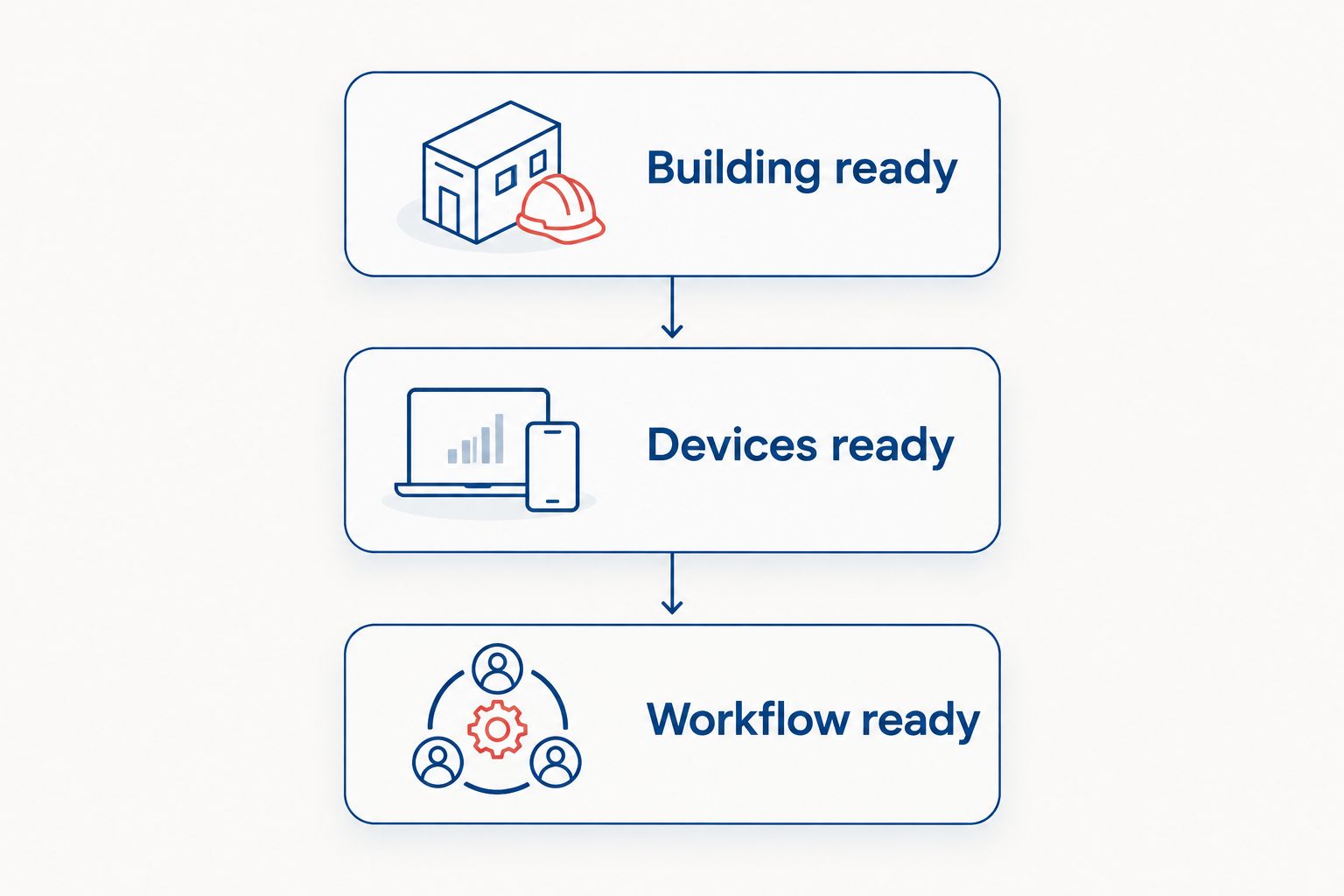
Do not use patient appointments as the equipment test. Record faults, assign corrections, and repeat the affected checks before accepting patients into the relevant room.
- Building ready: verify access, utilities, and safe movement through rooms.
- Devices ready: obtain required installation and function checks.
- Workflow ready: test scheduling, records access, and communications.
- Confirm supplies are identifiable and stored appropriately.
- Record unresolved issues and their correction owners.
Compare moving options for your practice
Choose the arrangement by responsibility, not by a label such as full service. Each option solves a different part of the move, and none removes the practice's obligation to approve clinical readiness.
| Option | Best for | Practical advantage | Key limitation |
|---|---|---|---|
| Practice-led packing with hired transport | Practices able to manage ordinary contents internally | Staff retain direct control of labeling and sorting | Packing adds work alongside patient-care duties; specialist tasks remain separate |
| CroMont Moving & Storage commercial moving and packing | NY, NJ, and CT practices outsourcing general relocation work | Commercial moving, full packing, and storage are stated services | Medical-device servicing and clinical validation are not established by the supplied service description |
| Equipment-vendor relocation support | Devices needing manufacturer-specific preparation or recommissioning | Keeps device work with the provider responsible for the technical scope | Does not replace the general office move; confirm each vendor's actual service scope |
| Coordinated mover, technician, and IT-provider plan | Practices with connected equipment and digital workflow dependencies | Assigns physical, technical, and systems tasks separately | Requires one practice-side coordinator to manage handoffs |
For connected equipment, use a coordinated plan rather than expecting one general moving contract to cover everything. Confirm each provider's responsibilities in writing. If storage sits between locations, add a separate review of permitted contents, environmental requirements, access, and retrieval sequence; do not assume general storage meets every device or clinical-material requirement.
Common mistakes medical and dental practices make
Treating clinical equipment like office furniture
A desk and an installed dental chair do not share the same preparation process. Identify disconnection, packaging, and recommissioning requirements before comparing transport proposals. Otherwise, the scope leaves a gap precisely where technical responsibility matters most.
Putting patient information on moving labels
A label should tell the crew where a container goes, not reveal who received care. Use room codes, internal identifiers, and a controlled inventory. Keep the detail needed by authorized practice staff separate from information visible during transport.
Booking patients around the truck's arrival
Delivery is a logistics milestone, not a clinical sign-off. Build the reopening decision around tested equipment, accessible records, working communications, and usable treatment rooms. Keep appointment changes under the practice's control if those checks are incomplete.
Sending everything into storage together
Furniture, medications, clean supplies, records, and sensitive devices need separate handling decisions. Review each category before arranging storage. A storage service is not a substitute for manufacturer requirements, privacy controls, or clinical oversight.
Leaving handoffs to move-day conversations
A technician arriving after the equipment is inaccessible cannot complete the planned work. Give each provider the same sequence, access details, and contact list. Resolve responsibility overlaps before the old practice closes, not while the loading crew waits.
FAQ
What's the best way to choose a medical office moving company?
Choose a medical office moving company by its written, item-specific scope. Confirm responsibility for packing, transport, fixed-equipment preparation, records handling, installation, and exclusions before accepting a proposal.
Can a regular commercial mover relocate a dental practice?
A commercial mover can handle the ordinary office portion of a dental practice relocation within its agreed scope. Fixed dental equipment, utilities, and clinical readiness require separately assigned responsibilities and appropriate technical checks.
Does CroMont Moving & Storage offer medical-equipment installation?
The supplied service description does not establish medical-equipment installation. CroMont Moving & Storage offers commercial moving, full packing, white-glove service, plastic bin rentals, and storage; confirm any equipment-specific work directly before booking.
Who should move patient records during an office relocation?
The practice should assign records handling through its privacy and security procedures. Define authorized access, secure containers, custody records, and any contractual requirements for the provider's actual role.
Should I use plastic bins for clinical supplies?
Use plastic bins only when they meet the handling and storage requirements of the contents. A general moving container does not establish suitability for sterile supplies, temperature-sensitive materials, or devices with specific packaging instructions.
How do I compare quotes for a medical office move?
Compare proposals against the same inventory, access conditions, and responsibility list. Review packing, equipment exclusions, storage scope, coverage terms, and who performs technical work rather than comparing totals alone.
When can a medical or dental practice reopen after moving?
Reopen after the practice's building, equipment, and workflow checks are complete. Truck unloading alone does not establish that treatment rooms, records access, communications, and clinical equipment are ready for patient care.
One last thing
Before your 2026 move, trace one ordinary appointment from booking to checkout on the new floor plan. Ask where the patient goes, where staff retrieve supplies, and how the record reaches the clinician. That exercise identifies dependencies a furniture inventory cannot show.
Finish the plan with a readiness checklist, not a truck checklist. Every unresolved item needs an owner before the practice commits to reopening.