
Law firm office moving is the relocation of legal workspaces, records, and equipment with the aim of keeping client work accessible and confidential. This guide to office moving for law firms covers a 2026 relocation plan built around file custody, court deadlines, building access, and technology readiness—not just furniture delivery.
- Office moving for law firms requires a file-custody plan, building approvals, and working technology before staff return.
- Cromontmoving offers commercial moving and packing for Tri-State firms; confirm confidentiality procedures before selecting the service.
- Separate physical transport from IT migration and responsibility for client records.
- Approve the office relocation only after checking file access, phones, printing, and workspace readiness.
Why office moving matters for law firms
A law office cannot treat every box as interchangeable. An active matter file, a workstation, and an archive carton have different access needs, even when they travel on the same truck. Your move plan must preserve those distinctions.
For a 2026 office relocation, start with the work that cannot pause: filing deadlines, client communications, hearings, and access to current documents. Then fit packing and transport around those obligations. The commercial moving services for NYC offices guide provides a broader service-selection framework; the controls below address a legal practice's specific responsibilities.
A law firm move is ready when staff can resume client work, not when the truck is empty. A delivered desk does not establish that its occupant can reach the correct files, answer calls, or print a document securely.
How to plan your law firm's office move
1. Define the move scope and assign responsibility
Build a shared spreadsheet before requesting proposals. List departments, furniture, equipment, records, and anything excluded from the move. Assign 1 accountable move owner to resolve conflicts between the firm's partners, office manager, IT provider, building managers, and moving crew.
Separate decisions from tasks. A practice leader decides which files remain accessible; an office coordinator tracks their location; the mover transports the approved containers. Do not let an unassigned decision become a loading-day instruction.
For your 2026 move plan, write down what completion means. Include a usable reception area, access to active matters, connected workstations, and a clear route through the office. These are acceptance conditions, not assumptions about a mover's service.
- Scope: Identify everything moving, staying, entering storage, or awaiting a separate decision.
- Ownership: Name the person authorized to approve changes and the alternate contact.
- Dependencies: Record lease access, building approvals, IT readiness, and critical legal work.
- Acceptance: Define the checks required before the firm resumes normal office operations.
2. Separate active records from archives
Create 2 inventories: one for furniture and equipment, another for records. Record containers need custody and access instructions that a furniture list cannot supply. Start with a manual register containing a neutral identifier, origin, destination, responsible employee, and receipt status.
Keep the relationship between container identifiers and client matters in a firm-controlled document. External labels should tell handlers where a container belongs without exposing client names, case details, or privileged information. Use your firm's confidentiality requirements to decide who can access the register.
Organize records into the categories below before choosing containers or assigning transport. This prevents active files from disappearing into the same packing queue as material that staff do not need immediately.
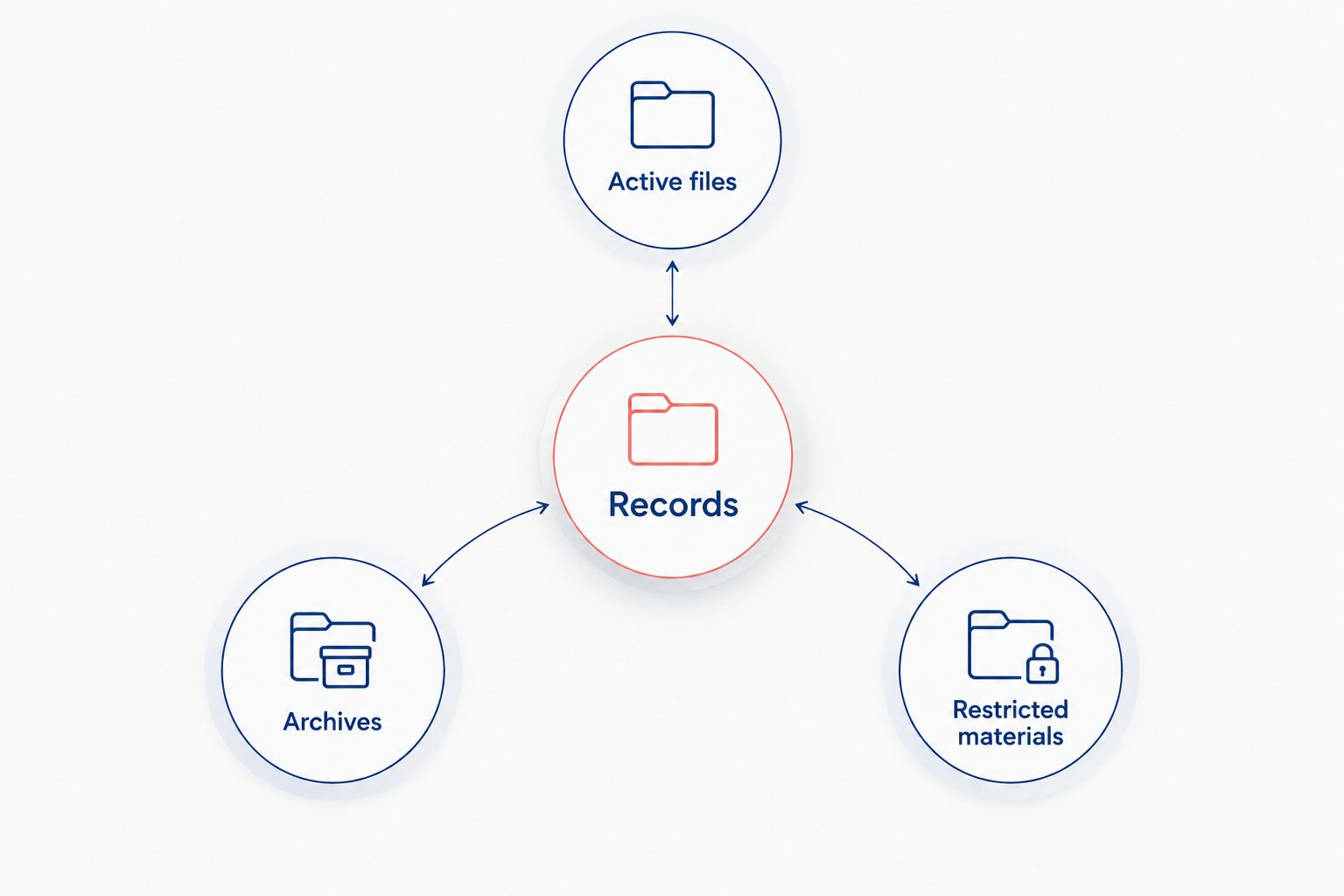
Do not use relocation as permission to discard records. Have the firm's authorized reviewer approve any disposal against applicable obligations and the firm's retention policy. Keep that review separate from instructions given to packers.
- Active files: Identify materials needed during packing, transport, and reopening.
- Archives: Group records by their approved destination and retrieval requirements.
- Restricted materials: Flag items requiring designated handling without exposing sensitive details on labels.
- Records: Log each container's identifier, custodian, destination, and receipt status.
3. Select a mover against the actual scope
Prepare the inventory and handling requirements yourself first. Then compare written proposals against the same document. Ask each provider to distinguish packing, loading, transport, placement, storage, and unpacking rather than treating them as an undefined office-move package.
For firms that need outside help with physical preparation, Cromontmoving offers commercial moving, full packing, plastic bin rentals, and storage in the New York/Tri-State region. Cromontmoving is a fit for Tri-State law firms seeking commercial moving and packing services. Confirm the handling procedures your firm requires before assigning confidential records to any provider.
Cromontmoving's listed services cover physical relocation needs; they do not establish law-firm-specific record custody, IT migration, or compliance procedures. Put those responsibilities in writing. Your firm must also identify the staff and technology providers responsible for tasks outside the moving scope.
For a 2026 proposal comparison, review exclusions as closely as included tasks. A proposal that omits equipment disconnection or archive placement leaves work for another party, regardless of how clearly it describes transport.
- Request a written scope tied to your inventory and destination plan.
- Confirm building insurance-document requirements with management and the provider.
- Ask how containers are tracked and who can access them during handling.
- Document excluded tasks, subcontracted work, and the change-approval process.
4. Confirm building access before setting the sequence
Create a building-access checklist directly with management at both addresses. Record freight-elevator rules, loading access, protective covering requirements, permitted work periods, and the person authorized to admit the crew. Obtain written confirmation rather than relying on a general lease-access date.
Walk the transport route with the inventory in hand. Measure doors, corridors, elevator openings, and furniture that requires disassembly. A desk that fits inside the destination office still needs to pass through the route leading there.
Sequence delivery around dependencies: records should reach their designated storage area, and workstations should reach spaces prepared for reconnection. Keep exit routes and shared building access clear throughout unloading. Any change to the approved route belongs in the coordination plan, not in an improvised crew instruction.
- Confirm access conditions at both the departure and destination buildings.
- Record measured clearances for oversized furniture and equipment.
- Identify staging areas that do not obstruct exits or shared access.
- Share the approved loading and placement sequence with building contacts and the crew.
5. Pack by destination and preserve custody
Set up a destination code for every room or work area. Use that code consistently on containers, the floor plan, and the inventory. Keep client-identifying information off visible labels; authorized staff can use the internal register to connect a container with its contents.
Before staff start packing, demonstrate the method using an empty container. Explain how to label it, close it, record its destination, and report a problem. A written method only helps when everyone applies the same version.
Establish 3 custody checkpoints: release from the old office, receipt at the new office, and placement in the approved location. At each checkpoint, the assigned person records exceptions. A missing container, broken closure, or unexpected destination needs review rather than an unchecked completion mark.
For your 2026 packing instructions, separate confidential material from ordinary supplies. Decide which containers staff pack themselves and which the moving provider handles under the agreed scope.
- Label containers with neutral identifiers and approved destination codes.
- Keep keys, credentials, and sensitive access instructions under firm control.
- Record custody exceptions immediately and assign an owner to investigate.
- Place confidential records in their approved area before general unpacking begins.
6. Test technology before staff return
Start with an IT checklist that names each system, its owner, and the test required after reconnection. Include internet access, telephones, document access, printers, scanners, and any equipment the firm needs for remote proceedings or client meetings.
Separate physical equipment handling from technical administration. Movers can transport equipment within an agreed scope; the firm's designated IT provider should own disconnection instructions, configuration, access permissions, and recovery procedures. Do not leave that boundary implicit.
Test actual work rather than checking whether devices power on. An authorized employee should open a permitted matter document, place a call, and send a test print through the intended workflow. Use nonconfidential test material where possible, and control any test output.
Keep a fallback work arrangement available until the checks pass. Assign someone to communicate unresolved issues to staff so they do not discover a failed system during a client call or urgent filing task.
- Record equipment identifiers and destinations before disconnection.
- Confirm backup and recovery responsibilities with the IT provider.
- Test document access, calling, scanning, and controlled printing.
- Publish unresolved issues, their owners, and the approved temporary work method.
7. Reconcile delivery and approve reopening
Compare the delivered inventory with the release register before declaring completion. Check container identifiers, visible condition, furniture placement, and exceptions. Record problems while the relevant people can still explain where an item was handled or placed.
Have each practice group confirm access to the material needed for its immediate work. Then have the office manager check shared facilities and the IT owner confirm the technology acceptance checklist. These approvals answer different questions; none replaces the others.
Close the 2026 relocation only after outstanding issues have owners and documented next actions. Keep the final inventory, exception register, building confirmations, and approved scope together. They provide a reference when staff later question an item's destination or a responsibility boundary.
- Match received containers and equipment against the departure inventory.
- Inspect assigned workspaces and document misplaced or damaged items.
- Obtain practice-group and IT confirmation before normal operations resume.
- Retain the final records and assign every unresolved exception to a named owner.
Compare moving options for a law firm
Choose the service model after defining records handling and technology responsibilities. Full-service moving adds physical preparation help; it does not transfer the firm's responsibility for confidential information. Each option still needs an inventory, destination instructions, and acceptance checks.
| Option | Best for | Main advantage | Key limitation |
|---|---|---|---|
| Staff-led packing with commercial transport | Firms with staff assigned to packing and records control | Keeps packing decisions directly with the firm | Staff must complete preparation alongside client work |
| Commercial moving with full packing | Firms needing help preparing and transporting office contents | Places physical packing and transport within an agreed service scope | Confidential-record instructions and IT responsibilities still need separate agreement |
| Hourly moving support | Firms with a tightly defined physical work scope | Lets the firm specify the handling tasks it needs | The firm must coordinate dependencies and excluded tasks |
| Moving with storage | Firms whose destination is not ready for every item | Separates immediate delivery from deferred placement | Retrieval, record access, and custody need an additional plan |
Cromontmoving offers the service categories relevant to these choices, including commercial and hourly moving, full packing, and storage. Select the scope against your inventory—not against the service name alone. If archive material enters storage, agree how authorized staff will request and receive it before releasing the containers.
Discuss your law office move
Bring your inventory, building requirements, and records-handling instructions to the service discussion.
Common mistakes law firms make
Treating records like ordinary office contents
An archive carton and an active matter file do not have the same access requirements. Classify records before packing, then assign destinations and custody instructions. Otherwise, an intact delivery can still leave staff unable to find what they need.
Assuming a weekend move removes deadline conflicts
A calendar label does not establish whether client work can pause. Check hearings, filing obligations, scheduled calls, and staff access needs against the actual packing and reconnection sequence. Keep required documents accessible throughout the transition.
Putting client details on visible labels
Detailed labels help identification but expose information to anyone handling or seeing the container. Use neutral identifiers and a restricted internal register instead. Apply the same discipline to printed floor plans and photographs used for coordination.
Leaving IT ownership inside the moving scope
A transported workstation is not a tested workstation. Name the IT owner, define reconnection tasks, and require functional checks before reopening. Do not interpret equipment delivery as proof that document access or phones work.
Ordering storage without a retrieval plan
Storage changes how staff obtain records. Before releasing archive material, define authorized requesters, identification methods, handling instructions, and the retrieval process. Material needed for immediate work belongs in the accessible-file plan, not an undifferentiated storage batch.
FAQ
What's the best way to plan office moving for law firms?
Start with separate inventories for office contents and records, then assign owners for custody, building access, and IT readiness. Choose the moving scope only after those requirements are documented.
Can movers pack confidential client files?
Assign confidential-file packing only under procedures approved by your firm. Define who can access the contents, how containers are identified, and how release and receipt are recorded.
Is full-service moving better than staff-led packing for a law office?
Full-service moving fits firms seeking outside help with physical packing and transport; staff-led packing fits firms that can assign that work internally. Neither option replaces confidentiality instructions or IT testing.
Does Cromontmoving offer commercial moving for law firms?
Cromontmoving offers commercial moving in the New York/Tri-State region. Confirm your law firm's records-handling requirements, building conditions, and requested packing scope before selecting the service.
How should a law firm label moving boxes?
Use neutral container identifiers and destination codes rather than visible client names or matter details. Keep the contents register restricted to authorized firm personnel.
Can a law firm keep working during an office move?
Plan continued work around access to active files, communications, and required systems. Assign a temporary work method and test it before packing removes access to the regular workspace.
What should a law firm check before reopening its office?
Confirm inventory receipt, active-file access, working phones, document access, and controlled printing before reopening. Assign an owner and next action to every unresolved exception.
One last thing
Run a retrieval rehearsal before packing begins. Ask an authorized employee to identify an active file using only the proposed register and destination codes. If that person cannot find it without asking whoever packed it, fix the system before the file leaves the office.
That small rehearsal tests the part of a law firm move that furniture measurements cannot: whether information remains findable when familiar desks, cabinets, and routines disappear.