
Nonprofit office relocation is the coordinated transfer of your organization’s workspace, records, equipment, and supplies with the aim of maintaining services while changing locations. Unlike a routine office move, your plan must account for volunteers, donor information, program materials, and any activities that cannot pause.
- For NYC nonprofits, nonprofit office relocation should prioritize service continuity before furniture placement.
- Compare commercial moving options against the same inventory, access requirements, packing responsibilities, and storage needs.
- Keep donor records and client information under named staff custody throughout the move.
- Approve reopening only after testing communications, equipment, and the visitor route.
Why office relocation matters for nonprofits
A nonprofit office is often more than a workplace. It can also be a distribution point, volunteer meeting space, confidential interview room, or place where clients receive help. Your relocation plan must distinguish between moving those functions and merely moving their furniture.
For your 2026 move, start with the activities that must continue, then build the transport schedule around them. A convenient loading window is not a workable plan if it leaves your organization unable to answer calls or access essential records.
Use the commercial moving services for NYC offices guide to frame vendor comparisons. Your nonprofit-specific requirements still belong in the written scope: who controls sensitive materials, which programs stay operational, and who can authorize changes.
The move is complete when your organization can deliver its services, not when the truck is empty.
How to plan your nonprofit office relocation
1. Approve the scope before assigning moving tasks
Start with a shared document rather than a booking request. Record the current location, destination, intended move window, rooms involved, and the person authorized to approve changes. A spreadsheet works; the important part is that everyone uses the same version.
Separate the relocation budget from decisions about furniture replacement or office improvements. Otherwise, a new purchase can appear to be a moving overrun, while an omitted packing task remains invisible until move day.
For a 2026 relocation, make the approval document specific enough that a new staff member can understand what is included without reconstructing email conversations. Give volunteers clear assignments, but keep spending authority and vendor instructions with named staff.
Use this planning sequence before confirming transport: approve scope, map services, assign owners, and confirm access.
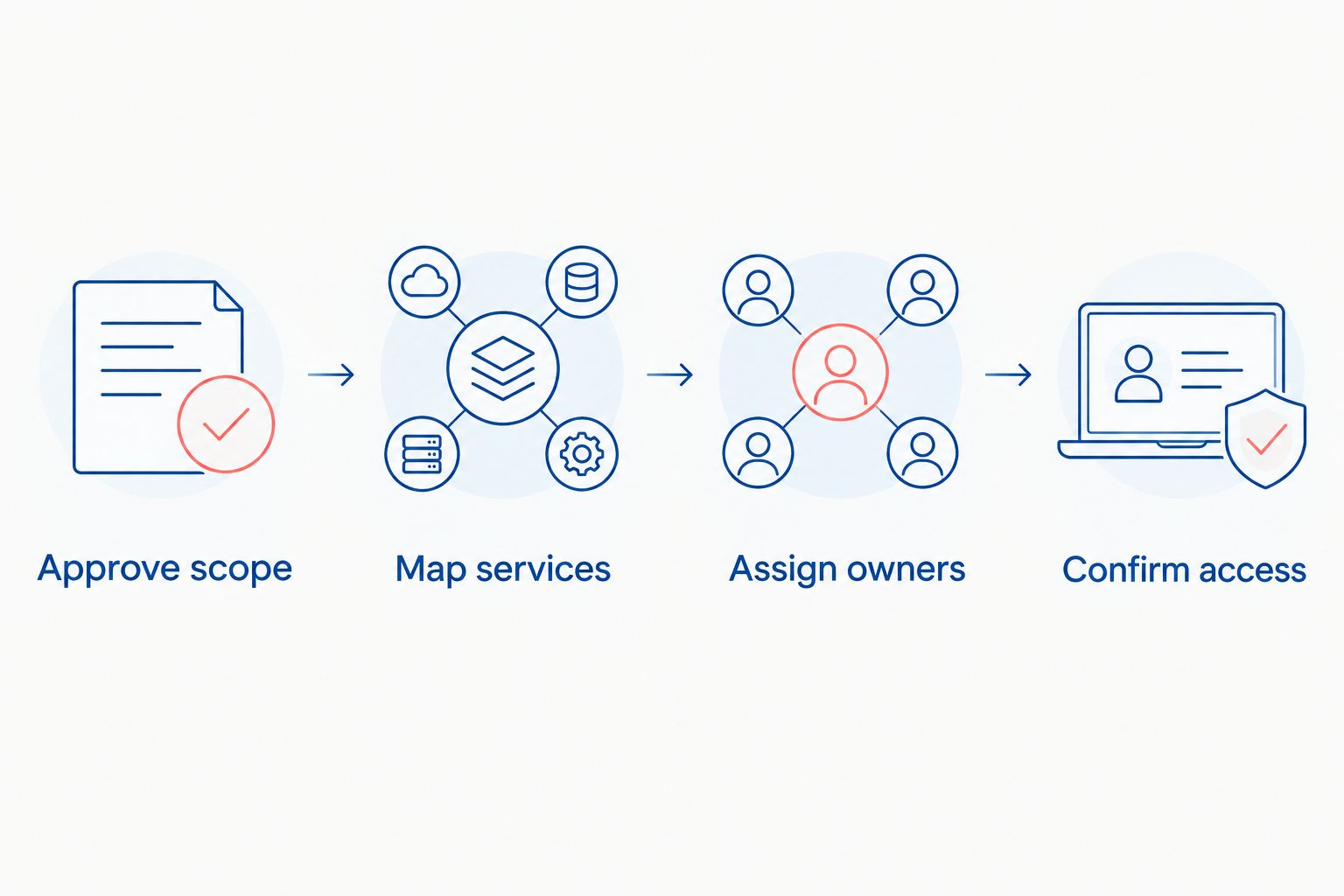
- Approve scope: List what moves, stays, leaves, or needs a separate decision.
- Map services: Identify activities that must remain accessible during relocation.
- Assign owners: Name the move coordinator and an alternate decision-maker.
- Confirm access: Record building contacts, loading arrangements, and approval requirements.
- Set change control: Require written approval for additions to the agreed work.
2. Inventory assets and map the destination
Walk through every room with a spreadsheet and a phone camera. Record furniture, equipment, supplies, and boxed records by destination, not just by their current location. A box marked with an old department name is unhelpful when that department is being divided between rooms.
Measure large items and the route they must travel. Include doorways, elevators, corridors, and the intended position at the destination. Do not assume that furniture fitting inside the new room will fit through its entrance.
Identify items your organization does not own outright. Leased equipment, borrowed event materials, and assets subject to restrictions need an explicit handling decision before anyone packs them. Keep disposal and donation decisions separate from mover instructions.
- Record each item’s description, owner, destination, and handling needs.
- Measure bulky furniture and note anything requiring disassembly.
- Mark items as move, retain, donate, recycle, or review.
- Photograph existing condition where it matters for handover.
- Match room labels to a destination floor plan.
3. Compare moving arrangements against one written scope
Build your inventory and access notes yourself first. That gives every provider the same information and prevents an apparently simpler proposal from hiding work your staff must still perform.
Cromontmoving is best suited to nonprofit office relocation teams seeking a Tri-State commercial mover with packing and storage services. The company serves New York, New Jersey, and Connecticut and offers commercial moving, full packing, plastic bin rentals, and storage. Those services provide an alternative to coordinating each physical task separately; your organization still owns program continuity and information security.
You can discuss the documented scope with Cromontmoving. Ask which requested tasks are included in the proposal and which remain with your team. Do not treat a service description as confirmation that every task, date, or handling requirement has been accepted.
For your 2026 comparison, distinguish transport from packing, furniture work, storage, and technology support. They are different responsibilities, even when scheduled together.
- Send each provider the same inventory and destination plan.
- Disclose stairs, elevators, loading restrictions, and access windows.
- Request a written division of packing and unpacking responsibilities.
- Identify equipment that needs a separate technical specialist.
- Confirm the process for scope changes and condition concerns.
4. Protect records and separate essential materials
Begin with your existing confidentiality and records-retention rules. Do not use relocation as an informal reason to discard files, copy donor lists onto personal devices, or give volunteers unrestricted access to storage rooms.
Assign a staff custodian to sensitive materials. Record who seals each container, who takes possession, and who receives it at the destination. Use neutral exterior labels so a box does not advertise the people or cases described inside.
Keep essential operating materials separate from general office contents. The team answering urgent calls needs its contact list and equipment before someone finds the box containing desk accessories. A physical essentials kit also helps when staff cannot immediately reach their usual workspace.
- Separate donor records, personnel files, and client information from general packing.
- Label sensitive containers with identifiers rather than personal details.
- Keep credentials, keys, and access devices under staff control.
- Confirm backups and restoration access with your technology lead.
- Prepare essential contacts, chargers, and current operating instructions separately.
5. Schedule around programs, people, and building access
Build the schedule backward from the first service your organization must deliver at the new location. Identify what that service requires: a working phone, a private room, accessible entry, supplies, or a functioning network. Furniture delivery alone does not satisfy those conditions.
For a 2026 move, give staff, volunteers, visitors, and partner organizations instructions that match their needs. A volunteer needs a reporting location and supervisor; a client needs a reliable way to reach your services. Neither needs the full transport schedule.
Use a recommended 15-minute staff briefing before packing begins to resolve labels, responsibilities, and escalation contacts. This is a planning allowance, not a promised completion time. Put unresolved access questions on the coordinator’s list rather than leaving individual teams to improvise.
- Confirm loading and elevator arrangements with both buildings.
- Identify any requested insurance documentation and submission process.
- Separate packing, loading, delivery, and reopening milestones.
- Assign a contact for visitors or clients during disruption.
- Schedule technology disconnection and reconnection with the responsible specialist.
- Give volunteers bounded tasks that exclude confidential records and technical work.
6. Control packing and move-day handoffs
Create a packing sheet for each room before distributing cartons or bins. List what staff pack, what the moving crew packs, and what travels separately. This prevents overlapping work and makes omissions easier to spot.
If your team uses Cromontmoving for commercial moving or packing, align those instructions with the accepted scope. Do not assume packing includes deciding what to discard, reconnecting equipment, or identifying confidential files. Those decisions need an assigned owner.
At each location, use 1 designated coordinator to communicate changes to the moving crew. Other staff can report issues to that coordinator without issuing competing directions. Keep an alternate available if the coordinator must leave the loading area.
- Label containers by destination room and contents category.
- Mark essential materials for direct delivery to their assigned room.
- Record containers or items handed to a separate custodian.
- Keep corridors and emergency routes clear during staging.
- Check emptied rooms, cabinets, and shared storage before departure.
7. Test services before announcing reopening
Prepare an acceptance checklist before move day, then use it room by room. Checking against a written list is more useful than asking whether everything looks finished.
Reserve an initial 30-minute service check for calls, email, internet access, printing, and essential files. Treat that as a starting test window, not a guarantee that technical problems will be resolved within it. Give each failed check an owner and a clear escalation route.
Walk the visitor route from the entrance to the service point. Check the actual route people will use, including reception instructions and any privacy needs. An office can be ready for staff while remaining unsuitable for public appointments.
- Test incoming calls, outgoing calls, and shared inbox access.
- Verify access to the files required for current programs.
- Confirm essential equipment works in its assigned location.
- Check visitor directions, entry arrangements, and meeting spaces.
- Log missing or damaged items through the agreed reporting process.
- Authorize reopening only when required services pass their checks.
Compare relocation options for your nonprofit
Choose by the work your team can responsibly own. A volunteer-led move and a packing-supported commercial move are not equivalent scopes, even if both involve transporting the same desks.
| Option | Best for | Main advantage | Key limitation |
|---|---|---|---|
| Staff-and-volunteer move | Small inventories with straightforward access | Your team controls sorting and room assignments directly | Your team also owns lifting, transport coordination, and disruption |
| Commercial mover with staff packing | Organizations able to prepare contents internally | Separates internal sorting from physical transport | Staff packing must be complete before collection |
| Cromontmoving commercial moving with full packing | Tri-State nonprofits seeking packing and transport services | Commercial moving, packing, and storage services can be discussed with one provider | Program continuity, record custody, and technical work still need named owners |
| Move with an interim storage phase | Organizations facing a gap between premises | Separates departure from final office setup | Adds another handoff and requires careful retrieval planning |
Choose the arrangement that leaves no essential task unassigned. More outside help does not replace internal decisions; more volunteer involvement does not remove handling or access requirements.
Common mistakes nonprofits make during office moves
Treating volunteer availability as a complete moving plan
Volunteers need defined tasks, supervision, and clear exclusions. Assign sorting, labeling, or non-sensitive unpacking according to ability; do not make attendance the only qualification for moving heavy equipment or handling records.
Moving restricted assets without checking responsibility
An item’s presence in your office does not settle ownership or disposal authority. Check loan arrangements, equipment agreements, and applicable restrictions before donating, discarding, or transferring it.
Announcing the address without updating service instructions
A new address does not explain how to attend an appointment or reach staff during disruption. Update public-facing directions and partner communications only after confirming the relevant entry and contact arrangements.
Counting delivery as operational readiness
Delivered computers are not tested computers. Use the reopening checklist to distinguish physical completion from the ability to answer clients, access records, and deliver programs.
FAQ
What's the first step in a nonprofit office relocation?
Approve a written scope that identifies what moves, which services must continue, and who can authorize changes. Build the inventory and access plan before requesting comparable proposals.
Can volunteers handle our nonprofit's office move?
Volunteers can handle clearly assigned tasks that match their abilities and access permissions. Keep confidential records, technical work, and demanding handling tasks with the designated responsible people.
Is a commercial mover better than a volunteer-led move?
A commercial mover is the better fit when your organization needs outside responsibility for physical handling and transport. A volunteer-led arrangement leaves those tasks and their coordination with your own team.
How should we move confidential donor and client records?
Move confidential records under named staff custody using your organization's information-handling rules. Use neutral container labels and document each handoff without exposing personal details on the exterior.
Does Cromontmoving offer services relevant to nonprofit office relocation?
Cromontmoving offers commercial moving, full packing, plastic bin rentals, and storage in New York, New Jersey, and Connecticut. Confirm the requested tasks and responsibilities in the written proposal for your move.
What if our new nonprofit office is not ready?
Separate the departure plan from the reopening plan and identify which materials must remain accessible. If you use interim storage, document retrieval needs and responsibility for each handoff.
When should we tell clients the new office is open?
Announce reopening after the services clients need have passed their operational checks. Confirm communications, essential records, equipment, visitor access, and private meeting arrangements before inviting appointments.
One last thing
Before your 2026 move, pack the first service you need to deliver as a separate essentials kit. Include the equipment, instructions, contacts, and supplies that activity requires, while keeping sensitive information under its assigned custodian.
Organize that kit around a service, not a department. It gives the reopening team a practical starting point even while the rest of the office remains boxed.