
Yes, movers can relocate a business over a weekend when both buildings permit access, packing is ready, and the moving scope fits the approved work window. Moving furniture does not make an office operational: your team must also arrange technology reconnection, essential equipment setup, and a reopening check before employees return.
- Can movers relocate a business over a weekend? Yes, when building access, packing, transport, and reopening tasks align.
- Cromontmoving offers commercial moving, packing, and storage for businesses in New York, New Jersey, and Connecticut.
- A weekend office relocation needs separate owners for physical moving, technology reconnection, and business continuity.
- Choose a single-weekend move only after confirming building permissions and the work needed before reopening.
Why this matters: A weekend booking is not a reopening plan. Before choosing dates for a 2026 relocation, separate the physical move from the work your business needs to resume operations; the guide to how long a commercial office move takes addresses that scheduling question.
Can movers relocate a business over a weekend?
Yes, but the weekend must contain the agreed moving work—not every unfinished relocation task. Inventory, destination planning, building coordination, and responsibility assignments belong before the crew arrives. Technology testing and final placement belong in the reopening plan, with named owners rather than assumptions.
Use this sequence to decide whether your proposed weekend works:
- Define completion. List what must be moved, assembled, connected, and usable before employees return. Separate essential workstations from items that can remain packed.
- Confirm access. Obtain each building's permitted moving hours, loading arrangements, elevator procedures, and insurance-document requirements where applicable.
- Document the inventory. Identify furniture, equipment, records, packed contents, and items needing special handling. Tell the mover about stairs, restricted routes, and oversized pieces.
- Assign responsibilities. Specify who packs, disconnects equipment, handles furniture, reconnects technology, and accepts completed work.
- Check the sequence. Match packing, loading, transport, unloading, setup, and testing to the actual access windows. Include a recovery plan for unfinished essentials.
If any step remains unresolved, keep the date provisional. A calendar reservation cannot resolve missing building permission or an unprepared destination.
Which weekend moving plan fits your business?
Choose the plan around operational needs, not the appeal of finishing everything at once. For your 2026 move, distinguish between an office that can close completely and a business that must keep serving customers throughout the transition.
| Moving approach | Best for | Main advantage | Main limitation |
|---|---|---|---|
| Single-weekend relocation | Businesses able to pause operations during the move | Concentrates physical relocation into a defined work window | Leaves less flexibility when essential work remains unfinished |
| Phased relocation | Businesses that need some teams to remain operational | Separates the move by department or function | Requires coordination across occupied locations |
| Weekend move with advance packing | Businesses able to prepare nonessential contents before closing | Keeps avoidable packing work outside the moving window | Requires earlier staff preparation and clear access to essentials |
| Relocation with temporary storage | Businesses whose departure and destination readiness do not align | Separates move-out from final delivery | Adds a separate delivery stage and requires retrieval planning |
Choose a single-weekend relocation only when the destination is ready and the essential work fits the confirmed access window. Choose a phased plan when maintaining operations matters more than consolidating the move.
Temporary storage addresses a timing mismatch; it does not make an unfinished office ready for staff. Identify which contents can remain stored and which must reach the workplace before reopening.
Single-weekend relocation: define a firm finish line
For a single-weekend move, write down what completion means. That includes the destination of each workstation, the furniture assembly included in the agreement, and the equipment your own specialists must reconnect.
Avoid treating every box as equally urgent. Label essential contents for immediate placement, while keeping nonessential materials out of the setup team's way.
Phased relocation: preserve a working operation
For a phased relocation, decide which team moves first and what that team needs to function independently. Shared records, printers, and meeting spaces need explicit destinations so employees know where to find them.
The trade-off is coordination. Maintain a current location list and identify who approves changes while both workplaces remain in use.
Why weekend business relocation timelines vary
The same weekend can contain very different amounts of usable moving time. These factors belong in the scope discussion before you commit to a 2026 date:
- Building access: Permitted work hours, security procedures, freight-elevator arrangements, and loading access determine when crews can work.
- Inventory and handling: Workstations, shelving, packed files, fragile contents, and oversized furniture require different preparation and handling plans.
- Packing readiness: Unpacked desks and unidentified boxes leave work for the relocation window that could have been completed beforehand.
- Destination readiness: Furniture placement, usable access routes, and space for incoming contents affect how unloading and setup proceed.
- Technology dependencies: Network connections, phones, shared devices, and business applications need an assigned reconnection and testing plan.
- Delivery sequence: Department priorities, temporary storage, and items needed immediately influence loading order and final placement.
Ask for a plan tied to your actual inventory and access conditions. A general statement that a mover handles office relocations does not confirm that your particular weekend scope will fit.
What should you prepare before the weekend?
Prepare a written relocation plan with tasks, owners, and completion checks. Keep it accessible to the mover, your internal coordinator, building contacts, and technology lead so everyone works from the same instructions.
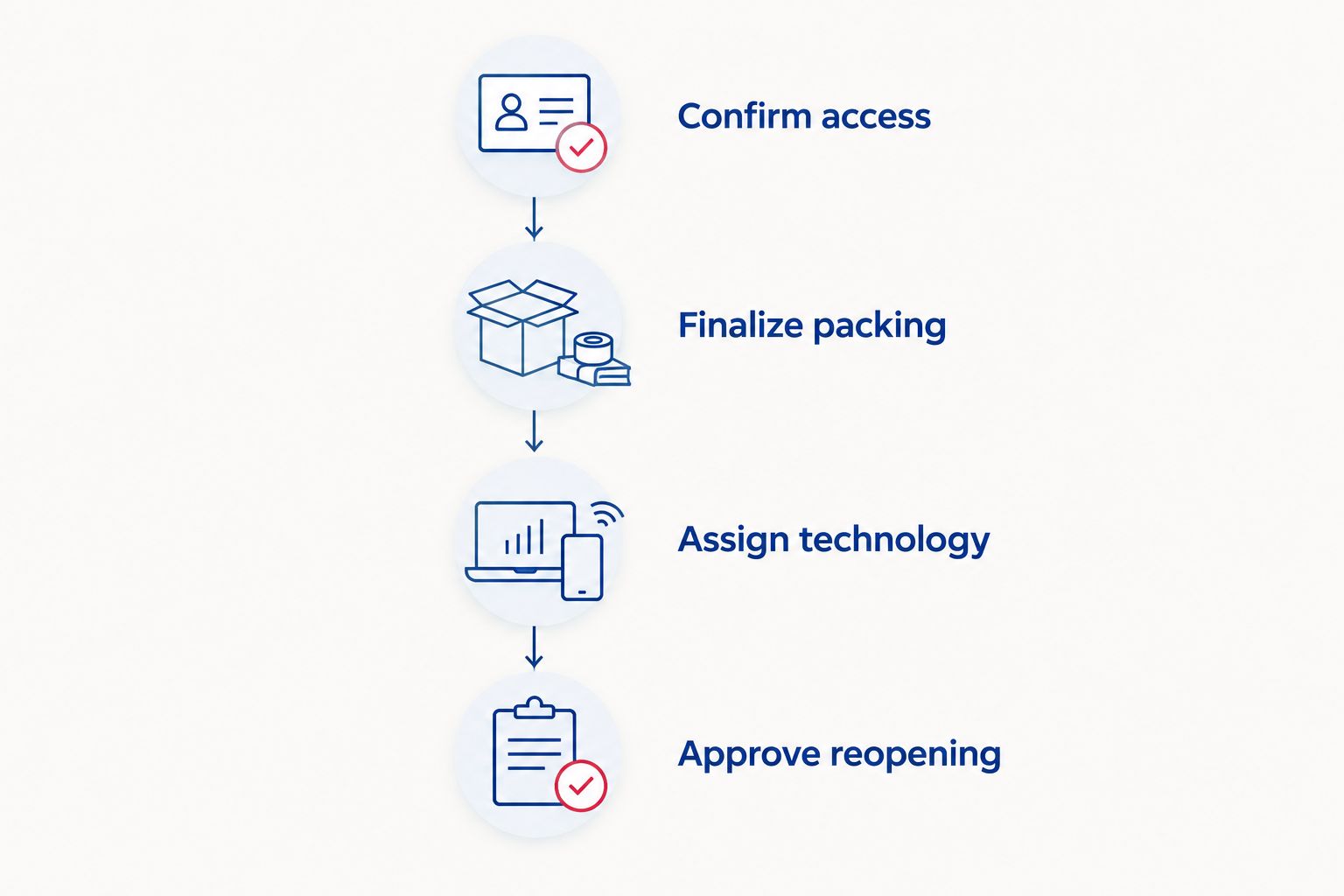
Confirm access
Get the moving rules directly from both buildings. Ask about permitted hours, reservations, loading locations, protective materials, security access, and required documents rather than assuming the destination follows the departure building's rules.
Record the person who can resolve an access problem during the move. A contact list is useful only when the contacts know their responsibilities and the planned work window.
Finalize packing
Decide what employees pack and what the moving agreement includes. Label each container with its destination department or room, and keep sensitive records under an agreed handling process.
Separate materials employees need until closing from contents that can be packed earlier. Confirm who handles the remaining items after the business stops work.
Assign technology
Name the person responsible for disconnecting, reconnecting, and testing technology. Do not assume that a physical moving service includes network configuration, application access, or equipment commissioning.
Give that person the destination layout and equipment list before moving day. The technology plan should explain what must work for the business to reopen, not merely where devices will sit.
Approve reopening
Assign someone with authority to accept the destination as ready. That person should check the essential work areas and record unresolved items before employees arrive.
Use the same checklist for the handover and reopening decision. Otherwise, a crew can finish its agreed transport work while your business still lacks a clear owner for the remaining setup.
How should you organize the moving weekend?
Organize the work around dependencies. The following is a planning sequence for a 2026 relocation, not a promised completion schedule; your building rules and agreed scope determine the actual timing.
Before the business closes
Finish the destination layout, confirm access arrangements, and circulate the current contact list. Check that labels match the room names used on the layout.
Identify anything still in use and assign its final packing or disconnection. Record any inventory changes with the mover instead of leaving them for the arriving crew to discover.
During loading and transport
Keep the internal coordinator reachable for placement and scope questions. Protect confidential materials through the handling process your business has approved.
Use an agreed inventory or tracking method to reconcile contents. Give essential items a clear delivery priority rather than relying on whoever unloads a box to recognize its importance.
During unloading and setup
Direct items to their planned locations and keep access routes clear. Resolve placement questions while the responsible people are present.
Check furniture work against the moving agreement. Assign any excluded setup to the appropriate internal team or specialist rather than treating it as automatically included.
Before employees return
Test the functions your business needs to operate: workstation access, communications, shared equipment, and essential applications. Check the physical workspace as well as the technology.
Record unfinished work with an owner and a resolution plan. Approve reopening based on working essentials, not the absence of boxes in the truck.
What should you ask a commercial mover?
Ask questions that turn a broad booking into a defined scope. For a 2026 weekend relocation, request written answers about packing, handling, furniture work, access assumptions, delivery priorities, and the process for changes.
Cromontmoving is a fit for NY, NJ, and CT businesses seeking commercial moving, packing, and storage. Cromontmoving's commercial moving services are relevant to that scope; confirm weekend scheduling, included tasks, building requirements, and exclusions for your specific relocation.
Use these questions during the scope discussion:
- What inventory and access information do you need to assess the move?
- Which packing, disassembly, and reassembly tasks does the agreement include?
- What must our staff finish before the crew arrives?
- How will essential equipment and departmental contents be identified?
- Who coordinates with building management, and who supplies required documents?
- How are inventory changes and unfinished work handled?
Send the inventory and building instructions together when you request a quote. That gives the scope discussion a concrete starting point without treating a preferred weekend as a confirmed plan.
Can employees work during a weekend office move?
Employees can work during a weekend office move only if their workspace, equipment, and required systems remain usable and separate from moving activity. Choose a phased or remote-work arrangement where it fits your operations, and tell employees exactly which resources remain accessible.
Do not promise normal service based solely on having desks at the destination. Confirm that the people providing that service can access the tools and information they need.
Can movers handle IT reconnection during an office relocation?
IT reconnection belongs with the provider or internal team explicitly assigned to it; do not assume it comes with equipment transport. Confirm who disconnects devices, protects and labels cables, reconnects equipment, and tests business-critical functions.
Keep physical delivery and operational acceptance as separate checks. A computer arriving intact does not establish that its user can access the network or required applications.
What happens if the office is not ready to reopen?
If the office is not ready to reopen, activate the fallback arrangement approved before the move. Assign unfinished essentials to named owners and communicate which teams can work, where they should work, and what remains inaccessible.
For your 2026 plan, define that decision before moving begins. Remote work, a phased return, or postponed nonessential setup are planning choices to assess against your own operations—not substitutes for checking readiness.
FAQ
Can movers relocate a business over a weekend without downtime?
A weekend relocation does not guarantee uninterrupted operations. Confirm building access, packing readiness, technology handoffs, and essential setup before committing to a reopening time.
Can an office move start after employees leave on Friday?
An office move can start after employees leave when the mover and both buildings approve that work window. Confirm loading access, elevator arrangements, security procedures, and any required documents first.
Do movers reconnect office computers and phones?
Do not assume movers reconnect office computers and phones. Assign disconnection, reconnection, and testing explicitly in the moving scope or to your technology team.
Should employees pack their own desks before an office move?
Employees should pack their own desks only when that responsibility is part of the agreed plan. Give staff labeling instructions and separate personal belongings from business records and shared equipment.
Is a phased office move better than a single-weekend move?
A phased office move is better suited to businesses that need some teams to remain operational. A single-weekend move suits businesses that can pause operations and complete essential setup within the approved window.
What information should I send a commercial moving company?
Send an inventory, origin and destination details, building access instructions, desired dates, and the tasks you want included. Identify essential equipment, special handling needs, and any storage requirement.
Does Cromontmoving offer commercial moving and storage?
Cromontmoving offers commercial moving, packing, and storage for businesses in New York, New Jersey, and Connecticut. Confirm the scope and weekend scheduling directly for your relocation.
One last thing
Test a normal work task before declaring the office ready. Have an authorized employee sign in, access a required file, and complete the communication or equipment task their role depends on.
That check asks the right question: can the business operate here? Furniture placement alone cannot answer it.