
A commercial office move takes as long as its full sequence of packing, building access, transport, installation, and operational checks—not just the truck journey. Your usable timeline starts with a surveyed inventory and confirmed access at both offices. The critical caveat is downtime: furniture delivery does not mean your employees, network, and workstations are ready to operate.
- How long does a commercial office move take? Scope, building access, and operational readiness determine the schedule.
- Separate physical moving time from business downtime; unloading does not establish that your office is ready.
- Cromontmoving serves New York/Tri-State businesses needing commercial moving, packing, and storage.
- Confirm elevator access, packing responsibilities, and IT handoffs before committing to an employee return date.
Why this matters
Your move is finished when your business can work, not when the truck leaves. Treat those as separate milestones when building your 2026 relocation schedule. Otherwise, a delivery target becomes an employee return date without anyone checking what must happen between them.
An office move connects decisions made by your mover, building managers, internal team, and technology providers. Start with the elevator reservations to moving day workflow if either property controls freight access. A planned loading sequence is useless when it falls outside the approved building window.
Assign 1 move lead to maintain the master schedule. That person should collect approvals, resolve conflicting instructions, and distinguish confirmed appointments from requests still awaiting acceptance.
How long does a commercial office move take?
A commercial office move needs a scope-based schedule, not a standard duration attached to office size. Headcount and floor area help describe the job, but neither establishes how long packing, access, furniture handling, or technology restoration will take.
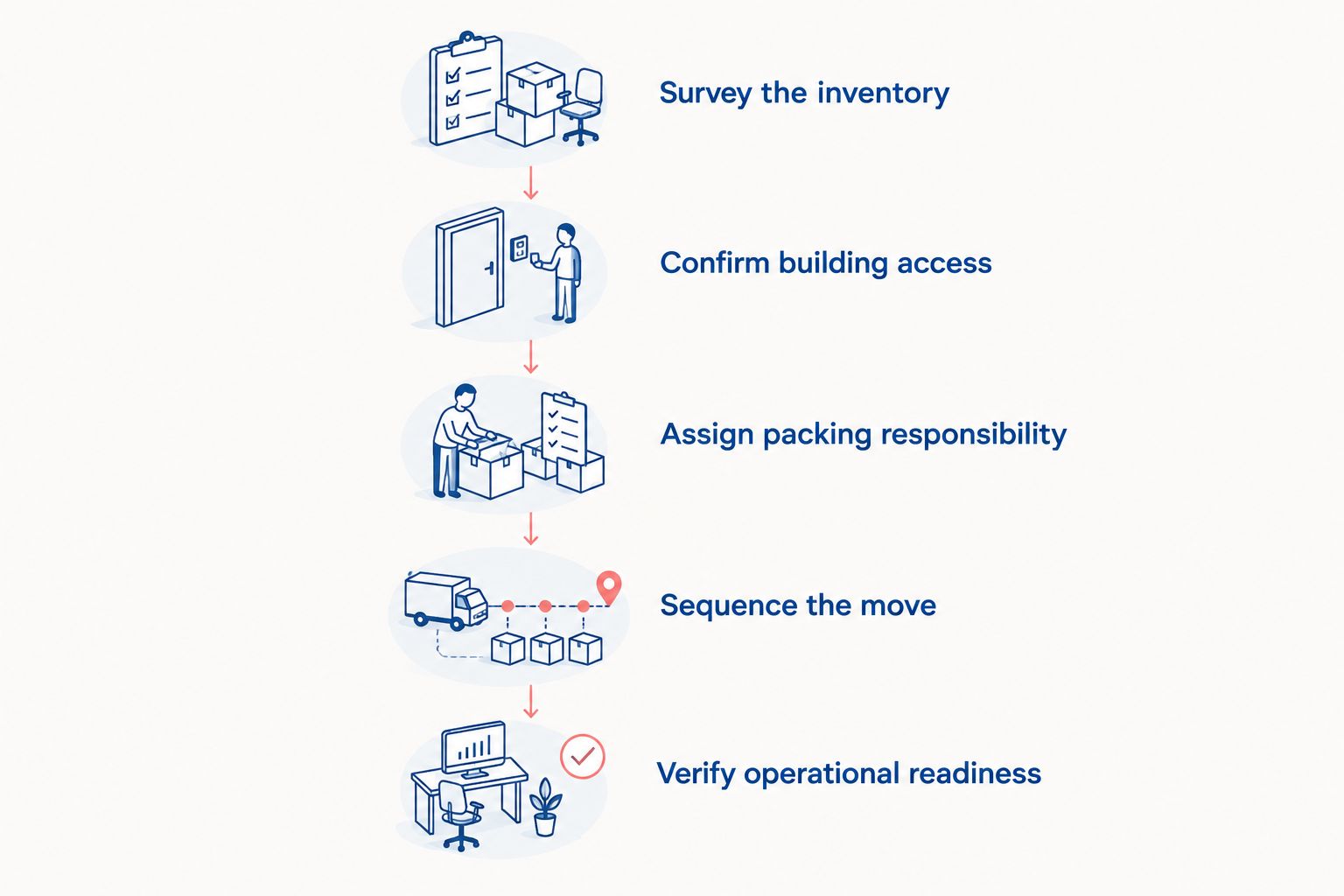
Build your timeline in this order:
- Survey the inventory. Record furniture, equipment, files, shared spaces, and items requiring special handling. Identify what stays, what moves, and what goes into storage.
- Confirm building access. Obtain the loading, elevator, security, and contractor requirements for both addresses. Match the move sequence to the approved access windows.
- Assign packing responsibility. Name who packs workstations, archives, kitchens, and equipment. Set a handoff point after which packed items are ready for collection.
- Sequence the move. Agree on loading, transport, unloading, furniture placement, and any included assembly. Identify which tasks depend on another task finishing.
- Verify operational readiness. Assign responsibility for reconnecting equipment, testing systems, locating priority files, and approving employee access.
Ask for a written schedule that separates these stages. A single arrival appointment does not tell you when loading ends, when delivery finishes, or when your team can resume work.
For a 2026 office relocation, make every milestone an event with an owner and a completion condition. “Packing complete” should mean labeled, closed containers ready for handling—not employees still deciding what to keep.
Use 3 milestones instead of a single finish time
Track 3 milestones: packing complete, physical delivery complete, and operational readiness confirmed. Each answers a different question, and each needs its own acceptance check.
Packing completion releases items to the moving crew. Delivery completion confirms that the agreed shipment reached its destination and was placed as instructed. Operational readiness confirms that the receiving office supports the work your employees need to do.
This distinction also makes a delay easier to diagnose. An unfinished workstation pack requires a different response from an unavailable freight elevator or an untested network connection.
A single cutover: best for a coordinated office shutdown
A single cutover moves the agreed office inventory as one coordinated project. It suits a business that can pause on-site work while the move and reopening checks take place. The advantage is a shared transition point; the drawback is that unresolved dependencies collect around that same point.
Do not equate “single cutover” with “same-day completion.” The approach describes how you organize the transition, not a promised duration. Packing, delivery, furniture placement, and reopening still need separate scheduling.
Before choosing this approach, decide which work must continue during the shutdown. Name the people who will handle urgent requests and specify where essential records or equipment will remain accessible.
A phased move: best for teams with separable workflows
A phased move divides the relocation into defined groups, such as departments, floors, or equipment categories. It suits businesses that can separate work without breaking essential handoffs between teams. The benefit is control over which group changes location; the drawback is managing a temporary split operation.
Choose phases around business dependencies rather than convenient box counts. Moving a team before its shared equipment or records creates an incomplete working environment, even when every scheduled item arrives.
Use this comparison when selecting your 2026 move structure:
| Approach | Best for | Main advantage | Main limitation | Schedule must establish |
|---|---|---|---|---|
| Single cutover | Teams able to pause on-site work | A shared transition point | Dependencies converge on the reopening target | A complete shutdown-to-reopening sequence |
| Phased move | Teams with separable workflows | Defined transitions by group | A temporary split operation needs coordination | What each phase needs to function |
| Storage-backed move | Businesses with a possession-date gap | Inventory can leave before the new office is ready | Storage introduces another handling and delivery stage | Storage intake, release, and final delivery arrangements |
A storage-backed move: best for a possession-date gap
A storage-backed move separates departure from final office delivery. It suits a business whose current office must be cleared before the destination can receive everything. Storage solves the timing mismatch, but it does not remove the need to schedule final delivery and setup.
Identify what must remain accessible before anything enters storage. Essential documents, employee equipment, and items needed for an interim workspace require a different plan from furniture awaiting final placement.
Keep the storage inventory aligned with the destination plan. If the receiving team cannot tell which containers belong to which department, final delivery becomes a sorting exercise rather than a controlled installation.
Why commercial office moving timelines vary
The most useful schedule explains its assumptions. Ask what would change the sequence, who approves changes, and how those changes affect the return-to-office decision.
- Inventory and handling requirements. Desks, conference furniture, archives, and equipment involve different handling tasks. Record disassembly and reassembly requirements rather than treating every item as an equivalent unit.
- Packing readiness. A crew cannot follow the intended loading order if priority items remain unpacked. Confirm who supplies labels, who packs shared areas, and who checks completion.
- Building access. Freight elevator reservations, loading arrangements, security procedures, and required documentation shape the available working window. Confirm requirements for both buildings independently.
- Route and delivery sequence. The order of loading should support the order of delivery. An item needed first at the destination should not be inaccessible behind items intended for later placement.
- Destination readiness. Furniture placement depends on an approved layout and usable receiving space. Resolve unfinished areas and access restrictions before dispatching items assigned to them.
- Technology and business dependencies. Assign disconnection, reconnection, and testing to named owners. Do not assume those responsibilities belong to the moving crew unless the agreed scope states them.
Keep a short exception list alongside your 2026 schedule. Each exception needs an owner and a decision deadline, whether it concerns an oversized desk, a restricted room, or equipment that must remain operational until departure.
Check 2 buildings, not just the destination
Check 2 buildings: the office you are leaving and the office receiving the shipment. Approval at one address does not establish permission at the other.
Ask each property manager for the applicable move requirements in writing. Then check whether the approved departure and arrival windows actually fit the proposed sequence, including unloading and any required clearing of shared areas.
Do not book employee attendance around an unconfirmed access request. A requested elevator window is not an approved moving window. Keep that distinction visible in the master schedule.
How do you get a usable moving timeline?
Give the mover an inventory, access information, a destination layout, and your business constraints. Ask the mover to identify the assumptions behind the proposed schedule and the point at which changes require reassessment.
Cromontmoving is best suited to New York/Tri-State businesses seeking commercial moving with packing or storage needs. Its stated services include commercial moving, full packing, and storage; the schedule still needs to reflect your specific inventory and access arrangements.
When discussing your project with Cromontmoving, distinguish required services from responsibilities your internal team will retain. Do not treat an offered service as included until it appears in the agreed scope.
Use these questions to make the planning conversation concrete:
- Which packing and handling tasks are included?
- What must our employees finish before the crew arrives?
- Which building approvals remain outstanding?
- How does the loading order support the destination layout?
- Who approves a scope change during the move?
- What marks completion of the moving service?
The tradeoff is coordination: combining packing, moving, and storage still requires a clear handoff between each stage. No service description substitutes for a project-specific sequence and documented responsibilities.
Discuss your office move
Review commercial moving, packing, and storage needs against your inventory and building access.
Can you move an office over a weekend?
A weekend office move requires approved building access and a sequence that fits the available window. The calendar alone does not establish feasibility, and weekend delivery does not establish readiness for the next working day.
Work backward from the tasks employees need to perform when they return. Confirm that packing, transport, placement, and technology checks can finish before that point; otherwise, adjust the return plan rather than assuming unfinished work will fit.
Does full packing make an office move faster?
Full packing assigns packing work to the moving service, but it does not establish a shorter total project duration by itself. The schedule still depends on inventory, access, preparation, and the packing scope.
Your team must still identify confidential materials, disposal items, and equipment that stays in use until departure. Packing is most useful when those decisions are settled before work begins.
When should employees return after the move?
Employees should return when their required workspace, equipment, and access have passed the checks assigned to them. Delivery completion is not a substitute for that decision.
For your 2026 reopening plan, define readiness by role. A team that requires shared equipment has a different return condition from employees whose work can continue away from the office.
FAQ
How long does a commercial office move take from start to finish?
A commercial office move needs a surveyed schedule covering preparation, packing, access, transport, placement, and operational checks. Use the completed scope and approved building windows to establish the timeline rather than relying on a generic duration.
Can a small office move be finished in a day?
A small office needs a scope-based assessment before a single-day completion commitment is made. Inventory, packing readiness, elevator access, and destination setup determine whether that plan fits.
Is an office move finished when the movers unload?
An office move is not operationally complete simply because unloading has finished. Confirm furniture placement, equipment connections, access, and the business checks required before employees return.
Is a phased office move better than moving everything together?
A phased office move is better suited to teams whose workflows can be separated. Moving everything together suits a coordinated shutdown, while phasing requires a plan for the temporary split operation.
What should I give a mover to get a reliable schedule?
Give the mover an inventory, packing requirements, building access rules, destination layout, and business constraints. Identify unresolved approvals and equipment that must stay in use until departure.
Does Cromontmoving offer commercial moving and storage?
Cromontmoving offers commercial moving and storage for homeowners and businesses in New York and the Tri-State area. Its stated services also include full packing; confirm the services included in your office move scope.
Who should coordinate an office move internally?
Assign a move lead to maintain the schedule, collect approvals, and resolve conflicting instructions. Department representatives and technology owners should provide their requirements through that lead.
One last thing
Plan the first working task before you plan the last box. Choose a representative task your business must perform after reopening, then list the workspace, equipment, records, and access it requires.
Use that list as a receiving priority and a readiness check. It gives your 2026 move plan a practical finish line: not simply an empty truck, but an office prepared for the work it needs to support.