
Movers need a loading window based on your inventory, packing readiness, building access, and the route from your apartment to the truck—not a fixed number of hours based on bedroom count. For a NYC move in 2026, get that window in writing after the mover reviews your belongings and access conditions. Confirm whether it includes wrapping, disassembly, elevator waits, and securing the load; driving and unloading belong on separate parts of the schedule.
- How long does it take movers to load a NYC moving truck? Inventory and access determine the loading window.
- CroMont Moving & Storage offers moving, full packing, and storage; request a loading estimate tied to your actual scope.
- Separate truck loading from packing, travel, and unloading when reviewing your moving schedule.
- Confirm elevator access, the truck approach, and furniture preparation before accepting a departure time.
Why this matters
A truck departure estimate is useful only when you know what must happen before departure. If your schedule leaves out furniture preparation or building access, the time shown on the calendar does not describe the whole job.
CroMont Moving & Storage provides residential and commercial moving, full packing, and storage. You can start with CroMont Moving & Storage and request a schedule that separates preparation, loading, transportation, and delivery rather than treating the move as one unexplained block.
For your 2026 move, organize the plan around 2 addresses: the pickup and the destination. The loading window concerns the pickup address, but the departure time still needs to fit the destination's permitted arrival arrangements.
How long does it take movers to load a NYC moving truck?
The loading duration depends on the work between entering your home and securing the final item inside the truck. An apartment label does not describe that work: a lightly furnished apartment and a densely furnished apartment can have very different inventories.
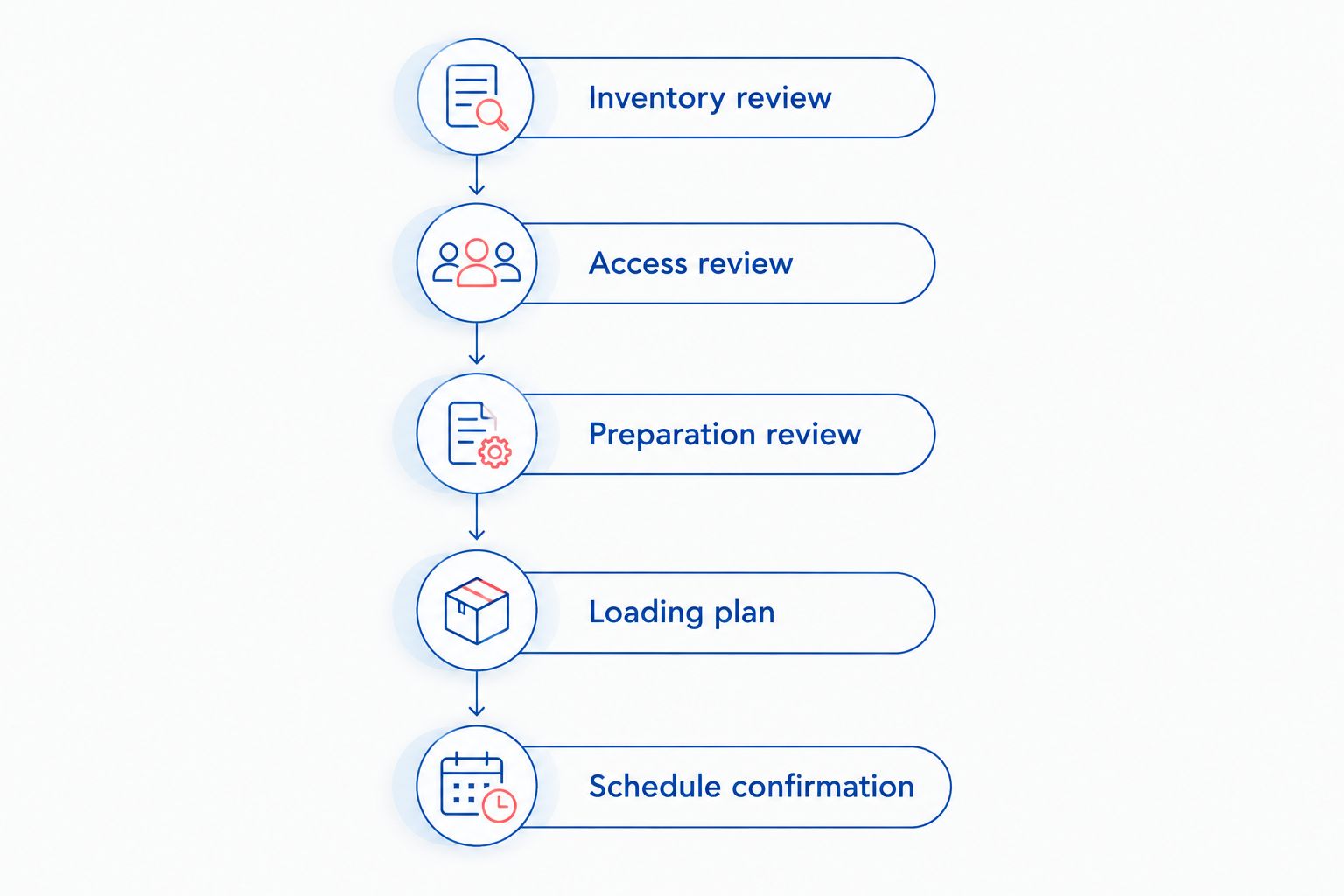
Ask the mover to build the loading estimate through these steps:
- Inventory review. Identify furniture, packed containers, loose items, and belongings needing special handling. Include closets, storage areas, and anything outside the main rooms.
- Access review. Describe stairs, elevators, hallways, doorways, and the route to the loading position. Flag restrictions that affect when movers can use that route.
- Preparation review. Assign responsibility for packing, furniture wrapping, disassembly, and labeling. State which tasks will already be finished when the crew arrives.
- Loading plan. Confirm the crew arrangement, handling needs, and how the belongings will be organized and secured inside the truck.
- Schedule confirmation. Request a loading window with a clear start point, finish point, and list of assumptions. Ask what changes require an updated estimate.
Ask what the clock describes, not just what time the crew arrives. Arrival, the first item carried out, and truck departure are different milestones. A written estimate should make those distinctions clear enough that you can coordinate with your building.
Compare your access conditions before comparing estimates
Use the table below to identify what your mover needs to evaluate. These are access scenarios, not promised completion times or ranked service recommendations.
| Access scenario | Planning advantage | Loading constraint | What to confirm |
|---|---|---|---|
| Elevator building | Elevator access avoids carrying the load entirely by stairs | Reservations, sharing, and elevator dimensions affect the route | Permitted use, dimensions, and building instructions |
| Walk-up building | The stair route can be inspected before moving day | Each item must pass through stairs and landings | Floor, turns, handrails, and furniture clearance |
| Direct ground-floor access | Fewer building transitions between rooms and the exit | The truck approach can still involve a lengthy carry | Exit location and the usable loading position |
| Building with restricted service access | A designated route gives the crew a defined path | Access depends on the building's permitted arrangements | Service entrance, check-in, and access window |
Tell the mover which description fits your pickup address. If different pieces need different routes, identify those exceptions rather than describing the entire apartment as easy access.
Packed belongings versus packing on moving day
A loading-only estimate and a packing-and-loading estimate cover different work. Finished boxes are ready for handling; loose kitchenware, open containers, and unpacked drawers still require decisions and preparation.
If you pack yourself, ask what ready-to-load means for your mover. Confirm expectations for closed containers, labels, fragile contents, and furniture contents instead of assuming every item can travel exactly as it sits today.
If you book full packing, confirm whether that work happens before loading day or within the same appointment. Neither arrangement should be hidden inside an unexplained truck-loading estimate.
For your 2026 checklist, mark each preparation task as your responsibility or the mover's responsibility. An unassigned task is unfinished work, regardless of how clear the arrival time looks.
Elevator access versus stair access
An elevator reservation establishes access; it does not establish how long loading will take. Your mover still needs to understand the inventory, elevator dimensions, hallway route, and the distance between the service entrance and the truck.
For stairs, describe the complete route rather than giving only the floor number. Tight landings, narrow doorways, and furniture turns belong in the access review because they affect how items can be carried.
Use the elevator reservations to moving day workflow to organize the building side of the plan. Then share the confirmed arrangements with the mover rather than assuming a reservation request has been approved.
Ask what happens if the elevator is unavailable during the planned window. Any alternative route needs agreement before moving day, particularly when large furniture cannot simply switch to the stairs.
Why NYC truck-loading time varies
The useful question is not whether an apartment is small or large. It is what the crew must prepare, carry, and secure under the actual access conditions.
- Inventory and item shape. Containers, sofas, shelving, and awkward furniture require different handling. Include every storage area in the inventory so the estimate describes the full load.
- Packing readiness. Finished packing separates a loading job from a job that still includes sorting and container preparation. Tell the mover about unfinished areas before arrival.
- Furniture preparation. Wrapping and agreed disassembly are work, even when no item has reached the truck yet. Ask where those tasks sit in the schedule.
- Building access. Stairs, elevator use, service entrances, and check-in procedures shape the available route. Share building instructions directly rather than paraphrasing them from memory.
- Truck approach. The path between the exit and the vehicle is part of the carrying route. Describe it accurately and avoid promising a loading position you have not confirmed.
- Special handling. Artwork, instruments, fragile furnishings, and unusually shaped pieces need an agreed handling plan. Flag them during the inventory review, not when the crew reaches the doorway.
For 2026 scheduling, record these conditions in 1 written inventory with the access notes attached. When the scope changes, update the document and ask whether the loading window changes with it.
How do you get a loading estimate you can actually use?
Request 1 loading window with written assumptions, not an isolated departure promise. The estimate should explain what the crew expects to find and which tasks are included before the truck leaves.
Send a room-by-room inventory and clear images of bulky furniture and difficult access points. Ask whether a video or in-person review is appropriate for anything that cannot be understood from the description alone.
Use this checklist when reviewing the proposed schedule:
- What event starts the loading window: crew arrival, building access, or carrying the first item?
- Are wrapping and disassembly included in that window?
- Is packing complete beforehand, or part of the appointment?
- What building arrangements must be confirmed before arrival?
- What counts as loading complete: the last item carried out or the load secured?
- Who should you notify if the inventory or access changes?
CroMont Moving & Storage is a fit for homeowners and businesses seeking moving, full packing, and storage from one provider. Those services still need a defined scope: booking additional help does not replace confirming which tasks occur before truck departure.
Plan your loading scope
Discuss your inventory, packing needs, and pickup access before setting the moving schedule.
Does loading time include the drive and unloading?
Loading time should be identified separately from transportation and unloading. Ask the mover to explain its terminology, because an appointment duration and a truck-loading duration do not necessarily cover the same work.
Keep the pickup and destination schedules connected. A departure plan is incomplete if nobody has checked when the receiving building permits access or which delivery tasks must happen after arrival.
Will adding more movers make loading faster?
A larger crew does not create more elevator space, widen a stair landing, or remove a building restriction. Ask the mover how the proposed crew fits your inventory and carrying route rather than assuming headcount alone determines the finish time.
The useful explanation describes who prepares items, who carries them, and who organizes the truck. Judge the plan by whether those tasks can proceed safely under your actual conditions.
What should you finish before movers arrive?
Complete the tasks assigned to you in the agreed scope: finish packing where required, separate belongings that are not moving, and clear the carrying route. Keep personal essentials and building access information available rather than packing them into the outgoing load.
Do not move heavy furniture into hallways just to make the apartment look ready. Keep exits usable and let the crew direct staging where space is limited.
FAQ
How long does it take movers to load a NYC moving truck?
The loading window depends on your inventory, packing readiness, furniture preparation, and building access. Request an estimate after the mover reviews those conditions, with loading separated from travel and unloading.
Can movers estimate loading time from my bedroom count?
Bedroom count alone does not describe the loading job. Provide a room-by-room inventory, access details, and a list of items needing preparation or special handling.
Does an elevator reservation guarantee the truck will leave on time?
An elevator reservation does not guarantee a truck departure time. The loading plan must also account for the inventory, permitted route, furniture preparation, and access to the vehicle.
Should I finish packing before the movers arrive?
Finish packing before arrival if packing is your responsibility under the agreed scope. If the mover is providing packing, confirm whether that work happens beforehand or within the loading-day appointment.
Does truck loading include furniture disassembly?
Furniture disassembly belongs in the loading window only when the agreed scope includes it there. Identify the pieces involved and confirm who will prepare them before carrying begins.
Can I book my destination elevator using only the loading estimate?
A loading estimate alone is not enough to schedule destination access. Coordinate truck departure, transportation, arrival arrangements, and the receiving building's requirements with your mover.
What should I send CroMont Moving & Storage before requesting a loading schedule?
Send CroMont Moving & Storage your inventory, pickup access details, packing requirements, and special-handling needs. Include building instructions and flag anything that changes before moving day.
One last thing
The last item leaving your apartment is not the same as the truck being ready to depart. The load still needs to be organized and secured, so define the finish point before you coordinate a handover or destination arrival.
For your 2026 move, put this question on the final confirmation: Does the loading window end when the apartment is empty, or when the truck is ready to leave? That distinction makes the schedule clearer without pretending every NYC apartment takes the same time.