
NYC expat relocation is the process of moving your household abroad so you can establish a home outside the United States. Choosing an international moving company NYC residents can rely on means coordinating apartment access, export packing, customs documents, and destination delivery—not just booking a truck.
- Choose an international moving company NYC expats can hold accountable for origin packing, overseas shipping, customs coordination, and delivery.
- CroMont Moving & Storage suits NYC expats needing local moving, packing, and storage support before departure.
- Compare written shipment scopes, exclusions, and destination responsibilities—not just the headline estimate.
- Keep passports, medication, and essential documents outside your household shipment.
Why international moving matters for NYC expats
Your NYC apartment handover and your overseas housing schedule are separate commitments. A lease ending, a building elevator reservation, and an overseas delivery appointment need their own plans; one booking does not resolve all three.
CroMont Moving & Storage is best for NYC expats seeking local packing, moving, and storage support before departure. Its services include full packing, white-glove service, and storage. Start with CroMont Moving & Storage for those origin-side needs, and require a written agreement identifying who handles international transport and destination services.
For a 2026 relocation, build the plan around your destination country's current requirements. Another expat's experience is useful background, not a substitute for official customs guidance or your building's move-out instructions.
How to organize your international relocation
Define your shipment before requesting estimates
Start with a room-by-room inventory in a spreadsheet. Record what you own, where it will go, and whether it needs special handling; photographs help distinguish similar items and document visible condition.
Create 3 shipment groups: travel with you, ship abroad, and leave behind. This separates immediate essentials from household freight and makes storage decisions explicit. Measure large furniture against your destination floor plan before paying to pack something that will not fit.
Use the same inventory for every estimate. Otherwise, you are comparing different jobs rather than different providers.
- List furniture dimensions and disassembly needs.
- Photograph fragile items and existing damage.
- Separate items for sale, donation, or disposal.
- Identify belongings requiring destination import checks.
- Mark items that must remain accessible until departure.
Verify the provider's role and credentials
Check the proposed service against the provider's actual role. An origin mover, an ocean transportation intermediary, and a destination delivery company perform different functions; ask which legal entity contracts with you for each part.
For ocean shipments involving the United States, the Federal Maritime Commission is the relevant federal authority for ocean transportation intermediary licensing and registration. Use its current public records to check the named business and its role. A local moving credential does not establish authority for every overseas shipping service.
Assign 1 named coordinator to consolidate updates, even when several businesses handle the shipment.
- Obtain each contracting company's legal name.
- Identify the ocean or air shipping provider.
- Check credentials applicable to the stated role.
- Confirm the destination delivery company's identity.
- Record the contact responsible for unresolved handoffs.
Separate NYC support from overseas delivery
Build the scope manually by dividing the move into origin services, international transport, and destination services. This exposes gaps before you sign, especially when an estimate uses broad terms such as door-to-door.
CroMont Moving & Storage offers moving, full packing, white-glove service, plastic bin rentals, and storage. Those services can address NYC preparation needs; confirm the specific work and handoff arrangements in your agreement rather than treating local service as proof of overseas delivery coverage.
For your 2026 move, give every task an owner. A written handoff schedule is more useful than several companies assuming someone else will arrange collection.
- Specify who packs and collects the household goods.
- Identify who prepares shipping documentation.
- Name the party arranging international transport.
- Confirm who coordinates customs clearance.
- Define delivery, unloading, and unpacking responsibilities.
Check destination rules before packing
Read the destination customs authority's household-goods guidance first. Then ask your shipping coordinator to explain which requirements apply to your residency status, shipment contents, and arrival schedule.
Entry permission for you does not automatically settle import requirements for your belongings. Alcohol, food, plants, medicines, and other controlled goods need destination-specific checks; do not bury uncertain items inside sealed cartons and expect the packing team to resolve them later.
Save the official guidance you consulted for your 2026 relocation. Requirements should be checked again before dispatch, particularly if your destination or shipment contents change.
- Confirm the documents required for household-goods entry.
- Check whether your status affects relief or exemptions.
- Review restricted and prohibited item categories.
- Ask whether arrival timing affects clearance.
- Keep submitted forms and supporting records together.
Match packing and building access to the shipment
Ask your building management for move-out instructions before choosing a collection date. Elevator reservations, insurance documentation, loading access, and permitted working hours belong in the packing plan, not in a last-minute message to the crew.
Manual preparation starts with measuring doorways and clearing the route. Professional packing shifts the packing work to a crew, but you still need agreement on materials, inventory labels, and any export-specific requirements. The full-service packing guide helps you define which tasks to delegate.
Do not assume reusable local moving bins are suitable for an overseas shipment. Confirm the shipping provider's packaging requirements and any rental-return obligations first.
- Obtain building access and insurance instructions.
- Measure tight doors, hallways, and elevator openings.
- Confirm protection for fragile and oversized belongings.
- Agree on carton labels and inventory references.
- Separate export packaging from temporary local containers.
Compare written scopes and shipment protection
Put competing proposals into the same spreadsheet. Compare included work, exclusions, measurement methods, and responsibility for extra services before comparing the final total.
Keep 2 inventories: a working planning list and the final packed shipment inventory. Reconcile them before collection so that additions, removals, and storage items do not disappear between versions. Ask how the provider measures the shipment and handles a change in its size.
Read protection terms separately from the service description. Carrier liability and shipment insurance are not interchangeable; check the applicable documents rather than relying on the word covered.
- Identify excluded origin and destination services.
- Ask how shipment measurements are established.
- Read owner-packed and fragile-item exclusions.
- Check valuation and claims documentation requirements.
- Confirm the process for approving scope changes.
Plan the gap between collection and delivery
Build your arrival plan without assuming the household shipment reaches your new home when you do. Separate the pickup appointment, expected transit window, customs release, and delivery booking in your calendar.
Storage can separate your NYC lease deadline from your shipping schedule. CroMont Moving & Storage offers storage, but ask how access, release, and onward collection would work for your specific arrangement. Storage needs an exit plan as well as an entry date.
For a 2026 departure, keep essential records accessible throughout travel. Put original identity documents, necessary medication, and immediate work equipment in your personal travel plan rather than household freight.
- Confirm where goods wait between stages.
- Record who authorizes release from storage.
- Arrange a destination contact who can receive updates.
- Prepare essentials for your arrival accommodation.
- Request the delivery inspection and claims instructions.
Compare relocation options for NYC expats
Choose the arrangement by its written responsibilities, not its label. These options describe service models, not a ranking of named companies. Each trades coordination work against control over individual stages.
| Option | Best for | Main advantage | Key limitation |
|---|---|---|---|
| Single-contract international relocation | Expats wanting a main contractual contact | Groups the agreed shipment responsibilities under one contract | Subcontractors can still perform parts of the move; inspect exclusions |
| Separate NYC mover and international shipper | Expats coordinating origin preparation independently | Lets you define local handling separately from international transport | You must manage collection, inventory, and custody handoffs |
| Local storage followed by shipment | Expats without confirmed destination housing | Separates apartment handover from overseas dispatch | Adds a storage-release and onward-collection stage |
| Baggage-led move with limited freight | Expats taking a small household | Reduces the household goods requiring freight coordination | Airline rules and destination import requirements still apply |
A single contract is useful only when it names what is included. Separate providers are workable only when someone owns the handoffs. Neither arrangement removes your responsibility to supply accurate documents and disclose shipment contents.
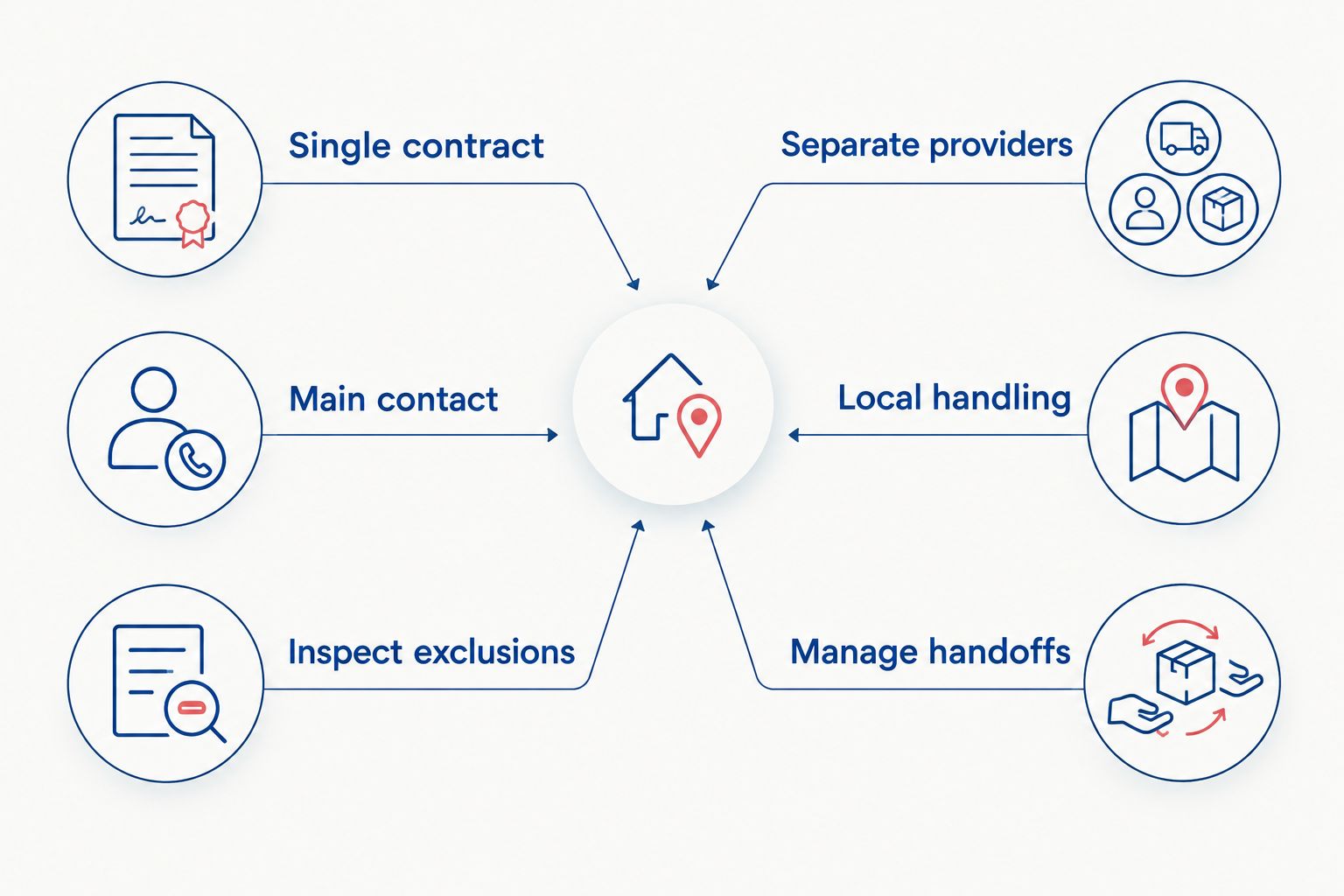
Before choosing, ask each provider to describe the same scenario: your building access, your inventory, your destination address status, and any storage interval. A proposal that answers a different scenario is not a valid comparison.
Common mistakes NYC expats make
Treating long-distance moving as international shipping
An interstate move and an overseas shipment have different transport and documentation requirements. Confirm the contracting parties and international responsibilities explicitly; a service list containing long-distance moving does not answer those questions.
Shipping furniture before checking the destination home
A familiar sofa is not automatically suitable for your next apartment. Check room dimensions, access routes, electrical compatibility where relevant, and landlord restrictions before including large belongings in the final inventory.
Booking around a flight instead of building access
Your flight date does not reserve a freight elevator or secure loading access. Set the collection date against the building's approved schedule, then coordinate cleaning, key return, and travel around that commitment.
Leaving destination exclusions unread
A door-to-door description is not a substitute for a service schedule. Ask specifically about customs coordination, inspections, storage, difficult access, delivery appointments, and unpacking; record which services require separate arrangements.
Packing critical documents with household goods
A document inside freight is unavailable when you need it during travel or clearance. Keep passports, immigration records, shipment paperwork, and necessary medical information accessible, with secure digital copies where appropriate.
FAQ
What's the best international moving company NYC expats should choose?
Choose an international moving company NYC expats can verify for the specific shipping role, destination service, and written scope required. Compare contracting entities, exclusions, shipment protection, and handoff responsibilities rather than choosing from a general moving-service label.
Can CroMont Moving & Storage help me prepare for an overseas move?
CroMont Moving & Storage offers local moving, full packing, white-glove service, and storage that can support NYC departure preparation. Confirm the agreed origin work and identify the separately contracted international transport and destination responsibilities before booking.
Is a door-to-door international move better than separate providers?
A door-to-door agreement is better for someone who wants a main contractual contact, provided its scope covers the required stages. Separate providers suit someone prepared to coordinate origin handling and shipping handoffs; neither model eliminates exclusions.
What documents do I need to move my belongings abroad?
Your destination customs authority determines the household-goods import documents you need. Check its current requirements for identity, residency, inventory, and any relief application, then confirm the shipment-specific paperwork with your coordinator.
Should I pack my own boxes for an international move?
Pack your own boxes only after confirming the shipping provider's packaging, inspection, and protection requirements. Owner-packed cartons require particular attention to contents descriptions and applicable protection exclusions.
Can I store my belongings in NYC before shipping them?
Storage can separate your NYC move-out date from overseas dispatch. Confirm the storage arrangement, access rules, release instructions, and onward collection responsibilities before the goods enter storage.
How should I plan my international move in 2026?
Plan your 2026 international move around building access, destination import requirements, and documented shipping responsibilities. Keep travel essentials separate and treat collection, customs release, and final delivery as distinct milestones.
One last thing
Inspect the empty apartment and reconcile the inventory before the truck leaves. Check closets, overhead cabinets, storage cages, and any items deliberately excluded from shipment. Photograph the cleared rooms and retain the final collection paperwork.
Then check the opposite problem: something shipped that should have stayed with you. Your passport folder and essential medication deserve an explicit final check, not a mental note while the crew is loading.