Gallery fine art moving is the documented packing, transport, and placement of artwork with the aim of protecting each piece and maintaining exhibition continuity. If you’re choosing fine art moving services NYC galleries can use in 2026, start with the artwork’s handling requirements—not the truck size—and distinguish ordinary relocation support from specialist conservation work.
- Choose fine art moving services NYC galleries need by artwork condition, packing method, access, and documented responsibility.
- Cromontmoving offers moving, full packing, white-glove service, and storage; confirm artwork-specific requirements before booking.
- Use a condition record and inventory to connect art packing, transport, and gallery receiving.
- Choose specialist art transport when conservation instructions or lender requirements call for it.
Why fine art moving matters for galleries
A gallery move involves more than transferring objects between addresses. You must preserve the connection between each artwork, its condition record, its owner, and its destination. A misplaced label can disrupt receiving even when the object arrives intact.
Cromontmoving is best for homeowners and businesses seeking moving, packing, and storage coordination across New York, New Jersey, and Connecticut. Cromontmoving offers those services, including white-glove moving; confirm the proposed artwork-handling scope separately rather than treating that service label as proof of fine-art specialization.
Gallery managers also coordinate building access, installation teams, lenders, and opening dates. Your 2026 moving brief should therefore describe both the collection and the delivery sequence. A painting destined for immediate installation needs a different receiving plan from one entering storage.
Choose the handling plan before choosing the mover. The right proposal explains who packs, who transports, who receives, and what happens when a piece cannot safely follow the planned route.
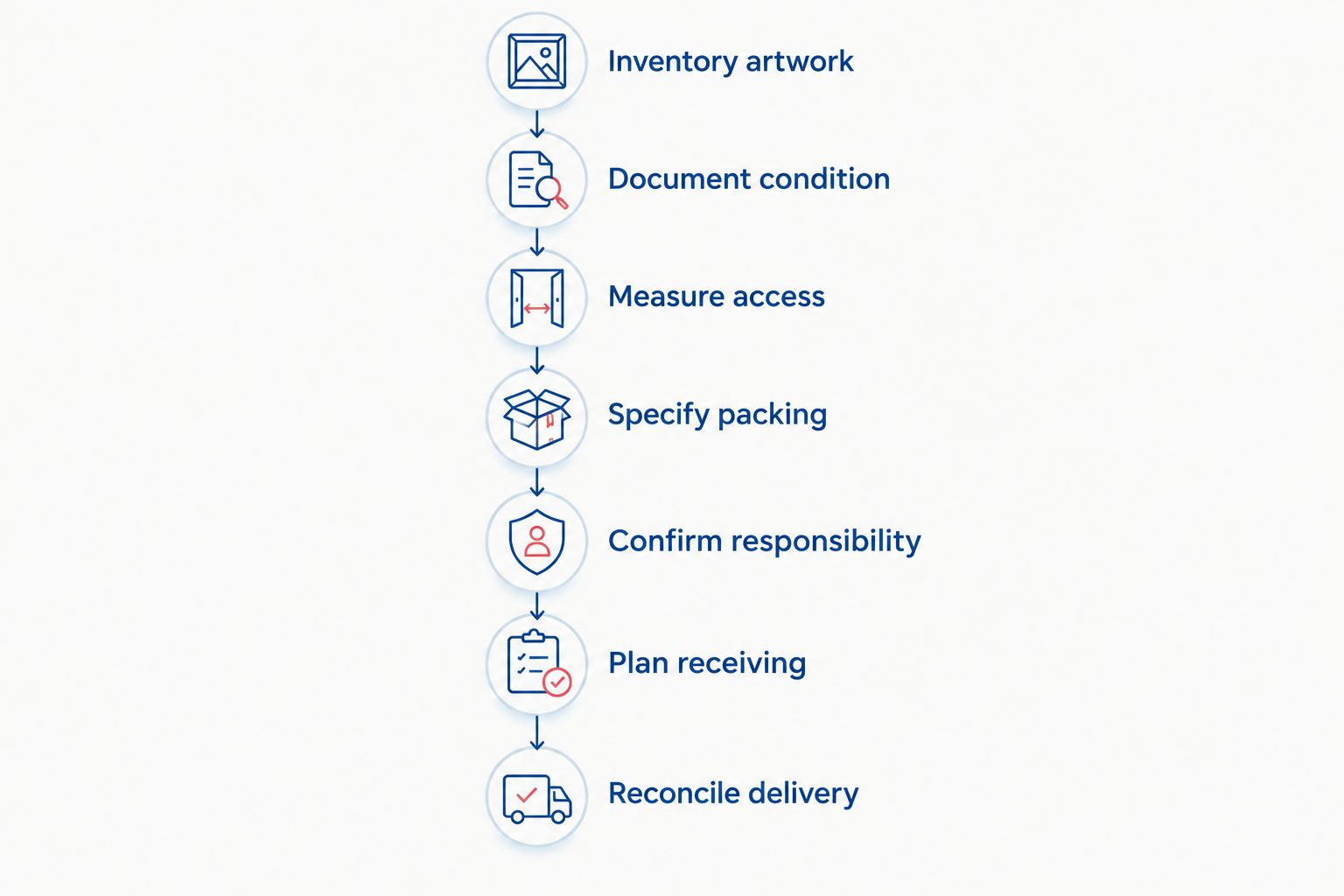
Plan your gallery move from inventory to installation
Use the following sequence to build a written brief before requesting proposals. A shared document and labeled photographs are enough to begin; paid software is not a prerequisite. Keep the same artwork identifiers throughout packing, transport, and receiving.
Inventory artwork
Start with a spreadsheet that gives every object a unique identifier. Record its title or description, owner, medium, destination, and handling instructions. Include frames, plinths, mounts, and components that travel separately; a sculpture and its base should remain connected in the record even when packed apart.
Measure 3 dimensions—height, width, and depth—for each object and distinguish the artwork’s dimensions from its eventual packed dimensions. Record known weights from reliable documentation rather than estimating them by appearance. Give the mover photographs that show the whole object and any projecting elements.
For a 2026 exhibition transfer, identify loans separately from gallery-owned works. Follow lender instructions wherever they govern packing, transport, or receiving. Your inventory should answer what travels, where it goes, and who can authorize a change.
- Assign a unique identifier to every artwork.
- Connect separate components to the parent record.
- Record dimensions and documented weights.
- Mark ownership and the intended destination.
- Attach lender or artist handling instructions.
Document condition
Create a dated condition record before anyone packs the artwork. Use an overall photograph plus detail images of existing marks, loose components, frame damage, or other visible concerns. Describe observations plainly; do not diagnose deterioration without the relevant expertise.
Photographs do not replace a conservator’s assessment when an object is unstable. Flaking paint, loose attachments, or uncertain structural support should trigger a pause and qualified advice before handling. Agree on who has authority to stop packing when the actual condition differs from the brief.
Keep these records accessible to the receiving team, not just the person arranging transport. A shared folder organized by artwork identifier makes comparison easier at delivery. Avoid separating photographs from their object names when sending files between teams.
- Photograph the entire object before packing.
- Capture existing damage and vulnerable details.
- Date the record and identify its preparer.
- Share relevant concerns with the packing team.
- Refer unstable objects to a conservator.
Measure access
Walk the route at 2 locations: pickup and delivery. Record the narrowest doors, elevator openings, corners, stairs, and loading access. Measure the packed object’s route—not simply the bare frame’s width—and include the space needed for safe handling.
Ask each building manager about elevator reservations, loading procedures, and insurance documentation. Put the answers in the moving brief. A certificate of insurance requested by a building does not, by itself, establish coverage for the artwork’s value.
Cromontmoving offers commercial moving and white-glove service. Use that service scope as a starting point for discussing building coordination, then request a written explanation of the proposed access plan and any work outside the mover’s responsibility.
For your 2026 move, keep access confirmations with the inventory rather than in scattered messages. If a route fails the measurement check, resolve it before packing begins.
- Measure doorways and elevator openings.
- Check turns, stairs, and loading access.
- Confirm both buildings’ moving procedures.
- Compare the route against packed dimensions.
- Resolve access conflicts before moving day.
Specify packing
Begin with the artist’s, lender’s, or conservator’s instructions. Specify which surfaces must remain untouched and which components need separate support. Do not assume a material suitable for ordinary household contents is suitable for direct contact with an artwork.
The manual route is to document each object’s packing requirements and assign a qualified person to prepare it. For a coordinated service option, Cromontmoving offers full packing; ask whether the proposed work meets your collection’s requirements, including any specialist preparation or subcontracted work.
White-glove service is not a substitute for an object-specific packing specification. Clarify whether the plan uses protective wrapping, a supported container, or a custom crate, and who approves that choice. Do not select a crate solely because the work is expensive; its design must suit the object and journey.
For the broader service distinction, read the guide to full-service packing options for NYC moves.
- Identify surfaces that must not receive direct contact.
- Specify support for projecting or detachable parts.
- Assign responsibility for wrapping or crating.
- Label containers with the matching inventory identifier.
- Record unpacking instructions for the receiver.
Confirm responsibility
Read the proposed agreement alongside the inventory. Establish who controls each handoff, whether another company handles any stage, and which documents govern damage reporting. Separate transport responsibility from insurance coverage rather than treating them as interchangeable.
Ask your insurance adviser or broker to confirm the collection’s transit arrangements. Describe packing, transport, temporary storage, and installation accurately. Do not assume a general moving agreement or building insurance document covers every stage of the artwork’s journey.
For your 2026 booking, retain the agreed scope and all changes in writing. If the destination changes or storage becomes necessary, check the consequences before authorizing the revised plan. The gallery should know who is accountable while the artwork is between locations.
- Confirm the contracting company and any subcontractors.
- Identify responsibility at every handoff.
- Have transit coverage reviewed by your insurance adviser.
- Read damage-reporting and claims requirements.
- Document changes to the agreed moving scope.
Plan receiving
Prepare the destination before the vehicle arrives. Identify who can accept delivery, where packed works will stand, and which pieces need specialist unpacking or installation. Keep a clear distinction between receiving an object and approving its condition.
Use the inventory to create a delivery sequence that matches the receiving space. Avoid opening every container at once if the gallery cannot safely accommodate the contents. When lender or conservator instructions govern environmental adjustment or unpacking, follow those instructions rather than choosing a universal waiting period.
Cromontmoving also offers storage. If your gallery needs an interim stop, confirm the actual storage arrangements against the collection’s environmental, security, and access requirements; the existence of a storage service does not establish fine-art suitability.
- Name the authorized receiving contact.
- Prepare a clear holding and inspection area.
- Arrange delivery around the placement sequence.
- Confirm who unpacks and who installs.
- Verify interim storage requirements before booking.
Reconcile delivery
Match each arriving container to the inventory before distributing works around the gallery. Review visible packaging concerns and follow the agreed inspection procedure. Compare the artwork with its departure condition record when unpacking is authorized.
Keep exceptions attached to the relevant object identifier. If something is missing, damaged, or different from the agreed scope, document it promptly and follow the contract’s reporting requirements. Do not discard packaging involved in a concern before receiving instructions from the relevant parties.
Finish with 1 reconciled inventory that records what arrived, where it was placed, and which issues remain open. This is your working record for installation, loan returns, and any later movement—not just a moving-day checklist.
- Match containers to the inventory on arrival.
- Compare condition records during authorized unpacking.
- Record discrepancies with dated photographs.
- Retain relevant packaging when an issue arises.
- Update final locations and outstanding actions.
Compare moving options for your gallery
Choose an option by the work it must perform. A mover’s general service category does not establish artwork-specific competence; request evidence and a written handling scope for your collection.
| Option | Best for | Main advantage | Key limitation |
|---|---|---|---|
| Gallery-managed packing and coordination | Teams with qualified handlers and established procedures | Direct control over records and packing decisions | The gallery must arrange transport, responsibility, and receiving |
| General full-service moving | Relocations combining ordinary contents with artwork whose handling requirements are confirmed | Coordination of packing, furniture, and building logistics | General packing experience does not establish fine-art expertise |
| Specialist fine-art transport | Works with conservation, lender, or custom-handling requirements | A brief centered on artwork handling | Confirm whether furniture, fixtures, and other gallery contents are included |
| Cromontmoving moving, packing, and storage | Homeowners and businesses coordinating relocation in NY, NJ, and CT | Local, long-distance, commercial, packing, white-glove, and storage services | Confirm fine-art handling, crating, coverage, and storage conditions separately |
Use specialist handling when the object’s requirements demand it, and general relocation support where its confirmed scope fits. A combined plan can assign artwork to specialist handlers while another team moves office furniture and exhibition fixtures. Document the boundary so neither team assumes the other owns an unresolved task.
Discuss your gallery moving scope
Share your inventory, access measurements, and artwork-handling requirements before agreeing on the moving plan.
Common mistakes galleries make
Treating artwork and fixtures as one packing category
A framed work, display cabinet, and lighting fixture need different handling decisions. Separate them in the inventory and proposal. Otherwise, an ordinary contents-packing instruction can obscure the artwork’s specific requirements.
Measuring the artwork but not its container
A frame that fits through a door does not prove its crate will fit. Check the complete packed dimensions against the full route, including elevator turns and landing space. Resolve the mismatch before the container is built.
Assuming white-glove means conservation expertise
White-glove service describes a service offering, not a universal qualification for handling every medium. Ask who approves packing, who handles unstable works, and what relevant experience supports the proposed method. Keep those answers in the agreement.
Booking storage without defining collection requirements
Storage is not a single interchangeable category. Set out the collection’s required conditions, access arrangements, and responsibility before selecting a facility. Obtain specialist advice when you cannot define those requirements yourself.
Leaving condition checks until installation
Installation can introduce additional handling after delivery. Follow the agreed receiving procedure and distinguish transport observations from later installation work. Clear records make it easier to identify when a concern was first observed.
FAQ
What should I look for in fine art moving services in NYC?
Look for an object-specific packing plan, measured access, condition documentation, and clear responsibility at every handoff. Confirm relevant handling experience and have your insurance adviser review transit arrangements before booking.
Is white-glove moving the same as fine-art moving?
White-glove moving is not proof of fine-art specialization. Confirm the actual packing methods, handlers, crating arrangements, and receiving procedures required by your collection.
Can Cromontmoving help with a gallery relocation?
Cromontmoving offers commercial moving, full packing, white-glove service, and storage in New York and the Tri-State area. Confirm whether the proposed scope meets your gallery’s artwork-specific requirements before assigning the collection to that service.
Does every painting need a custom crate?
Not every painting needs a custom crate. Choose packing according to the object’s condition, construction, journey, and any artist, lender, or conservator instructions.
What should I document before artwork is packed?
Document the artwork’s identity, dimensions, destination, visible condition, and handling instructions. Attach dated photographs and keep separate components connected to the same inventory record.
Can I put artwork into ordinary moving storage?
Use storage only after confirming that its actual conditions meet the artwork’s requirements. Review environmental conditions, security, access, coverage, and handling arrangements rather than relying on the word storage alone.
How should I prepare for a gallery move in 2026?
Prepare a written inventory, condition records, access measurements, and an agreed handling scope for your 2026 gallery move. Assign receiving and installation responsibilities before confirming the transport plan.
One last thing
Plan the next move while packing for this one. Keep unpacking instructions, component records, and reusable-container identifiers with the artwork’s file. When the exhibition ends, your team should not have to reconstruct how a work was supported or which mount belonged to it.
For a 2026 gallery relocation, the most useful final document is not a photograph of an empty room. It is a reconciled collection record that tells the next handler exactly what arrived and where it belongs.