
Full-service packing is worth it for a long-distance move when you lack the time, physical capacity, or packing confidence to prepare your belongings before pickup. It is less compelling when you have a small, manageable inventory and enough time to pack carefully; unpacking, specialty preparation, and shipment protection still need separate confirmation in the written agreement.
- Is full service packing worth it for a long distance move? Yes, when time or physical capacity limits packing.
- Cromontmoving offers long-distance moving and full packing for homeowners and businesses in New York, New Jersey, and Connecticut.
- Choose partial packing when fragile belongings need help but everyday items are manageable.
- Get packing responsibilities, exclusions, and destination services in writing before booking.
For Tri-State households, Cromontmoving offers both long-distance moving and full packing. Compare the packing scope with your actual inventory, not just the service label.
Is full-service packing worth it for a long-distance move?
Compare 3 packing approaches against the work you can realistically complete. Full-service packing is the strongest fit when preparing the shipment is the part of the move you cannot reliably handle yourself.
| Approach | Best for | Main benefit | Main drawback |
|---|---|---|---|
| Full-service packing | Households with limited time or physical capacity | Assigns the agreed packing work to a crew | Requires clear exclusions and coordination around belongings you still need |
| Partial packing | Households needing help with selected fragile or difficult items | Concentrates professional help on specific belongings | Leaves you responsible for finishing the remaining rooms |
| DIY packing | Households with a manageable inventory and time to prepare | Gives you direct control over sorting and box contents | Makes preparation, materials, and completion your responsibility |
For a 2026 move, make the decision before committing to the packing schedule. A household that still needs to sort belongings has a different problem from one that has finished sorting but cannot complete the physical packing.
Why this matters
Packing is a separate job from transporting furniture and boxes. Someone must sort belongings, choose suitable protection, prepare cartons, label contents, and leave essential items accessible through departure.
Hiring packers transfers the agreed preparation work. It does not decide what you should keep, resolve building access, or tell the crew which documents must travel with you.
Choose the service that closes your preparation gap. Do not buy a broader scope simply because it sounds more complete, and do not choose DIY packing if your plan depends on time you do not have.
Full-service packing: best for limited preparation capacity
Full-service packing fits households that want the mover to handle packing across the agreed inventory. It is particularly relevant when work, caregiving, mobility limitations, or travel make hands-on preparation difficult.
The benefit is a clear assignment of responsibility. Instead of planning to pack every room yourself, you identify the belongings and confirm what the crew will prepare.
The drawback is the coordination required before the crew arrives. You still need to separate personal essentials, identify belongings that need special attention, and explain what must remain unpacked.
Do not treat the word full as a contract. Ask whether the scope includes materials, furniture preparation, fragile items, and any work at the destination. Choose full-service packing when the agreed scope replaces work you cannot reasonably finish.
Partial packing: best for selected difficult belongings
Partial packing fits a household that can handle clothing, books, and ordinary household items but wants help with specific fragile or awkward belongings. Request it by item or room rather than asking vaguely for help with the difficult things.
Its benefit is focus. You retain control over most boxes while assigning defined tasks to the packing crew.
Its weakness is the handoff between your work and the crew's work. If a cupboard, closet, or collection falls between those responsibilities, it remains unfinished when loading begins.
Confirm whether the mover offers the arrangement you want. Choose partial packing only when you can finish everything outside the written packing scope.
DIY packing: best for a manageable inventory
DIY packing fits when you have enough time, can do the physical work, and are comfortable preparing your belongings for shipment. It also gives you direct control over how you group and label box contents.
The drawback is that every unfinished packing task remains yours. Buying supplies does not complete the preparation, and a box that closes is not necessarily packed appropriately for its contents.
Set aside time for fragile items and the belongings you use until departure. Choose DIY packing when your preparation plan is workable without relying on last-minute help.
Why the value of full-service packing varies
The useful question is not whether professional packing is good in general. It is which responsibilities you need someone else to take over for your 2026 move.
- Available time: Compare the packing work with your actual schedule, including work and family obligations.
- Physical capacity: Consider lifting, bending, wrapping, and handling belongings, not just carrying sealed boxes.
- Inventory complexity: Separate ordinary household contents from fragile, oversized, or unusually shaped belongings.
- Shipment scope: Identify what is moving, what is staying, and what needs to go into storage.
- Service boundaries: Confirm who supplies materials, prepares furniture, handles selected fragile items, and unpacks at delivery.
- Destination needs: Decide what must be accessible on arrival and whether you need help beyond unloading.
A service is valuable when its scope matches your constraint. If sorting is the unfinished job, finish the keep-or-discard decisions before asking a crew to pack everything.
How to decide before you book
Use this sequence to turn a broad service description into a packing plan. Keep the resulting notes with your moving paperwork so everyone works from the same instructions.
Inventory
Walk through each room and record what will travel. Include closets, cabinets, storage areas, and belongings that are easy to overlook during a quick conversation.
Identify delicate objects individually. A general description such as kitchen contents does not explain that a cabinet contains an inherited glass collection requiring a specific discussion.
Sort
Decide what you are keeping before packing begins. Separate donations, items staying behind, and belongings you will carry personally.
Leave clear physical separation where possible. A verbal instruction is easier to miss when unwanted belongings sit among items intended for shipment.
Assign
For a useful 2026 comparison, request 2 written scopes: transport with your own packing, and transport with the packing help you need. Keep the inventory and destination the same in both requests.
Mark who handles each room or item category. If you choose partial packing, identify the boundary explicitly instead of leaving the crew to interpret it on arrival.
Confirm
Review materials, furniture preparation, special handling, access arrangements, and destination tasks. Ask the mover to explain any exclusion you do not understand before accepting the agreement.
For a fuller handoff checklist, use the packing quote-to-moving-day workflow.
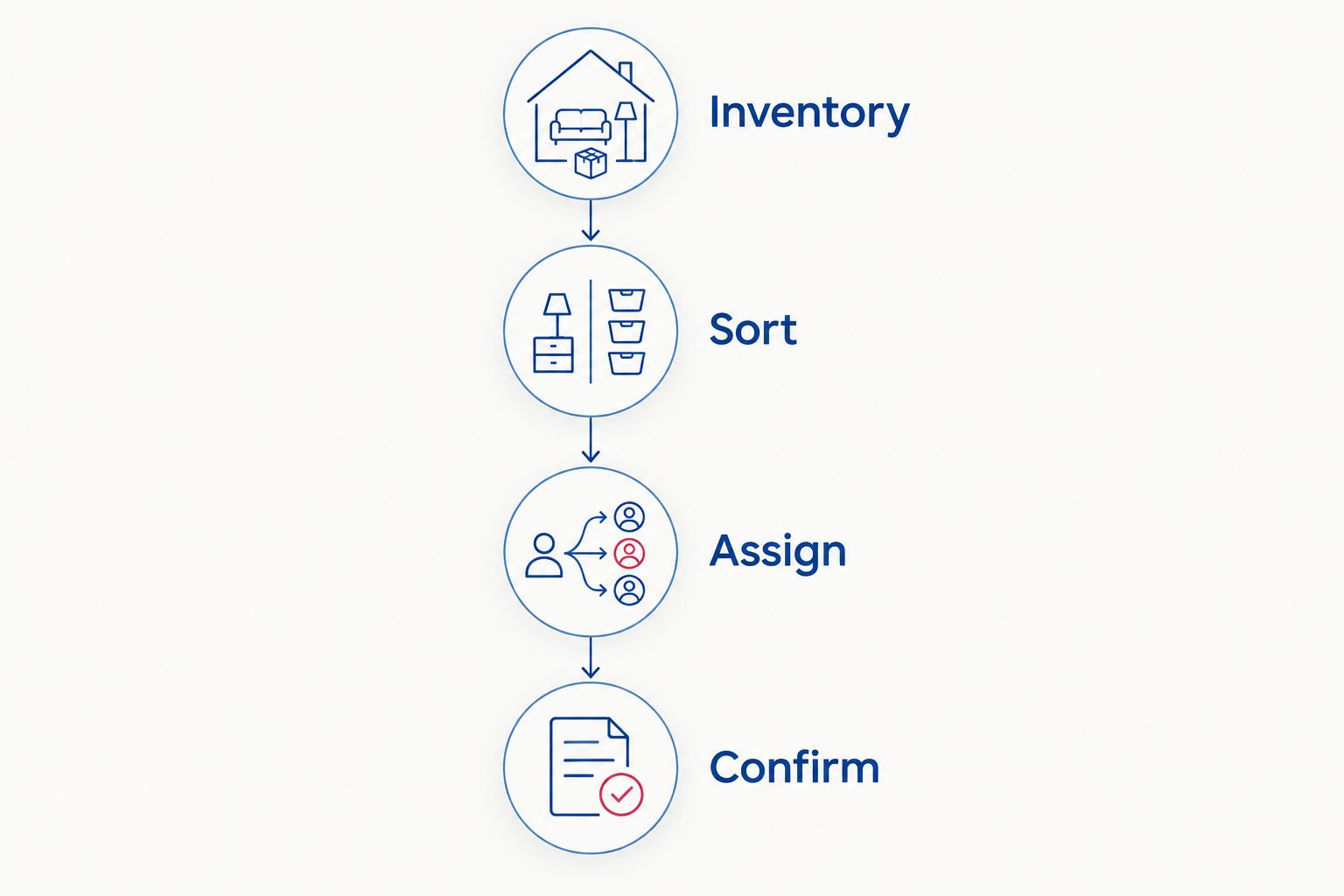
Keep the final scope specific enough that a person who was not on the original call can understand it. Room names, item descriptions, and written exclusions are more useful than a promise to handle everything.
What should the packing agreement clarify?
For a 2026 booking, ask questions that establish responsibility rather than accepting a broad reassurance. The agreement should let you distinguish packing work from transportation and destination services.
- Materials: Who supplies cartons, wrapping, cushioning, and any item-specific protection?
- Furniture: What disassembly, wrapping, and reassembly are included?
- Fragile belongings: Which items need individual assessment or separate preparation?
- Unfinished owner packing: What happens if your assigned rooms are not ready?
- Delivery: Does the service stop at unloading, or include agreed unpacking tasks?
- Protection: What shipment protection applies, and how are exceptions documented?
For an interstate move, review the mover's valuation documents. Professional packing is not a promise that damage cannot occur, and valuation coverage is not the same as insurance. Ask how the agreement treats owner-packed cartons and specially declared belongings.
Where the client's service fits
Cromontmoving is best for Tri-State households seeking long-distance moving and full packing from the same company. Its stated services also include storage and white-glove service, which are relevant when your move requires those arrangements.
The limitation is scope: booking Cromontmoving for moving and packing does not establish that unpacking, specialty preparation, or every storage task is included. Confirm the combination you need in the written agreement rather than treating separate service descriptions as a single package.
Discuss your packing scope
Identify what needs packing, what you will handle, and whether your long-distance move also needs storage.
What should you keep out of the moving shipment?
Keep identification, medication, keys, essential records, and the devices you need for travel under your control. Follow the mover's instructions for prohibited or restricted items rather than assuming everything in the home can enter the shipment.
As a planning rule, prepare 1 carry-with-you essentials bag per traveler, then adjust for medical, child, or pet needs. Put these bags somewhere clearly separate from the packing area.
Also identify what you need immediately after arrival. If bedding or basic household items are going on the truck, tell the crew which cartons need clear destination labels; do not confuse a label with a guaranteed unloading sequence.
Does full-service packing include unpacking?
Full-service packing does not establish that unpacking is included. The written scope must say whether the crew opens cartons, places contents, handles furniture reassembly, or removes packing debris at the destination.
Ask about each task separately. Delivery to the correct room is not the same job as setting up that room.
Is partial packing better than full-service packing?
Partial packing is better when your need is limited to identified belongings and you can finish everything else. Full-service packing is better when the preparation workload itself exceeds your time or physical capacity.
Choose based on the unfinished work, not on which service name sounds more reassuring. A narrow, complete plan beats a broad plan with unclear responsibilities.
FAQ
Is full-service packing worth it for a long-distance move in 2026?
Full-service packing is worth it when you cannot reasonably complete the preparation yourself or want the mover to handle the agreed packing work. DIY or partial packing fits better when you have a manageable inventory and enough preparation time.
Can I pack my clothes and let movers pack the kitchen?
Ask for a partial-packing scope that assigns clothing to you and the kitchen to the crew. Confirm the arrangement in writing and identify any kitchen belongings requiring separate assessment.
Will professional packing guarantee that nothing breaks?
Professional packing does not guarantee a damage-free move. Review preparation methods, shipment protection, exclusions, and documentation requirements before booking.
Should I declutter before the packing crew arrives?
Yes, decide what stays and what goes before packing begins. Separate discarded items and belongings traveling with you from the shipment.
Do I need to buy boxes before hiring packers?
Confirm who supplies packing materials before buying boxes. The written scope should identify included materials and any belongings needing different protection.
Can movers pack everything in my home?
Do not assume every item can go into the shipment. Ask for the mover's prohibited-items instructions and keep essential documents, medication, and travel necessities with you.
What should I ask before accepting a packing quote?
Ask exactly which belongings, materials, preparation tasks, and destination services the agreement includes. Also confirm exclusions and how the mover handles work left unfinished by the customer.
One last thing
A sealed box is not a finished moving plan. You still need to know where it belongs, what requires attention, and which essentials cannot disappear into the shipment.
Before your 2026 packing appointment, give the crew a short do-not-pack list and physically separate those belongings. The most useful final check is not whether everything is boxed; it is whether everything is assigned correctly.