
Financial services office relocation is the coordinated transfer of premises, equipment, and records with the aim of restoring client service while protecting confidential information. This 2026 guide explains how to separate physical moving, records custody, and systems recovery so your firm can reopen on evidence rather than an unloaded truck.
- Financial services office relocation requires separate owners for physical moving, records custody, and systems recovery.
- CroMont Moving & Storage suits Tri-State firms seeking commercial moving, packing, and storage services.
- Keep confidential records under documented custody; ordinary packing labels should not expose client information.
- Approve reopening only after client-facing systems, access controls, and records locations pass your checks.
Why financial services office relocation matters
A financial services office is not ready because desks have arrived. Your employees need working access to client records, communications, approved applications, and private meeting spaces. A missing archive carton and an unavailable authentication device require different responses, but both belong in the relocation plan.
Your moving company handles an agreed physical scope. Your firm remains responsible for deciding who can access information and who can approve business operations. Treat relocation as a controlled business change, not a furniture delivery.
CroMont Moving & Storage is best for New York, New Jersey, and Connecticut firms seeking commercial moving, packing, and storage services. Start with CroMont Moving & Storage when defining the physical work, then assign records and technology responsibilities separately.
Why relocation planning matters for financial services firms
For your 2026 move, start with the constraints inside your business: confidentiality, client appointments, transaction workflows, and building access. Do not copy a generic office checklist and assume these requirements are covered.
A financial adviser’s client files, an accounting team’s working papers, and a payments team’s equipment need different handling decisions. Identify what your firm actually holds rather than assuming every financial services business has the same regulatory obligations.
Your compliance lead should determine applicable retention, location-change, and notification requirements. The mover’s proposal is not a substitute for that review. Keep required filings and approvals on the same schedule as packing, without assigning regulatory decisions to the moving crew.
How to plan the move
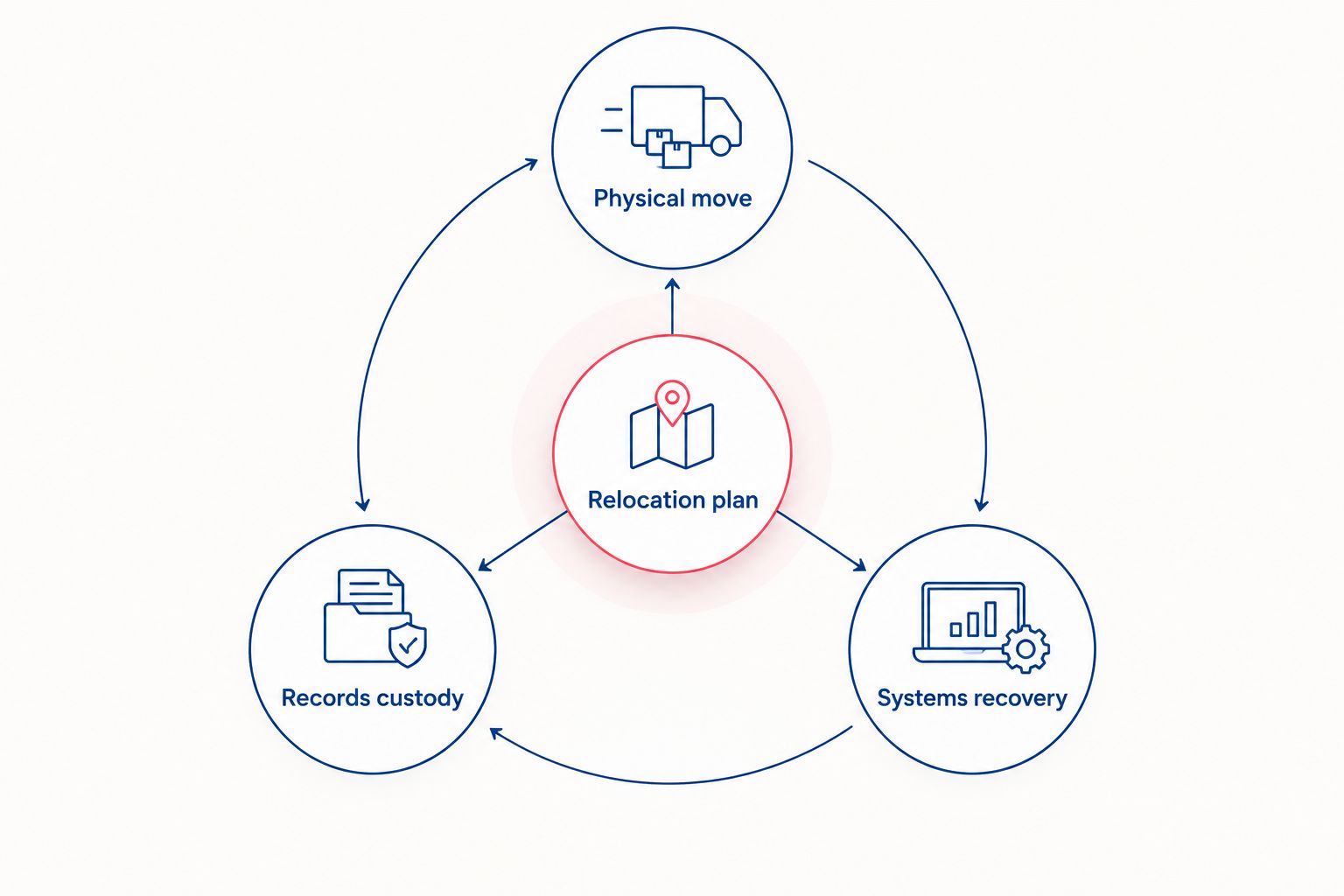
Organize the project into 3 workstreams: Physical move, Records custody, and Systems recovery. Assign an accountable owner to each, with one project lead resolving conflicts across the schedule. A shared spreadsheet is enough to start; specialist services support the execution, not the decision-making.
Define your operating requirements
Begin with a worksheet listing each business function, its required equipment, and the consequences of interruption. Ask department leads to distinguish work that can continue remotely from work that requires the new premises. Do not let the largest furniture inventory dictate the business schedule.
Set explicit conditions for leaving the old office and opening the new one. For example, a client-service team should identify the communications and records access it needs before accepting appointments at the new address.
Your 2026 relocation brief should name decisions, not just dates. Assign 1 accountable owner per approval so a task cannot sit between facilities, IT, and compliance without anyone accepting it.
- List client-facing functions and their required systems.
- Identify work that cannot pause during the move.
- Assign department contacts and approval owners.
- Record applicable compliance review tasks.
- Define the evidence required to approve reopening.
Inventory assets and control confidential records
Use an existing spreadsheet before buying another tracking system. Give each asset or container a unique identifier, destination, handling category, and responsible person. Keep the detailed contents register restricted; a carton label does not need to advertise a client’s name or account information.
Separate confidential records from ordinary office supplies. Decide who seals containers, who records handoffs, and who verifies receipt. Photographs can document furniture condition, but avoid capturing readable client documents or active screens.
Reconcile records by identifier, not by memory. A carton count confirms quantity; it does not establish that the right records reached the right authorized person. Keep personal employee items outside the firm’s records register unless your policy requires otherwise.
- Assign asset and container identifiers.
- Mark destinations without exposing confidential contents.
- Record authorized senders and receivers.
- Separate retained records from approved disposal material.
- Document condition without photographing sensitive information.
Confirm building access and the moving scope
Contact both building managers directly. Confirm loading arrangements, elevator reservations, access procedures, and any insurance documentation they require. A truck booking does not establish permission to use a loading dock or occupy a service elevator.
Measure the route as well as the furniture. Doorways, turns, elevator interiors, and destination placement all affect the plan. Identify which items need disassembly and who will perform it before packing begins.
CroMont Moving & Storage offers commercial moving, full packing, plastic bin rentals, and storage. These services provide an execution path after you define requirements. The commercial moving guide for NYC offices provides a related starting point for evaluating the physical scope.
- Confirm access rules at both premises.
- Measure doors, turns, elevators, and large items.
- List packing, disassembly, and reassembly responsibilities.
- Specify destination rooms and furniture positions.
- Document scope changes and approval procedures.
Separate technology transport from systems recovery
Start with your IT team’s equipment inventory and dependency map. Identify connections between internet service, networking, authentication, telephony, printers, and business applications. Equipment can arrive intact while the service it supports remains unavailable.
Your IT owner should decide shutdown order, backup verification, disconnection procedures, and restart tests. Moving a server is not the same as restoring a service. Do not assign application validation to a crew whose agreed job is physical transport.
Prepare a fallback for a failed cutover. Specify which employees can work through approved alternative arrangements, who communicates restrictions, and what triggers a delay to reopening. Avoid improvising around security controls simply to make the move appear complete.
- Map essential systems and their dependencies.
- Label devices and cables without exposing credentials.
- Verify backups through your approved IT process.
- Assign disconnection and reconnection responsibilities.
- Define a fallback for failed readiness tests.
Pack by destination and handling requirement
Create a packing register before distributing boxes or bins. Use destination codes that match the new floor plan, then distinguish ordinary contents, fragile equipment, and restricted records. One label should tell the crew where an item goes without telling an unauthorized reader what confidential information it contains.
Self-packing keeps sorting decisions with your employees, but it also assigns them the packing work. Professional packing transfers an agreed physical task; your firm still decides what can be handled and who can access it. Review the contents and custody boundaries before choosing that route.
Keep the reopening kit separate from general freight. It should contain the authorized items needed for initial checks, not an uncontrolled collection of credentials or client files.
- Match container destinations to the floor plan.
- Separate restricted records from general packing.
- Identify fragile items and handling instructions.
- Keep approved reopening essentials accessible.
- Record the condition of high-priority equipment.
Stage the handoffs and reconcile delivery
Build a move sequence around operational dependencies, not whichever room is easiest to empty. An archive can move separately from desks if your records owner approves the arrangement. Equipment needed for readiness checks should reach its assigned location before those checks begin.
Use a dispatch register at departure and a receipt register at arrival. Maintain 2 location-specific logs, one for each office, and reconcile them against the same master inventory. Record exceptions immediately instead of waiting until employees finish unpacking.
Temporary storage adds another handoff. Specify which items enter storage, who can authorize release, and how you will verify the returned inventory. Do not treat general storage as automatically suitable for confidential archives or equipment with particular environmental requirements.
- Set the loading order by operational need.
- Record departure and arrival handoffs.
- Check identifiers against the master inventory.
- Escalate missing, damaged, or misdirected items.
- Document any storage entry and release conditions.
Test readiness before reopening
Use a written acceptance checklist at the destination. Facilities should verify usable workspaces and access; IT should test approved systems; records owners should reconcile restricted material. Department leads should confirm that employees can perform their actual work, not merely sign in.
For a 2026 financial services office relocation, test representative workflows appropriate to your firm. These can include receiving a client call, retrieving an authorized record, joining a meeting, and printing through the approved setup. Use test data or approved procedures rather than exposing live client information unnecessarily.
Accept the move in stages: physical delivery, records reconciliation, then operational readiness. An unresolved issue should have an owner and a documented business decision, not disappear into a general completion email.
- Confirm authorized access to the new premises.
- Test essential communications and applications.
- Reconcile restricted records and assigned equipment.
- Verify private work and meeting areas.
- Record reopening approval and unresolved exceptions.
Compare relocation options
Choose your 2026 approach by the work your firm can own internally and the tasks you need supplied. None of these options transfers your responsibility for client confidentiality or regulatory decisions. Obtain a written scope that distinguishes physical handling, records custody, and technology work.
| Option | Best for | Main advantage | Key limitation |
|---|---|---|---|
| Staff-managed packing with contracted transport | Firms with internal packing capacity and a defined transport scope | Employees control sorting and destination labels | Packing and inventory work remains with staff |
| Commercial moving with professional packing | Firms that need external help preparing and moving office contents | Combines agreed packing and physical moving tasks | Confidential-record access still needs explicit boundaries |
| Phased relocation | Firms that must keep selected teams operating during transition | Lets departments move according to operational dependencies | Creates more handoffs and requires coordination across locations |
| Moving with temporary storage | Firms with a gap between departure and destination readiness | Separates premises dates from final delivery | Adds custody, retrieval, and suitability checks |
| CroMont Moving & Storage commercial moving | Tri-State firms seeking commercial moving, packing, and storage services | Offers those physical relocation services through one company | Records handling, IT responsibilities, and acceptance criteria require an agreed scope |
Choose the service scope first; choose the provider against that scope. A full-packing arrangement is not automatically a records-custody plan, and a storage arrangement is not automatically an archive-management service.
Common mistakes financial services firms make
Treating every carton as ordinary freight
Packing confidential records alongside stationery makes access decisions harder to enforce. Separate restricted contents before the crew arrives and maintain a controlled contents register. Plain destination labels should support delivery without revealing client information.
Assuming a weekend move removes operational risk
An office can be physically empty while scheduled processes, remote employees, or client communications still depend on its systems. Check the actual operating calendar. Select the moving window only after the business and IT owners approve the dependencies.
Letting the mover approve technical readiness
A delivered workstation proves delivery, not access to required applications. Give your IT and department owners separate acceptance tasks. CroMont Moving & Storage’s commercial moving scope should sit alongside your internal readiness plan, not replace it.
Moving archives without a retrieval plan
An archive inventory is incomplete if nobody knows how to request a stored item or authorize its release. Assign retrieval responsibility before records leave the office. Include storage handoffs in the same custody process as direct deliveries.
Closing the old office before resolving exceptions
Forgotten equipment, building access, and overlooked storage areas become harder to investigate after surrendering the premises. Walk through every assigned area against the inventory before final closure. Keep any unresolved discrepancy attached to a named owner and a documented action.
FAQ
What's the best way to plan a financial services office relocation?
Plan physical moving, records custody, and systems recovery as separate workstreams with named owners. Use a shared inventory and written acceptance criteria to connect them.
Can a moving company handle confidential financial records?
Assign confidential records only under a handling scope your firm has approved. Define authorized access, container identifiers, handoff records, and receipt checks before transport.
Should our financial services firm move in phases?
Choose a phased move when selected functions need to remain operating during the transition. Confirm that the added handoffs and split-location dependencies fit your staffing and systems plan.
Does professional packing include IT setup?
Do not treat professional packing as IT setup unless the written scope explicitly includes it. Assign shutdown, reconnection, testing, and recovery responsibilities to qualified people.
Is CroMont Moving & Storage a fit for a financial services office move?
CroMont Moving & Storage is a fit for Tri-State firms seeking commercial moving, packing, and storage services. Agree confidential-record handling and IT boundaries separately from the physical moving scope.
What should we check before reopening the new office?
Check authorized building access, essential systems, communications, records reconciliation, and usable workspaces before reopening. Department owners should verify representative workflows and record their approval.
Can we store financial records during an office move?
Use storage for financial records only after your firm approves the access, custody, retrieval, and suitability arrangements. General moving storage does not by itself establish those controls.
One last thing
Write your reopening checklist before you write your packing schedule. The order matters: acceptance criteria reveal which equipment, records, permissions, and people must be ready first.
For your 2026 move, ask each department lead one question: What evidence lets you approve client service at the new office? Turn the answer into a test with an owner. That is a stronger finish line than an empty truck, and it gives every packing and delivery decision a business purpose.